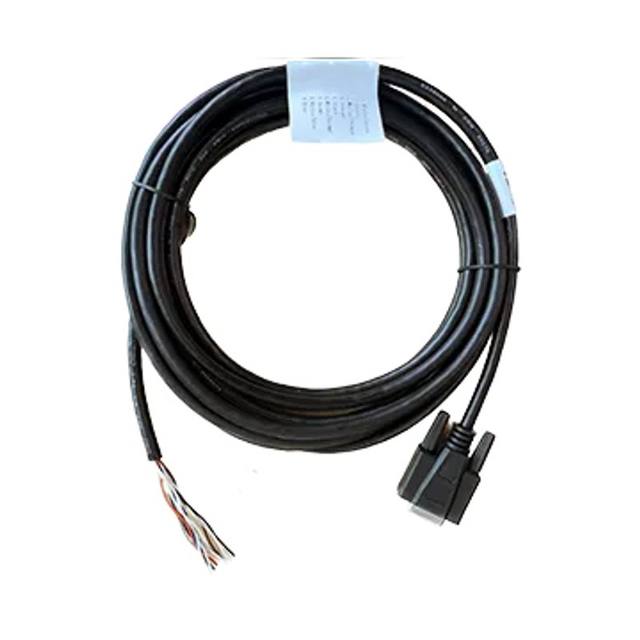
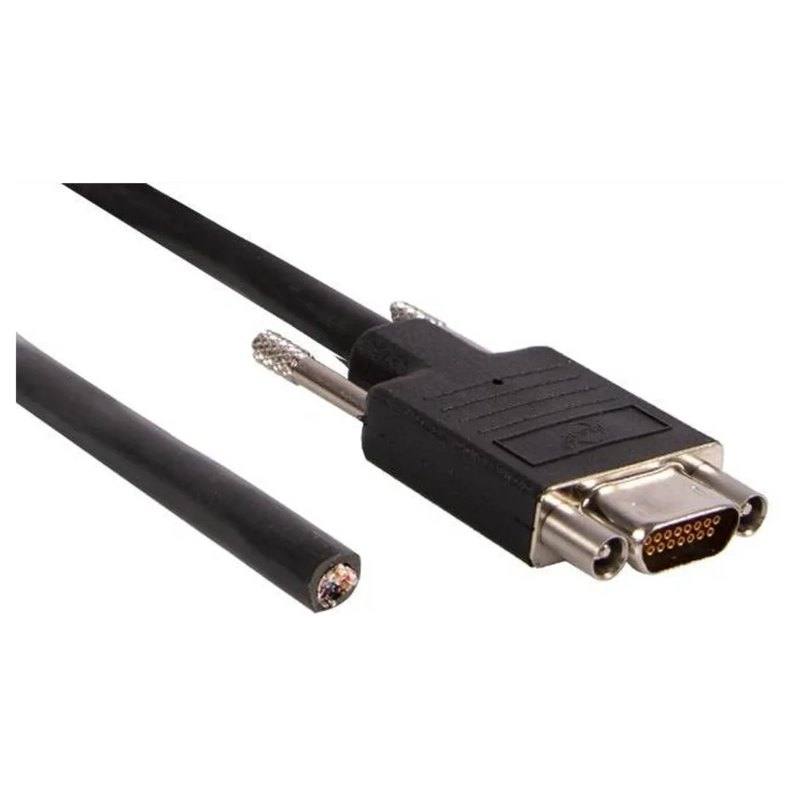
Basler I/O Cable, Micro-D15 / open — I/O / power cable, to Micro-D15 (host side), static installation, length 1.83 m. The other end is open so that the cable can be shortened to fit the specific application.
Brand
Basler
Cable type
I/O / power — Basler type "I/O / Power Cable", interface "I/O"
This cable moves I/O to the frame grabber: the Micro-D15 connector goes on the I/O port of a Basler CXP-12 Interface Card or an imaWorx or imaFlex CXP-12 board, so trigger, encoder or strobe wiring can end at the PC instead of at the camera. The far end is open, to be shortened and terminated on your terminals.
At 1.83 m it is a short lead, meant to reach a terminal block next to the PC. In CoaXPress line scan systems the encoder is typically wired to the grabber, which then times the camera; the pin assignment for each card is in its manual.
Best for
CoaXPress line scan systems, where the encoder or a part-detect sensor is wired to the grabber.
Strobe and light-control outputs taken from the grabber, keeping exposure timing in one place.
Multi-card PCs where each card needs its own I/O breakout.
Selection notes
Check the pin assignment of your card model in its manual before wiring the open end.
If the terminal block is more than 1.83 m away, extend from the open end through a terminal with shielded cable, and keep encoder runs as short as you can.
Static installation only.
Specifications: General
Brand
Basler
Cable type
I/O / power — Basler type "I/O / Power Cable", interface "I/O"
This product groups every purchasable order code that shares the same sensing method, range and output. Cable length, connector type and operation mode (Light-ON/Dark-ON, NO/NC) vary by order code below.
Get a first image quickly with the pylon Viewer, then move into the pylon SDK for your application. These cameras are GenICam/GenTL-compliant, so any compliant vision software can drive them as well.
Download and install the pylon Camera Software Suite for your OS from Basler. This provides the pylon Viewer, the GenTL transport-layer producers and the pylon SDK (C/C++/.NET/Python). On Windows the installer adds the needed drivers; on Linux follow the included setup notes for USB and network permissions.
2. Connect the camera and check the link
Cable the camera to its matching interface: GigE Vision to a GigE port (use a quality cable and, ideally, a dedicated NIC with jumbo frames enabled), USB3 Vision to a USB 3.x port with the supplied cable, or CoaXPress to the frame grabber. Provide power where required (PoE, USB bus power, or PoCXP). Open the pylon Viewer and confirm the camera appears in the device list; for GigE, make sure the camera and NIC are on the same subnet.
3. Grab a first image and set exposure, gain and pixel format
Select the camera in the pylon Viewer and start a continuous grab. Adjust exposure time and gain until the image is well exposed (avoid clipped highlights), set the pixel format (e.g. Mono8 or a Bayer/RGB format), and focus the lens. Use a test pattern if the lens or scene is not ready yet.
4. Configure triggering and acquisition
Decide between free-run and triggered acquisition. For synchronized capture, set the trigger source (software or a hardware line on the I/O connector), trigger mode and any debounce or exposure mode, then verify timing. Note the parameter names you change in the Viewer feature tree, as you will reuse them in code.
5. Move to the SDK or a GenICam-compliant library
Recreate your settings in code with the pylon SDK (C, C++, .NET or Python) to open the device, apply the same features and pull frames into your pipeline; pylon vTools and pylon AI can add processing blocks. Because the cameras are GenICam/GenTL standard, third-party vision libraries work too. Once the image stream is stable, you can route frames to a deep-learning inspection such as Rosepetal for automated defect detection.
Frequently asked questions
Basler CXP-12 Interface Card 1C, 2C and 4C, imaWorx CXP-12 Quad, and imaFlex CXP-12 Quad and Penta.
No. It connects to the I/O connector of the frame grabber, with the far end open for your wiring.