
- Recommended by AIS Vision
Datasensing TL46 Contrast Sensor Family
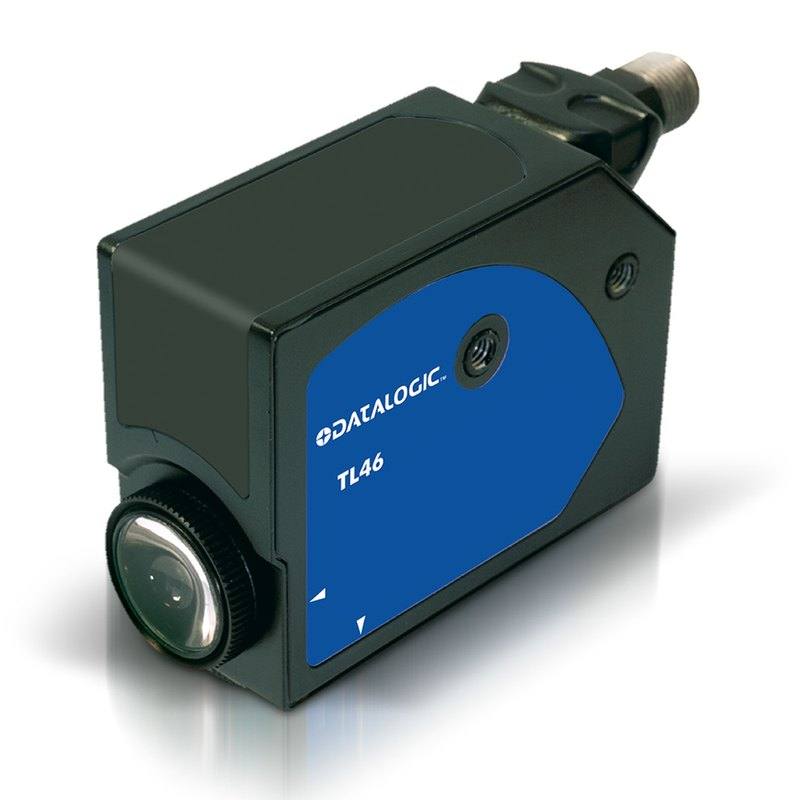
TL46
The TL46 family detects color registration marks using a fixed-focus 9 ±3 mm spot (1.5 x 5 mm minimum, configurable lenses to 40 mm) with selectable RGB, white or red LED emission. It spans seven models (basic TL46-W, standard TL46-WL with bargraph, enhanced TL46-WLF, color-mode TL46-WE, low-jitter TL46-WJ, basic IO-Link TL46-W...PZ and ultra-fast IO-Link TL46-WH...PZ, plus the trimmer-set TL46-A), with switching frequencies of 10/15/20/30/50/70 kHz and jitter as low as 3 us. Outputs include PNP, NPN, push-pull, a 0-5 V analog output (A/W/WL models) and IO-Link V1.1.2; the aluminium IP67 housing uses an M12 5-pole connector rotatable to 5 positions. It is powered from 10-30 VDC and rated for -10 to +55 C operation.
- Brand
- Datalogic / Datasensing
- Sensor type
- Contrast / registration-mark sensor
- Sensing method
- Diffuse contrast detection (fixed-focus reflective spot)
- Light source
- RGB LED (blue 465 nm / green 520 nm / red 630 nm), white LED 400-700 nm, or red LED 630 nm depending on model
- Range / distance
- 9 ±3 mm standard focus (18 / 22 / 28 / 40 mm with optional glass lenses)
- Response time
- 33 us (TL46-W); down to 6 us (TL46-WH...PZ), 10 us (TL46-WJ), 16 us (TL46-WLF/WE), 25 us (TL46-A/WL)
- Switching frequency
- 15 kHz (TL46-W); up to 70 kHz (TL46-WH...PZ), 50 kHz (TL46-WJ), 30 kHz (TL46-WLF/WE), 20 kHz (TL46-A/WL), 10 kHz (TL46-WE color mode)
- Output type
- PNP / NPN / push-pull (PP) by part number; 0-5 V analog output on TL46-A/W/WL
- Communication
- IO-Link V1.1.2 Smart Sensor Profile (TL46-W...PZ, TL46-WH...PZ); plus digital switching outputs
- Supply voltage
- 10-30 VDC (limit values), ripple 2 Vpp max
- Connection
- M12 5-pole connector, rotatable to 5 positions
- Housing material
- Aluminium housing; lens PMMA (A/W) or glass (W-815G/WL/WLF/WJ/WE)
Technical overview
The Datasensing TL46 is a contrast (registration-mark) sensor family from Datalogic, working on the diffuse principle: it projects a fixed-focus reflective spot onto a moving web and reads the difference in remitted light between a printed mark and its background. The standard focus sits at 9 +/-3 mm with a 1.5 x 5 mm minimum spot, and optional glass lenses extend the working distance to 18, 22, 28 or 40 mm so the head can be set back from the material plane when guards or web flutter demand it. Emission is chosen by model: selectable RGB (blue 465 nm, green 520 nm, red 630 nm), white LED across 400-700 nm, or a fixed red 630 nm LED. That multi-color emission is the heart of a contrast sensor, because it lets the device pick the wavelength that maximizes the gray-scale delta between a specific ink color and its substrate, which is exactly what a single-color photoelectric sensor cannot do reliably on colored print.
| Brand | Datalogic / Datasensing |
|---|---|
| Sensor type | Contrast / registration-mark sensor |
| Range / distance | 9 ±3 mm standard focus (18 / 22 / 28 / 40 mm with optional glass lenses) |
|---|---|
| Response time | 33 us (TL46-W); down to 6 us (TL46-WH...PZ), 10 us (TL46-WJ), 16 us (TL46-WLF/WE), 25 us (TL46-A/WL) |
| Switching frequency | 15 kHz (TL46-W); up to 70 kHz (TL46-WH...PZ), 50 kHz (TL46-WJ), 30 kHz (TL46-WLF/WE), 20 kHz (TL46-A/WL), 10 kHz (TL46-WE color mode) |
| Communication | IO-Link V1.1.2 Smart Sensor Profile (TL46-W...PZ, TL46-WH...PZ); plus digital switching outputs |
|---|---|
| Connection | M12 5-pole connector, rotatable to 5 positions |
| Supply voltage | 10-30 VDC (limit values), ripple 2 Vpp max |
|---|
| Operating temperature | -10 to +55 C (storage -20 to +70 C) |
|---|---|
| IP rating | IP67 |
| Sensing method | Diffuse contrast detection (fixed-focus reflective spot) |
|---|---|
| Light source | RGB LED (blue 465 nm / green 520 nm / red 630 nm), white LED 400-700 nm, or red LED 630 nm depending on model |
| Output type | PNP / NPN / push-pull (PP) by part number; 0-5 V analog output on TL46-A/W/WL |
|---|
| Housing material | Aluminium housing; lens PMMA (A/W) or glass (W-815G/WL/WLF/WJ/WE) |
|---|---|
| Dimensions | approx. 31 x 81 x 58 mm |
| Weight | 170 g max |
Frequently asked questions
Related technical guides
How to choose an industrial sensor for vision triggering and part detection
A practical guide to selecting discrete sensors that trigger cameras, index parts and gate inspection on a vision station. Covers sensing principle, range, target, PNP/NPN/IO-Link outputs, response time and IP rating, plus wiring the trigger to the camera.
Photoelectric sensor types explained: through-beam, retroreflective, diffuse and background suppression
A practical guide to the core photoelectric sensing principles, through-beam, retroreflective, diffuse and background suppression, covering range, reliability, target and surface dependence, light source choice, output options and how to pick the right one for your application.
Wavelength and color in machine vision lighting: white, red, blue, green, IR and UV
A practical engineering guide to choosing LED wavelength in machine vision lighting. Learn how monochromatic red, blue, green, IR and UV light change contrast, how to exploit complementary colors, and how to match wavelength to your camera, lens and optical filters.
AIS Vision · Integration
We validate camera + lens + lighting
AIS Vision defines and tests the optimal combination of camera, optics and lighting for your application before you buy.