Skip to content
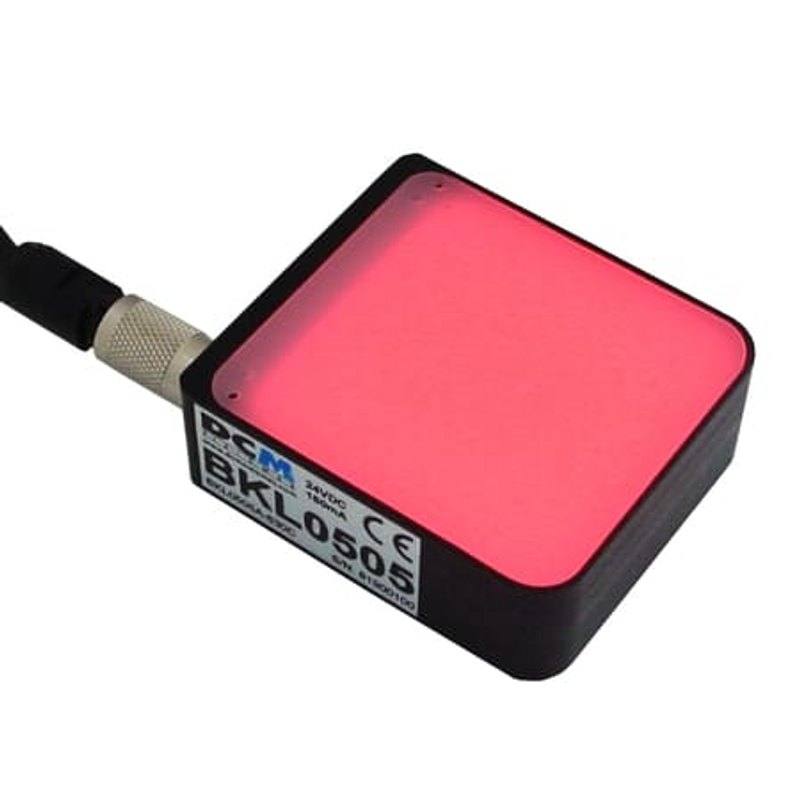
DCM Sistemes BKL0505A machine vision lighting
  • Rosepetal compatible
  • Recommended by AIS Vision

DCM Sistemes BKL0505A Area Backlight

BKL0505A

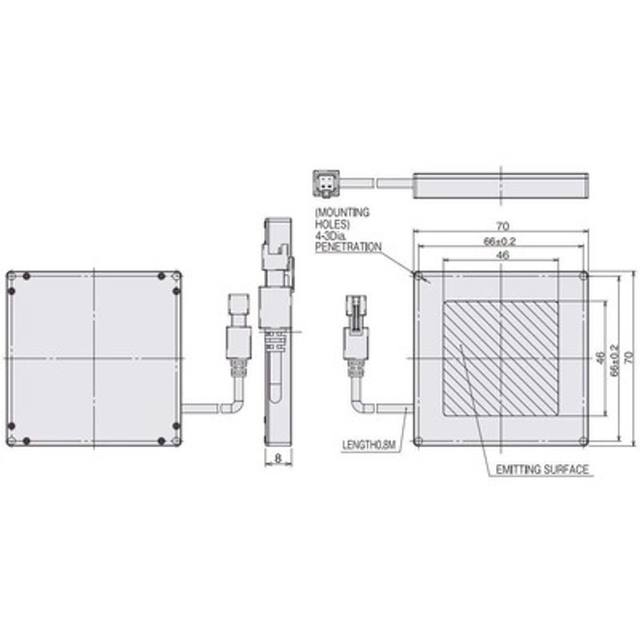
The BKL0505A is a posterior diffuse backlight with a 50x50 mm active emitting surface in an anodized-aluminium housing measuring 62x55x22 mm and weighing 91 g. It runs on 24 VDC and is available in white (W00), blue (470 nm), green (525 nm), red (630 nm), IR (850 nm) and RGB variants, in continuous (C), strobe (S) or iBlueDrive (i) operating modes. The continuous (C) version connects via a 2-pin chassis aerial connector and requires no controller, while strobe and RGB versions need an external strobe/RGB controller. By placing the object between camera and the uniform light source it produces high-contrast silhouettes ideal for edge detection, dimensional measurement and presence verification.

Brand
DCM Sistemes
Lighting type
Backlight (diffuse area backlight)
Color / wavelength
White (W00); also blue 470 nm, green 525 nm, red 630 nm, IR 850 nm, RGB
Available wavelengths
White (W00), Blue 470 nm, Green 525 nm, Red 630 nm, IR 850 nm, RGB
Mode
Continuous (C); also Strobe (S) and iBlueDrive (i)
Diffuser
Yes (diffuse emission backlight)
Emission angle
Diffuse
Illuminated area
50 x 50 mm active surface
Controller required
No for continuous (C) mode; strobe/RGB versions require an external controller
IP rating
IP40
Supply voltage
24 VDC (±3% continuous, ±8% iBlueDrive)
Power consumption
1.2 W (white W00, continuous)

Technical overview

The BKL0505A is a posterior diffuse area backlight, which means it does its job by sitting behind the part rather than illuminating it from the camera side. Its 50 x 50 mm active emitting surface produces a uniform field of light, so when an object is placed between the camera and that surface, the part blocks the light and presents itself to the sensor as a crisp dark silhouette against a bright, even background. This transmitted-light geometry is what makes backlighting the go-to choice for edge-based tasks: the boundary between part and background becomes a high-contrast transition that thresholding and subpixel edge algorithms can lock onto reliably, which is exactly why DCM positions it for edge detection, dimensional measurement and presence verification.

Electrically and mechanically the unit is built to drop into a fixture with minimal fuss. It runs on 24 VDC and, in the continuous (C) variant, draws just 1.2 W (white W00) and connects through a 2-pin aerial connector on the chassis with no controller required, so it can be wired directly to a panel supply and left on. The anodized-aluminium housing measures 62 x 55 x 22 mm and weighs only 91 g, making it light enough to mount on a small bracket or integrate into a compact transmitted-light stage. The 22 mm depth and 50 x 50 mm window define the envelope you have to design around, and the IP40 rating plus a 0 to 40 C operating range mark it as a clean-environment device for enclosed cells rather than a washdown or high-temperature line.

Wavelength and operating mode are the two levers that change what this light reveals. The standard build is white (W00), but the same body is offered in blue 470 nm, green 525 nm, red 630 nm, IR 850 nm and RGB versions; narrowing to a single wavelength lets you pair the light with a matched bandpass filter to reject ambient light and sharpen the silhouette edge, and the shorter blue and green wavelengths generally give slightly finer edge definition than red or IR for precision gauging. Mode selection matters for moving parts: the continuous (C) version needs no controller, while the strobe (S) version and RGB builds require an external strobe/RGB controller, and the iBlueDrive (i) variant uses a 3-pin aerial connector. The supply tolerance differs by mode as well, holding to plus/minus 3% in continuous operation and the looser plus/minus 8% under iBlueDrive. For anything on a fast-indexing line, plan the strobe variant and its controller in alongside the camera trigger so the flash is synchronized to exposure; for static or slow-moving inspection, the continuous version keeps the integration trivial.

Best for

  • Dimensional measurement and gauging of small parts (up to roughly the 50 x 50 mm window), where the silhouette edge feeds subpixel measurement tools
  • Presence/absence and completeness verification, using the high-contrast outline to confirm a feature, pin or component is there
  • Profile and edge inspection of stamped, molded or machined parts placed on a transmitted-light stage
  • Connector, lead-frame and electronic component inspection in electronics and semiconductor work where clean silhouettes matter
  • Packaging and fill/closure checks where the part outline against a bright field reveals shape, position or missing elements

Selection notes

  • Size your part to the 50 x 50 mm active surface: the illuminated window must fully back the feature being measured with margin, so for larger parts step up to a bigger backlight in the BKL series rather than over-running this field.
  • Choose the wavelength deliberately. White (W00) is the general-purpose default, but selecting a monochromatic version (blue 470 nm, green 525 nm, red 630 nm or IR 850 nm) lets you add a matched bandpass filter to suppress ambient light, and shorter wavelengths tend to give tighter edge definition for precision gauging.
  • Match the operating mode to motion. The continuous (C) version needs no controller and wires through a 2-pin aerial connector, but the strobe (S) version and RGB builds require an external strobe/RGB controller, and the iBlueDrive (i) variant uses a 3-pin connector. Budget the controller and trigger wiring before committing to a strobed design.
  • Respect the environment envelope. IP40 and a 0 to 40 C operating range mean this is for clean, enclosed cells, not washdown or hot zones; if the application sees dust, liquids or higher temperatures it needs additional enclosure or a different fixture.
  • Plan the mechanical stack around the 62 x 55 x 22 mm housing and 91 g weight, leaving the working gap between the lit surface and the part so the object sits in front of a uniform field and the camera images a clean, evenly bright background.

Specifications: General
BrandDCM Sistemes
Lighting typeBacklight (diffuse area backlight)

Specifications: Interface
Connection2-pin aerial connector on chassis (continuous); 3-pin aerial for iBlueDrive

Specifications: Optical
Color / wavelengthWhite (W00); also blue 470 nm, green 525 nm, red 630 nm, IR 850 nm, RGB
Available wavelengthsWhite (W00), Blue 470 nm, Green 525 nm, Red 630 nm, IR 850 nm, RGB
DiffuserYes (diffuse emission backlight)
Emission angleDiffuse

Specifications: Electrical
ModeContinuous (C); also Strobe (S) and iBlueDrive (i)
Controller requiredNo for continuous (C) mode; strobe/RGB versions require an external controller
Supply voltage24 VDC (±3% continuous, ±8% iBlueDrive)
Power consumption1.2 W (white W00, continuous)

Specifications: Environment
IP ratingIP40
Operating temperature0 to 40 C

Specifications: Geometry
Illuminated area50 x 50 mm active surface

Specifications: Mechanical
Housing materialAnodized aluminium
Dimensions62 x 55 x 22 mm
Weight91 g

Frequently asked questions

Related technical guides

Rosepetal · AI

Test this camera with Rosepetal

Validate your visual inspection with AI: send us sample images and we evaluate the case on your hardware.

AIS Vision · Integration

We validate camera + lens + lighting

AIS Vision defines and tests the optimal combination of camera, optics and lighting for your application before you buy.