Skip to content
DCM Sistemes DKL1813A machine vision lighting
  • Rosepetal compatible
  • Recommended by AIS Vision

DCM Sistemes DKL1813A Darkfield Light

DKL1813A

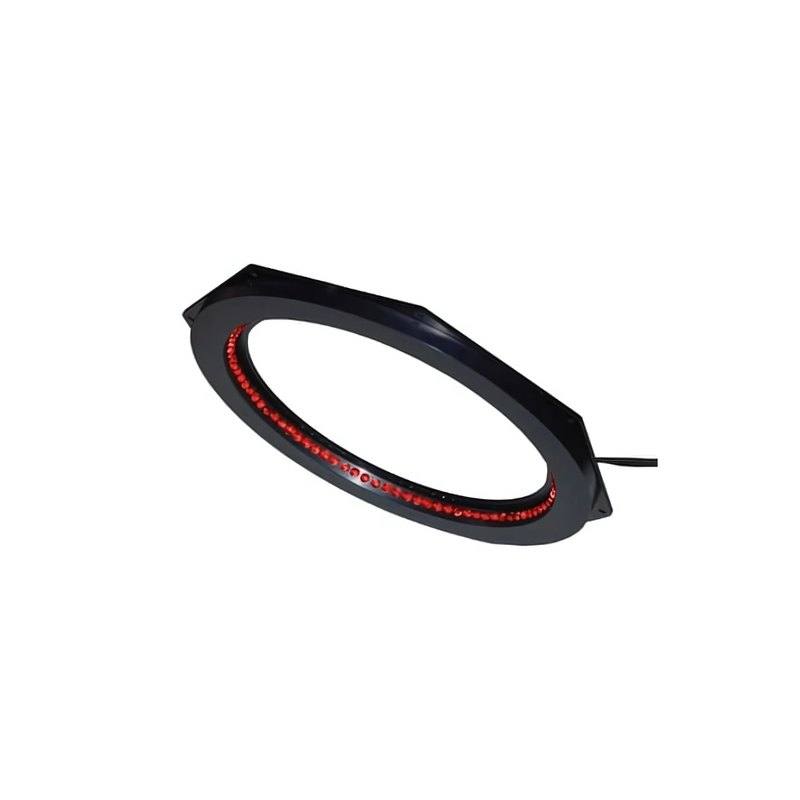
The DKL1813A is the smallest model in DCM Sistemes' DKL series of direct darkfield ring lights, with a 188 x 188 x 13 mm anodized-aluminium housing, a 130 mm inner diameter and a recommended working distance below 10 mm. It delivers a high amount of grazing light to emphasize small cracks, lines and height variations while eliminating direct glare and shadows. It runs from 24 VDC (+/-3%) via a 2-pole flying-lead cable, drawing up to about 5 W in continuous (Type C) mode, and is offered in Continuous, Powered, Strobe and Intelligent (iBlueDrive) operating variants. Available wavelengths span UV 400 nm, Blue 470 nm, Green 525 nm, Red 630 nm, IR 850 nm and White, with an IP40 rating and 0-40 C operating temperature.

Brand
DCM Sistemes
Lighting type
Dark field (direct low-angle ring darkfield)
Color / wavelength
Available in White, Blue 470nm, Green 525nm, Red 630nm, IR 850nm, UV 400nm
Available wavelengths
UV 400nm, Blue 470nm, Green 525nm, Red 630nm, IR 850nm, White
Mode
Continuous (Type C); also Powered (P), Strobe (S) and Intelligent iBlueDrive (i) variants
Working distance
RWD < 10 mm
Controller required
No (continuous Type C); strobe controller needed for Type S, iBlueDrive integrated for Type i
Diffuser
No (direct darkfield)
IP rating
IP40
Inner diameter
130 mm
Illuminated area
Ring-format darkfield, 130 mm inner diameter, 188 x 188 mm outer
Emission angle
Low-angle grazing (darkfield) emission

Technical overview

The DKL1813A is a direct, low-angle (darkfield) ring light, the smallest model in DCM Sistemes' DKL series. Its operating principle is geometric rather than spectral: LEDs arranged around a 130 mm inner-diameter ring fire light at a shallow grazing angle relative to the part surface, so smooth specular areas reflect light away from the camera and appear dark, while any edge, scratch, engraving, embossed character or height step scatters light back into the lens and stands out brightly. This is why the recommended working distance is specified as under 10 mm: the effect depends on keeping the light very close to and nearly co-planar with the surface so the angle of incidence stays low. The 188 x 188 x 13 mm anodized-aluminium housing is deliberately thin (13 mm) to let the ring sit flat against or just above the part, with the camera looking down through the 130 mm aperture.

Electrically the light is simple to design in. It runs from a 24 VDC supply (+/-3%) and draws up to about 5 W in continuous Type C mode, with the exact figure colour-dependent (roughly 2.9-5 W across the wavelength options). The standard connection is a 2-pole flying-lead cable (180 mm, brown = +24 V, blue = 0 V), so in its continuous form it needs no controller at all, just a regulated 24 V rail. The same optical head is offered in four operating variants: Continuous (C), Powered (P), Strobe (S), and Intelligent iBlueDrive (i). The strobe variant requires an external strobe controller, while the iBlueDrive variant integrates intelligent strobe/overdrive driving and switches to a 3-pole aerial male inline connector. That spread lets the same geometry serve a steady continuous setup or a high-brightness, motion-freezing pulsed setup on a moving line.

Wavelength is selectable independently of the darkfield geometry: the part can be ordered in White, Blue 470 nm, Green 525 nm, Red 630 nm, IR 850 nm or UV 400 nm. Because darkfield already converts surface relief into contrast through angle, the wavelength choice is mainly used to fine-tune contrast against a specific material or to drive fluorescence (UV) or penetrate certain coatings (IR), rather than to create the defect contrast itself. The housing is rated IP40, which is suited to clean, enclosed inspection stations rather than washdown or heavy-spray environments, and the unit is rated for 0-40 C ambient. At 340 g it is light enough to mount on a simple bracket or a compact gantry directly over the inspection point.

Best for

  • Revealing fine surface defects on flat or low-relief parts: scratches, hairline cracks, micro-pitting and tool marks that disappear under flat front lighting but scatter brightly under grazing light.
  • Reading laser-etched, embossed, debossed or engraved marks and characters (OCR/OCV and DPM-style codes) where the contrast comes from surface relief rather than ink colour.
  • Inspecting reflective or specular surfaces such as machined metal, anodized parts, electronic components and semiconductor substrates, where the part stays dark and only the features light up.
  • Close-proximity inspection where the camera and light must sit within ~10 mm of the part, for example small electronic or metal components on a fixtured station.
  • Pulsed inspection on a moving line using the Strobe or iBlueDrive (Type i) variant to freeze motion and overdrive brightness for short, bright exposures.

Selection notes

  • Working distance is the critical design parameter: the darkfield effect relies on RWD < 10 mm, so the mechanical layout must let the 188 x 188 x 13 mm ring sit very close to and nearly co-planar with the surface. If your geometry forces a larger standoff, the grazing effect weakens and a different light type may be needed.
  • Size the field of view to the 130 mm inner-diameter aperture: the camera images through the ring, so the inspected area must fit comfortably inside that opening at the short working distance.
  • Choose the operating variant up front. Continuous (Type C) needs only a 24 VDC rail and no controller; Strobe (Type S) requires an external strobe controller; iBlueDrive (Type i) integrates the driver but changes the connector to a 3-pole aerial inline, so plan wiring and triggering accordingly.
  • Confirm the 24 VDC supply tolerance (+/-3%) and budget the per-colour current draw (about 2.9-5 W) when sizing the power rail, especially if several lights share one supply.
  • The IP40 rating limits this to clean, dry, enclosed stations; it is not intended for washdown, dusty or high-spray environments. Add external protection if the cell is harsher.
  • Pick the wavelength to suit the material and task (e.g. UV 400 nm for fluorescence, IR 850 nm for coating penetration, or a colour to maximise contrast), remembering the defect contrast itself comes from the darkfield angle, not the colour.

Specifications: General
BrandDCM Sistemes
Lighting typeDark field (direct low-angle ring darkfield)

Specifications: Interface
Connection2-pole flying leads, L = 180 mm (BN = +24V, BU = 0V); iBlueDrive variant: 3-pole aerial male inline connector

Specifications: Optical
Color / wavelengthAvailable in White, Blue 470nm, Green 525nm, Red 630nm, IR 850nm, UV 400nm
Available wavelengthsUV 400nm, Blue 470nm, Green 525nm, Red 630nm, IR 850nm, White
Working distanceRWD < 10 mm
DiffuserNo (direct darkfield)
Emission angleLow-angle grazing (darkfield) emission

Specifications: Electrical
ModeContinuous (Type C); also Powered (P), Strobe (S) and Intelligent iBlueDrive (i) variants
Controller requiredNo (continuous Type C); strobe controller needed for Type S, iBlueDrive integrated for Type i
Driver technologyAvailable with iBlueDrive intelligent strobe/overdrive technology (Type i)
Power consumptionUp to 5 W (Type C, 24 VDC); colour-dependent 2.9-5 W
Supply voltage24 VDC +/-3%

Specifications: Environment
IP ratingIP40
Operating temperature0 to 40 C operating

Specifications: Geometry
Inner diameter130 mm
Illuminated areaRing-format darkfield, 130 mm inner diameter, 188 x 188 mm outer

Specifications: Mechanical
Housing materialAnodized aluminium
Dimensions188 x 188 x 13 mm
Weight340 g

Frequently asked questions

Related technical guides

Rosepetal · AI

Test this camera with Rosepetal

Validate your visual inspection with AI: send us sample images and we evaluate the case on your hardware.

AIS Vision · Integration

We validate camera + lens + lighting

AIS Vision defines and tests the optimal combination of camera, optics and lighting for your application before you buy.