
- Rosepetal compatible
- Recommended by AIS Vision
DCM Sistemes DKL3223A Darkfield Light
DKL3223A
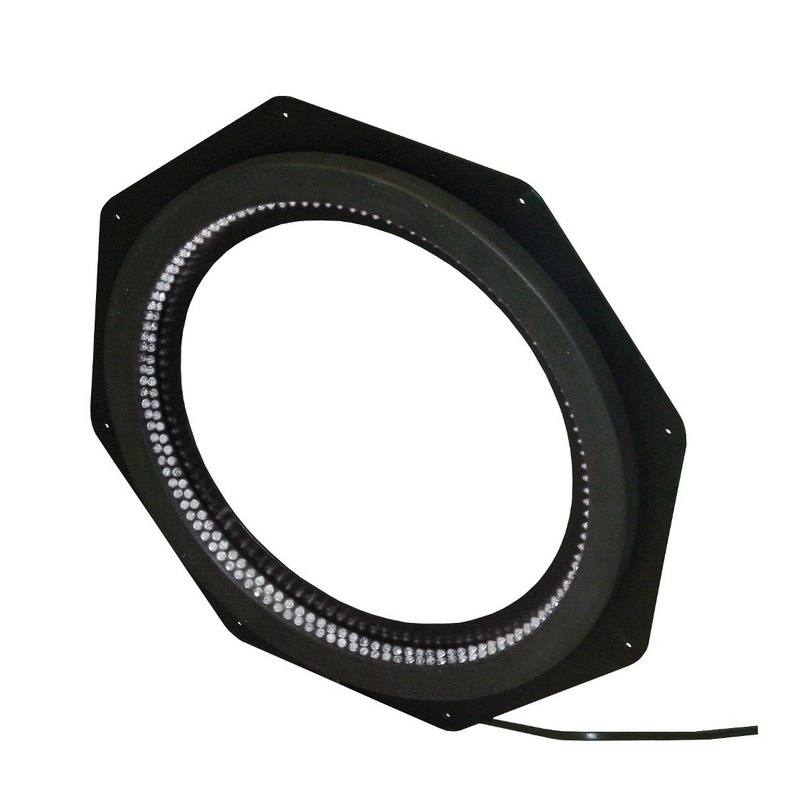
The DKL3223A is part of DCM Sistemes' DKL darkfield series, providing a high-intensity low-angle direct light that grazes the part from the camera axis to emphasize small cracks, lines, edges and height variations while suppressing glare and shadows. It has a 230 mm inner diameter and a recommended working distance below 20 mm, and is powered from 24 VDC via 2-pole flying leads. It is offered in white and monochromatic UV 400 nm, blue 470 nm, green 525 nm, red 630 nm and IR 850 nm variants, in continuous (Type C), powered/overdrive (Type P) and strobe (Type S) modes; strobe operation requires a VST-series strobe controller. Continuous consumption is about 20 W (blue/white) and the unit is housed in black anodized aluminium with an IP40 rating.
- Brand
- DCM Sistemes
- Lighting type
- Dark field (low-angle direct)
- Color / wavelength
- Available in white, UV 400 nm, blue 470 nm, green 525 nm, red 630 nm, IR 850 nm
- Available wavelengths
- White, UV 400 nm, Blue 470 nm, Green 525 nm, Red 630 nm, IR 850 nm
- Mode
- Continuous (C), Powered/overdrive (P) and Strobe (S) modes
- Working distance
- Recommended working distance < 20 mm
- Controller required
- Yes for strobe (VST-series strobe controller)
- Diffuser
- No (direct darkfield emission)
- IP rating
- IP40
- Inner diameter
- 230 mm inner diameter
- Emission angle
- Low-angle (grazing) darkfield illumination
- Power consumption
- ~20 W continuous (Type C, blue/white); up to 127 W peak in strobe
Technical overview
The DKL3223A is a large-format direct, low-angle darkfield ring light: a 337 x 337 mm square frame just 13 mm thick with a generous 230 mm clear inner aperture. Unlike a brightfield ring or a diffuse dome, its LEDs project light at a grazing angle from near the camera axis, so smooth, flat surfaces reflect that light away from the lens and stay dark, while any feature that breaks the plane (a crack, scratch, engraved line, embossed character, edge or step in height) scatters light back and lights up brightly against the dark background. This is why it has no diffuser (the spec explicitly lists diffuser: No) the effect depends on keeping the emission direct rather than softened. The trade-off is a short, unforgiving geometry: DCM recommends a working distance below 20 mm, so the part must sit very close under the ring and the camera looks down through the 230 mm aperture at whatever passes beneath.
| Brand | DCM Sistemes |
|---|---|
| Lighting type | Dark field (low-angle direct) |
| Connection | 2-pole flying leads, L = 180 mm (BN = +24 V, BU = 0 V) |
|---|
| Color / wavelength | Available in white, UV 400 nm, blue 470 nm, green 525 nm, red 630 nm, IR 850 nm |
|---|---|
| Available wavelengths | White, UV 400 nm, Blue 470 nm, Green 525 nm, Red 630 nm, IR 850 nm |
| Working distance | Recommended working distance < 20 mm |
| Diffuser | No (direct darkfield emission) |
| Emission angle | Low-angle (grazing) darkfield illumination |
| Mode | Continuous (C), Powered/overdrive (P) and Strobe (S) modes |
|---|---|
| Controller required | Yes for strobe (VST-series strobe controller) |
| Power consumption | ~20 W continuous (Type C, blue/white); up to 127 W peak in strobe |
| Supply voltage | 24 VDC ±3% |
| IP rating | IP40 |
|---|---|
| Operating temperature | 0 to 40 °C |
| Inner diameter | 230 mm inner diameter |
|---|
| Housing material | Anodized aluminium (color not specified by manufacturer) |
|---|---|
| Dimensions | 337 x 337 x 13 mm (outer), 230 mm inner aperture |
| Weight | 930 g |
Frequently asked questions
Related technical guides
How to choose machine vision lighting
A practical guide to choosing machine vision lighting: geometry, wavelength, strobe vs continuous, ambient control and how to maximise feature contrast for reliable inspection.
Types of machine vision lighting: ring, backlight, coaxial, dome and dark field
A practical guide to machine vision lighting geometries — ring, bar, backlight, coaxial, dome and dark field — explaining what each reveals, the surfaces it suits, and how to choose the right one directly from your inspection problem.
Strobe vs continuous lighting and how to choose a lighting controller
A practical guide to continuous, strobed, and overdrive LED lighting in machine vision: why a short pulse freezes motion, why overdrive (not strobing alone) adds brightness, how to synchronize the pulse to camera exposure, the duty-cycle limits that protect LED life, and how to size and select a lighting controller.
Rosepetal · AI
Test this camera with Rosepetal
Validate your visual inspection with AI: send us sample images and we evaluate the case on your hardware.
AIS Vision · Integration
We validate camera + lens + lighting
AIS Vision defines and tests the optimal combination of camera, optics and lighting for your application before you buy.