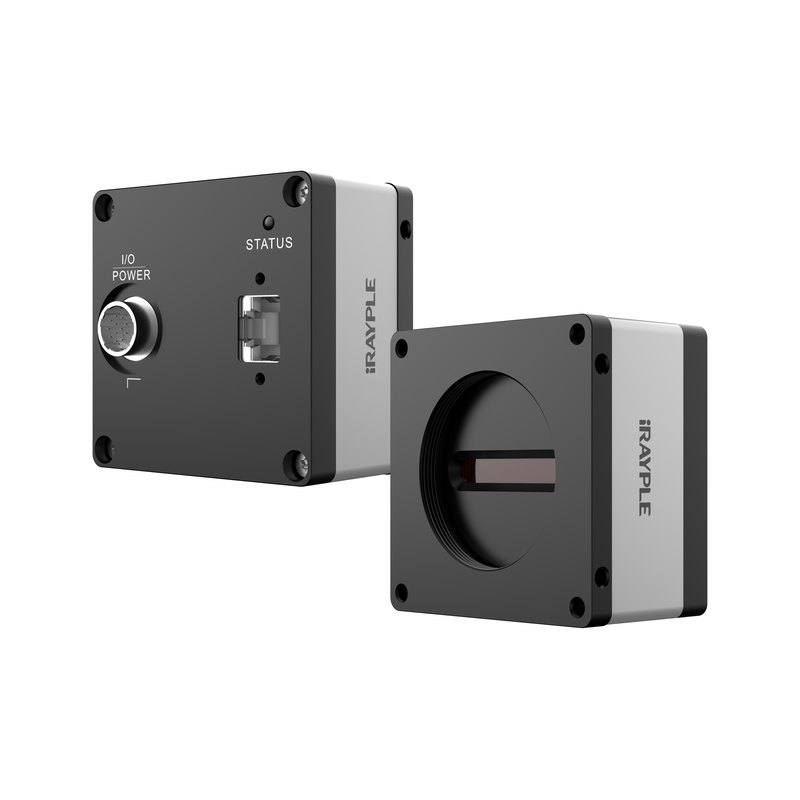
The iRAYPLE L5022MG141E (mono) and L5022CG141E (colour) are 5000-series line scan cameras using a 2K CMOS sensor with 2048 x 1 resolution, 14 x 14 µm pixels and a 49 kHz horizontal scan rate over a GigE Vision interface. They offer 12-bit output (Mono8/10/12 and packed formats), >38 dB SNR, 66 dB WDR, gain 1-32, gamma with LUT and an 8 µs to 100 ms exposure range, with software/hardware/free-run trigger modes. The camera uses an M42 x 1 lens mount, is powered by DC 12-24 V through a 12-pin Hirose connector at 4.5 W, and conforms to GigE Vision and GenICam standards with CE, FCC, UL and RoHS certification.
Brand
iRAYPLE
Camera type
Line scan
Interface
GigE (Gigabit Ethernet)
Horizontal resolution
2048 px (2048 x 1)
Mono / color
Monochrome (L5022MG141E) / Colour (L5022CG141E)
Shutter
CMOS line sensor
Line rate
49 kHz
Pixel size
14 x 14 µm
Mount
M42 x 1
Sensor size
2K CMOS line sensor
Power
DC 12-24 V (wide-range) via 12-pin Hirose connector; 4.5 W
The iRAYPLE L5022MG141E (monochrome) and L5022CG141E (colour) are 5000-series line scan cameras built around a 2K CMOS line sensor with a 2048 x 1 active resolution and large 14 x 14 micron pixels. Unlike an area-scan camera, a line scan device captures a single row of pixels at a time and assembles a continuous image as the part moves past it on a web, conveyor or rotating drum, so resolution along the direction of travel is set by the line rate and the transport speed rather than by the sensor itself. With a 49 kHz line rate the camera can build seamless, distortion-free images of continuously moving material, and the 14 micron pixels are generous for a line sensor, which improves light collection and helps reach the quoted >38 dB SNR even at high scan rates. The 12-bit pipeline (Mono8/10/12 plus packed formats), 66 dB wide dynamic range, programmable gain from 1 to 32, and gamma with a LUT give plenty of room to pull detail out of both bright and shadowed regions of a surface in a single pass.
Imaging is delivered over a GigE Vision interface conforming to the GigE Vision and GenICam standards, which keeps integration straightforward in any compliant software stack and allows cable runs up to roughly 100 m without repeaters - a practical advantage on large web-handling and packaging lines where the controller sits far from the imaging head. GigE bandwidth is the gating factor for sustained throughput, so the realistic maximum line rate in service depends on how many bits per pixel are streamed; the 8 to 100,000 microsecond (8 us to 100 ms) exposure range gives the latitude to trade integration time against speed. Trigger flexibility is central to line scan work: the camera supports software, hardware and free-run modes, so the line trigger can be slaved to an encoder on the transport to lock pixel spacing to physical travel and eliminate stretch or compression in the image when line speed varies.
Optically the camera uses an M42 x 1 mount, a larger thread than the C-mount used on most area-scan cameras and the appropriate choice for covering the long 2048-pixel line and 14 micron pitch without vignetting; lens selection should target the image circle and resolution the M42 line demands. Power is a wide-range DC 12-24 V supplied through a 12-pin Hirose connector, drawing only 4.5 W, and the housing is a compact 62 x 62 x 35.3 mm at 245 g rated from -30 to +50 C, so it tolerates cold stores and warm production halls alike. CE, FCC, UL and RoHS marking covers the usual industrial deployment requirements. Because line scan throws all available light onto a single row, pairing the camera with a bright, uniform line light (and the encoder-locked trigger above) is essential to realise the sensor's speed and dynamic range.
Best for
Continuous web surface inspection of moving material such as printed film, paper, foil and textile, where a 49 kHz line rate builds seamless full-width images without the seams or motion blur of area-scan tiling.
Defect and surface-quality inspection on conveyors and rolls, using the 12-bit, 66 dB wide-dynamic-range output to reveal both subtle low-contrast flaws and bright specular regions in a single pass.
Battery and electrode coating inspection, where the wide -30 to +50 C operating range and uniform line imaging suit demanding, large-format roll-to-roll processes.
Inline OCR/OCV and print verification on fast-moving labels and packaging, scanning full web width at high speed with encoder-locked triggering for dimensionally stable text.
Dimensional measurement across the web, where the fixed 2048-pixel line and encoder-synchronised line trigger give consistent, calibrated cross-web spacing.
Selection notes
Line scan needs motion and synchronisation: plan for an encoder on the transport feeding the hardware/free-run trigger so the line rate tracks actual travel speed, otherwise the image stretches or compresses as line speed varies.
GigE bandwidth caps sustained throughput, so the real-world line rate depends on the pixel format streamed (Mono8 vs 10/12-bit and packed modes); choose the bit depth that fits both your dynamic-range needs and the available Gigabit budget.
Budget for lighting first - a single row of pixels has very little integration time at 49 kHz, so a high-intensity, uniform line light across the full 2048-pixel field is required to use the SNR and 66 dB WDR the sensor offers.
Match optics to the M42 x 1 mount and the 2048 x 14 micron line: select a lens with an image circle and resolution rated for the M42 line format, and size magnification from your required cross-web field of view and resolution.
Decide mono versus colour at order time - L5022MG141E is monochrome and L5022CG141E is colour; mono maximises sensitivity and detail for defect and measurement work, while colour is needed only where chromatic information matters.
Confirm power and connectorisation: the camera takes wide-range DC 12-24 V at 4.5 W through a 12-pin Hirose, and the 100 m GigE reach lets the controller sit well away from the imaging head.
Specifications: General
Brand
iRAYPLE
Camera type
Line scan
Specifications: Sensor
Horizontal resolution
2048 px (2048 x 1)
Mono / color
Monochrome (L5022MG141E) / Colour (L5022CG141E)
Shutter
CMOS line sensor
Pixel size
14 x 14 µm
Sensor size
2K CMOS line sensor
Specifications: Performance
Line rate
49 kHz
Specifications: Interface
Interface
GigE (Gigabit Ethernet)
Protocols
GigE Vision, GenICam
Specifications: Optics
Mount
M42 x 1
Specifications: Electrical
Power
DC 12-24 V (wide-range) via 12-pin Hirose connector; 4.5 W
Power consumption
4.5 W
Specifications: Environment
Operating temperature
-30 to +50 °C
Specifications: Mechanical
Dimensions
62 x 62 x 35.3 mm (excluding rear case connector)
Weight
245 g
Applications this camera is commonly selected for. Open one to see the full recommended hardware and approach.
We could not derive compatible lenses from the available data for this camera.
Matched automatically by: lens mount fits the camera mount · lens image circle covers the camera sensor — this camera: M42 x 1 · 2K CMOS line sensor sensor.
Follow these steps to bring up your iRAYPLE camera, capture a first image, and move from the viewer to your own application. The flow is the same across the A, AE, AX and L series; only the physical interface differs.
Download and install the iRAYPLE machine-vision SDK together with its viewer client for your operating system. The installer provides the camera drivers, the GenTL producer, and the viewer you will use for first light. For GigE Vision models, also install or enable the bundled filter/performance driver on the network adapter to maximize throughput.
2. Connect the camera to the correct interface
Wire the camera to its matching host interface: a dedicated Gigabit (or 10 GigE) NIC for GigE Vision models, a USB3 Vision port with a quality cable for USB3 models, or a frame grabber for CoaXPress models. Power the camera (PoE, USB bus power, or PoCXP / external supply as applicable). For GigE Vision, put the NIC and camera on the same subnet and, where supported, enable jumbo frames.
3. Detect and open the camera in the viewer
Launch the iRAYPLE viewer, run device enumeration, and select your camera from the discovered list. Open it to load the device feature tree (GenICam node map). If a GigE camera is found but cannot be opened, correct the IP configuration so the camera and NIC are in the same address range.
4. Set exposure, gain and trigger, then grab a first image
Start with continuous (free-run) acquisition under stable lighting. Adjust exposure time and gain for a well-exposed, low-noise image, set the pixel format (e.g. Mono8 or a Bayer/RGB format), and tune white balance on color models. Once the live image looks correct, switch trigger mode to hardware or software trigger to synchronize capture with your process, and verify a single triggered frame.
5. Move from the viewer to the SDK or a GenICam library
With imaging confirmed, reproduce the same settings in code using the SDK's C/C++ or Python API: enumerate, open, configure the relevant GenICam features, register a frame callback or grab loop, and convert frames to your pipeline's buffer format. Since the cameras are GenICam/GenTL-compliant, you can alternatively drive them from a third-party GenICam vision library. From here a stable image stream can feed a deep-learning inspection step such as Rosepetal for automated quality control.
Frequently asked questions
It is a line scan camera with a 2048 x 1 sensor - it images a single row of pixels at a time and builds a continuous picture as the material moves past. That makes it ideal for inspecting continuous webs, rolls and conveyor-fed product, but it requires the part to be in steady motion and is not suited to imaging stationary, discrete objects the way an area-scan camera is.
The sensor is 2K, giving 2048 pixels across the line with 14 x 14 micron pixels, and it runs at a 49 kHz line rate. Cross-web resolution is fixed by the 2048-pixel line, while resolution along the direction of travel is set by the line rate together with the transport speed and encoder triggering.
It uses a GigE (Gigabit Ethernet) interface conforming to GigE Vision and GenICam, so it works with standard compliant software and supports cable runs up to about 100 m, letting the controller sit far from the imaging head. Sustained throughput is bounded by Gigabit bandwidth, which depends on the pixel format you stream.
Both. The L5022MG141E is monochrome and the L5022CG141E is colour. They share the same 2K CMOS line sensor, 14 micron pixels, 49 kHz line rate and GigE interface; choose mono for maximum sensitivity in defect and measurement tasks, or colour where colour information is required.
It uses an M42 x 1 lens mount, suited to covering the full 2048-pixel line, and is powered by wide-range DC 12-24 V through a 12-pin Hirose connector, drawing 4.5 W. The body measures 62 x 62 x 35.3 mm, weighs 245 g and operates from -30 to +50 C with CE, FCC, UL and RoHS certification.