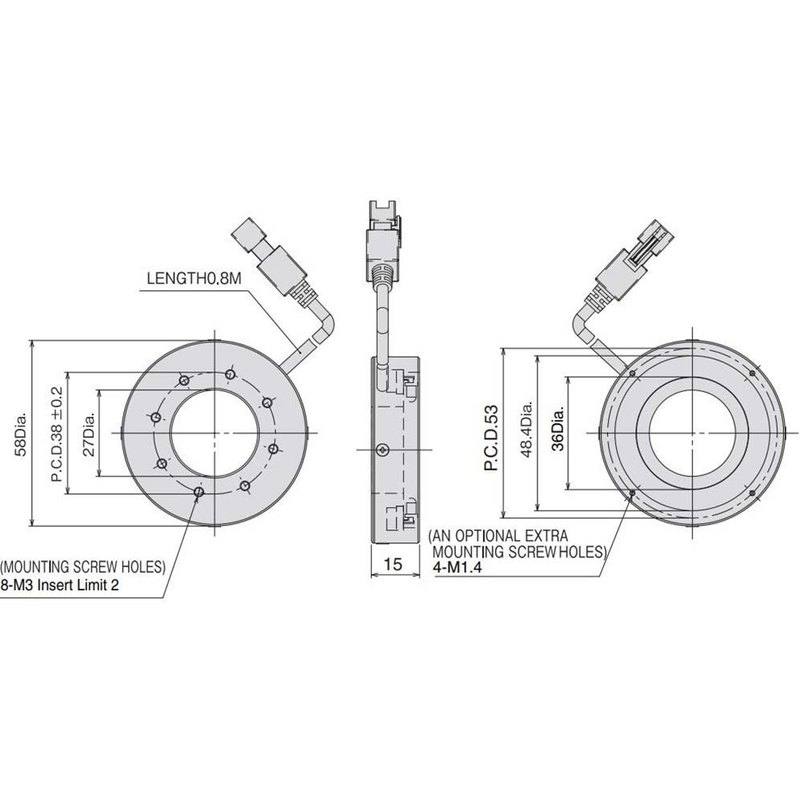
The FLV-DL5890 is part of Omron's FLV Series low-angle ring illumination lineup, providing grazing-incidence illumination ideal for revealing surface defects, scratches, and texture on flat or curved workpieces. It uses high-density LED arrays in an aluminum housing with a 58 mm outer diameter and approximately 27 mm inner aperture, delivering up to 1.9 W (white/blue) or 1.3 W (red) per unit. Power and control are supplied through a dedicated Omron lighting controller (FLV-TCC4, FLV-TCC1, FLV-TCC3H, or FLV-ATC series), and an optional diffuser plate (FLV-DL5890DF) and polarizing plate (FLV-DL5890PL) are available as accessories. The unit meets IP20 protection, operates from 0 to +50°C, and weighs approximately 90 g.
Brand
Omron / Sentech
Lighting type
Low Angle Ring Light (Dark Field)
Color / wavelength
White / Red (635 nm typ.) / Blue (460 nm typ.)
Available wavelengths
White, Red (635 nm), Blue (460 nm)
Mode
Continuous (strobe via controller)
Controller required
Yes – FLV-TCC4 / FLV-TCC1 / FLV-TCC3H / FLV-ATC series
Diffuser
Optional diffuser plate (FLV-DL5890DF)
IP rating
IP20 (IEC 60529)
Inner diameter
~27 mm
Emission angle
90° (per model designation); low-angle ring light, not grazing incidence
The FLV-DL5890 is a low-angle (dark-field) LED ring light built around a compact 58 mm outer-diameter aluminum housing with an approximately 27 mm inner aperture — sized to work coaxially with small- to medium-format lenses targeting close working distances. Three wavelength variants are offered: white broadband, red at 635 nm, and blue at 460 nm. The choice of wavelength is a genuine optical decision for the installer: the red variant draws only 1.3 W and is suited to monochrome cameras with high silicon sensitivity around 600–700 nm, making it efficient for general metallic surface work. The blue 460 nm variant (1.9 W, matching white) provides shorter wavelength illumination that can sharpen the apparent contrast of fine surface texture — particularly useful on ceramic, glass, or coated plastics where chromatic response of the sensor matters. White light offers spectral flexibility for colour cameras or for multi-wavelength experiments without changing the head. The light mode is continuous, with strobe capability delegated entirely to the connected Omron controller (FLV-TCC4, FLV-TCC1, FLV-TCC3H, or FLV-ATC series); the head itself carries no onboard strobe or intensity control circuitry, which keeps the head small and light at roughly 90 g.
The defining characteristic of the FLV-DL5890 is its low-angle ring illumination geometry — light is delivered at a low angle across the surface of the workpiece rather than from directly above, so that any raised or recessed surface feature — a scratch, pit, burr, stamped character, weld seam, or embossed mark — casts a pronounced shadow or produces a bright specular reflection that would be invisible under on-axis illumination. The product designation includes a 90-degree model suffix per Omron's FLV series naming convention; the ring format ensures azimuthally uniform shadow formation regardless of defect orientation, avoiding the blind spot that a directional bar light creates. The optional diffuser plate accessory (FLV-DL5890DF) softens the emission and trades peak intensity for more uniform coverage when working with slightly curved surfaces or when glare artefacts must be reduced. The optional polarising plate (FLV-DL5890PL) can be paired with a polarising filter on the lens to further suppress specular returns from highly polished substrates, isolating scattered surface scatter instead. The 0.8 m pigtail cable with a 3.5 mm diameter and minimum bend radius of 20 mm is routed directly to the controller; there is no intermediate connector on the head, so cable dressing and strain relief at the mounting bracket must be planned into the fixture design.
For system integration, the controller dependency is not optional — the head has no standalone power supply option. The FLV-TCC4 and FLV-TCC1 are the multi-channel and single-channel standard continuous/strobe controllers, and the FLV-TCC3H and FLV-ATC series extend to high-current strobe and externally triggered strobe modes respectively. Strobe synchronisation with the camera's exposure trigger is the primary method for freezing motion and maximising apparent intensity without exceeding the LED junction's thermal limit. Because the head dissipates at most 1.9 W in continuous mode, thermal loading on the fixture is low and the IP20-rated housing (suitable for clean indoor environments without directed water or dust ingress) will remain within the 0–50 °C operating range under virtually any normal industrial duty cycle. The aluminium housing conducts heat efficiently and contributes to the consistent LED colour point that surface-colour-sensitive inspection tasks depend on.
Best for
Fine surface-defect detection on machined metal parts — scratches, tool marks, pitting, and burrs become high-contrast shadows under the low-angle ring geometry, enabling reliable detection with standard area-scan cameras.
Embossed or debossed mark verification on plastic mouldings and stamped sheet metal, where the shallow angle reveals character depth that flat coaxial or diffuse illumination would wash out entirely.
Semiconductor wafer and substrate edge inspection and glass panel surface screening, where the optional polarising plate suppresses specular blowout and the blue 460 nm variant enhances contrast on dielectric coatings and oxide layers.
Pharmaceutical blister pack and tablet surface inspection in clean indoor environments — the compact 58 mm OD and low 90 g mass allow integration into tight multi-light fixtures or rotary turntable stations without mechanical interference.
Dimensional gauging of relief features such as coin faces, connector pin coplanarity checks, and fine-pitch PCB pad inspection, where the ring geometry casts consistent shadows from all azimuthal directions, making feature height estimations more repeatable.
Selection notes
Controller compatibility is mandatory: the FLV-DL5890 has no standalone supply path. Confirm which FLV-TCC or FLV-ATC controller channel count and strobe frequency match the line rate of your camera before purchasing the head, and verify that the controller's output voltage and current profile matches the head's 1.9 W (white/blue) or 1.3 W (red) continuous rating.
Working distance and lens selection are coupled to the 27 mm inner aperture: the lens barrel must physically clear that aperture, and the camera's field of view at the intended working distance must sit within the ring's illumination cone. Low-angle ring lights generally perform best at short working distances, so verify that your lens can focus at that range or that a spacer ring is accounted for in the optical stack.
Wavelength selection affects both contrast and sensor compatibility. Red 635 nm is the lowest-power option and works well with standard silicon sensors on metallic or opaque surfaces. Blue 460 nm improves contrast on translucent, coated, or ceramic surfaces but requires confirming that the sensor's QE at 460 nm is adequate and that any bandpass filter in the optical path is matched. White light is safest for colour cameras but provides the least wavelength-specific contrast enhancement.
The IP20 rating means the light is qualified only for clean, dry indoor installations. If the inspection cell involves coolant mist, cutting fluid spray, or wash-down cycles, a supplementary enclosure or protective cover is required; the head itself provides no protection against liquids or particulate ingress beyond finger-safe electrical protection.
The optional diffuser (FLV-DL5890DF) and polariser (FLV-DL5890PL) accessories mount directly on the head and are most useful in opposing scenarios: use the diffuser when workpiece curvature causes uneven shadow formation or when glare creates false positives; use the polariser when highly polished surfaces saturate the sensor with specular reflection.
Specifications: General
Brand
Omron / Sentech
Lighting type
Low Angle Ring Light (Dark Field)
Specifications: Interface
Connection
Proprietary lighting controller connector cable (3.5 mm dia., 0.8 m)
Specifications: Optical
Color / wavelength
White / Red (635 nm typ.) / Blue (460 nm typ.)
Available wavelengths
White, Red (635 nm), Blue (460 nm)
Diffuser
Optional diffuser plate (FLV-DL5890DF)
Emission angle
90° (per model designation); low-angle ring light, not grazing incidence
Specifications: Electrical
Mode
Continuous (strobe via controller)
Controller required
Yes – FLV-TCC4 / FLV-TCC1 / FLV-TCC3H / FLV-ATC series
Power consumption
1.9 W (White/Blue); 1.3 W (Red)
Specifications: Environment
IP rating
IP20 (IEC 60529)
Operating temperature
Operating: 0 to +50 °C; Storage: −15 to +60 °C
Specifications: Geometry
Inner diameter
~27 mm
Specifications: Mechanical
Housing material
Aluminum
Dimensions
OD ≈58 mm; cable ø3.5 mm × 0.8 m, min. bend R20 mm
Weight
Approx. 90 g
Applications this camera is commonly selected for. Open one to see the full recommended hardware and approach.
These steps take an Omron Sentech (STC) camera from the box to a stable first image and on to your own application. They apply across the GigE Vision, USB3 Vision and CoaXPress STC families; the interface only changes how you cable and power the camera.
Download and install the Sentech SDK on the host PC. The package provides StViewer, the viewing and configuration software you use to bring the camera up, and StApi, the programming SDK you integrate later. Because the cameras are GenICam/GenTL-compliant, StApi also registers a GenTL producer, so any GenICam-compliant third-party vision software can discover and drive the camera as an alternative front end.
2. Cable, power and connect the camera
Connect according to the interface. GigE Vision: link to a Gigabit NIC (use PoE or the separate power input) and put the camera and host on the same subnet; for USB3 Vision use a USB 3.x port and a certified cable; for CoaXPress (STC) connect to a CoaXPress frame grabber, which also supplies Power-over-Coax. Then open StViewer and let it enumerate the camera. If a GigE camera does not appear, check the IP configuration and firewall, and on USB3 confirm the host bandwidth and driver.
3. Configure exposure, gain and white balance
Open the device in StViewer and start a live stream. Set exposure and gain for a well-exposed, low-noise image: raise exposure first and only add gain when more light or a faster shutter is not an option, keeping exposure short enough to freeze motion on global-shutter models. On colour cameras, run white balance under your actual production lighting. Adjust the lens aperture and focus on a representative target before tuning anything else.
4. Set the trigger and grab a first image
Start in free-run (continuous) acquisition to confirm a clean, stable image. For inline inspection switch to hardware or software triggering: select the trigger source, set the active edge and any delay, and wire the strobe or illumination to the camera's I/O so lighting fires with each exposure. Acquire and save a frame in StViewer; this saved image is your reference for the SDK stage and for downstream inspection.
5. Move to the StApi SDK (or any GenICam software)
Once the image is stable, reproduce the same settings in code. Use StApi to open the device, apply the GenICam features you validated in StViewer (exposure, gain, trigger, pixel format) and grab frames into your application via the bundled C++, C, C#/.NET or Python interfaces; the included samples are the fastest starting point. Prefer a different stack? The same GenICam/GenTL camera works with third-party vision libraries. With a reliable feed, you can route it into a deep-learning inspection such as Rosepetal for AI-based defect detection.
Frequently asked questions
No. The product datasheet specifies that power and control must be provided through a dedicated Omron FLV-series lighting controller (FLV-TCC4, FLV-TCC1, FLV-TCC3H, or FLV-ATC series). The head uses a proprietary cable and connector; there is no documented path to drive it from a generic bench supply. Strobe timing, intensity adjustment, and safe LED drive current are all managed by the controller.
The white and blue (460 nm) variants are rated at 1.9 W, while the red (635 nm) variant is rated at 1.3 W in continuous mode. Lower wattage in the red variant reflects the efficiency of red LEDs at that wavelength rather than reduced output performance — red LEDs at 635 nm generally have higher luminous efficacy than blue LEDs. In practice, apparent brightness on a camera sensor also depends on the sensor's spectral quantum efficiency, so the 1.3 W red head can produce comparable or superior effective signal on a standard silicon sensor compared with the higher-wattage blue variant.
Two optical accessories are available. The diffuser plate (FLV-DL5890DF) reduces peak intensity and broadens the emission distribution; it is useful on curved or uneven workpieces where the bare ring creates non-uniform shadows, or where specular hot spots cause false alarms. The polarising plate (FLV-DL5890PL) is used in conjunction with a matching polarising filter on the camera lens to suppress direct specular reflection from mirror-like surfaces, revealing scattered surface defects that would otherwise be hidden by glare.
The specification states a minimum bend radius of 20 mm for the 3.5 mm diameter, 0.8 m pigtail cable. In practice, this means the cable exit path from the head must be designed to avoid sharper bends — particularly relevant in compact fixtures or robot-mounted setups where the head may travel or rotate. Since the cable terminates at a proprietary controller connector with no intermediate breakout, the full 0.8 m length must be routed to the controller without shortening or splicing.
No. The unit is rated IP20 per IEC 60529, which means it provides protection against solid objects larger than 12.5 mm (finger-safe) but offers no rated protection against liquids or dust ingress. It is designed for clean, dry indoor machine-vision installations. If the application environment involves coolant mist, cutting fluid spray, or wash-down cycles, a supplementary enclosure or protective cover must be provided.