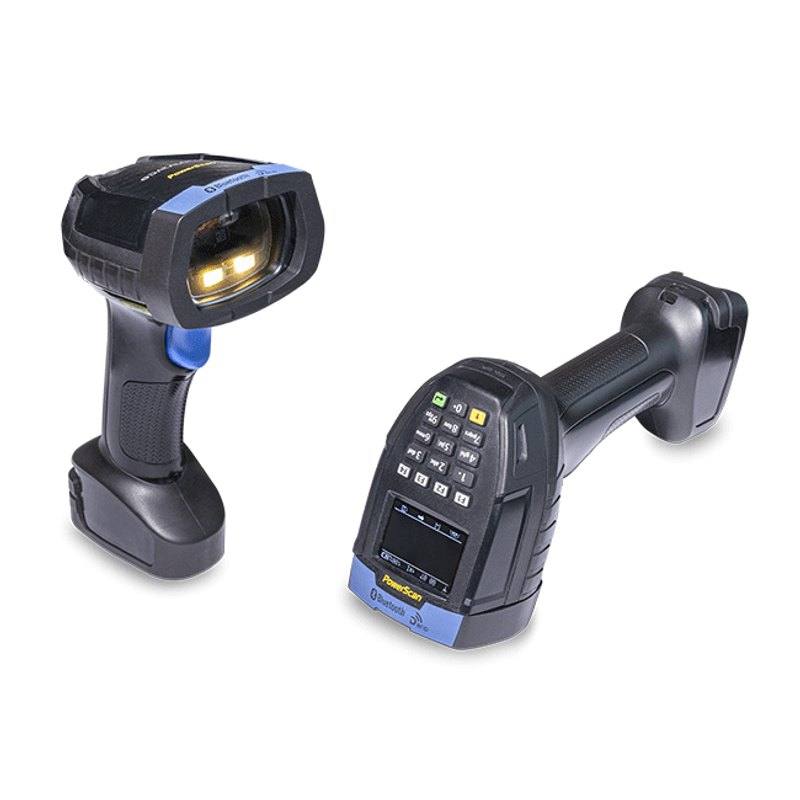
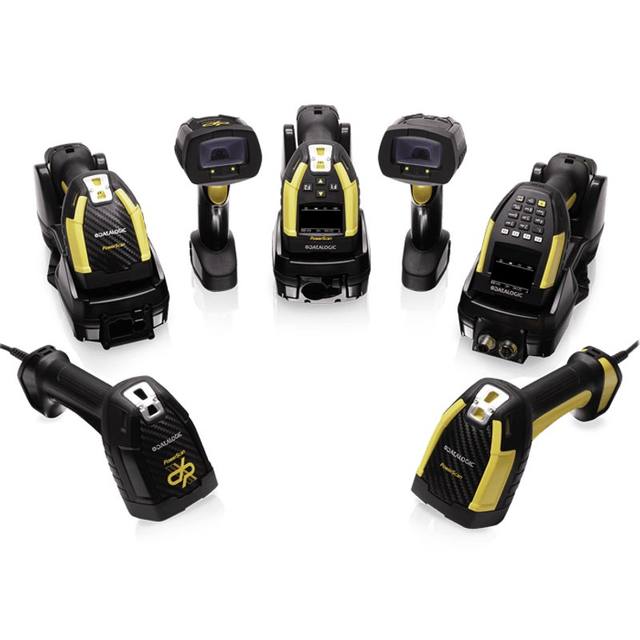
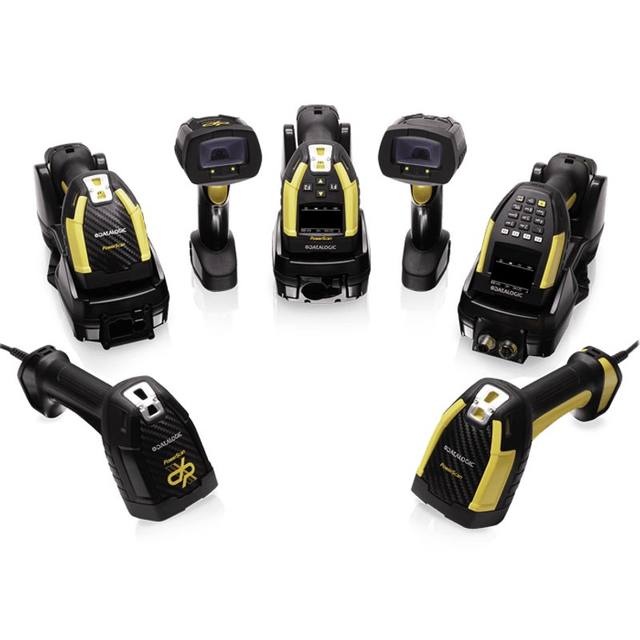
Datalogic PowerScan PBT9600-DC RFID — cordless industrial handheld reader; 2D imager; interfaces Bluetooth / USB / RS-232 / Ethernet. 4 order codes on datalogic.com.
Brand
Datalogic
Reader type
Code reader
Form factor
Cordless handheld
Cordless
Yes
Scan technology
2D imager (reads 1D/2D barcodes) + UHF RFID reader/writer; dual camera with colour image capture
Supported codes
UHF RFID tags, 1D/2D barcodes, OCR text; colour image capture
Communication
Bluetooth (cordless) to modular cradles supporting USB, RS-232, Ethernet and more
This handheld combines a 2D imager for 1D and 2D barcodes and OCR text with a UHF RFID reader and writer, so one device handles items that carry a printed code, a tag or both. RFID read and write reaches up to 1 m (3.2 ft), with a configurable range and multiple tag formats, and a dual-camera arrangement adds colour image capture. UHF tags typically read without line of sight and several at a time, but metal and liquids detune them, so test with the tag type and surface you will use.
As the Document Capture version it has an OLED display and a 16-key keypad for entering information on the device. Bluetooth links it to modular cradles with USB, RS-232, Ethernet and more, and the removable battery supports wireless charging. EU and US versions exist because UHF frequency allocations differ by region (typically 865–868 MHz in Europe and 902–928 MHz in North America), and the reader is sold in North America and Europe only.
Best for
Reconciling an item's RFID tag with its printed barcode in one pass at goods-in or returns.
Inspections that need a colour image and a scan together, for quality control or signature confirmation.
Reading tags on boxed or stacked items whose labels do not face the operator, within the 1 m RFID range.
Selection notes
Order the version for your region: the EU and US order codes use different UHF frequencies.
Reduce the configurable RFID range if neighbouring tagged items must not be picked up by accident.
Check on your own labels that the barcode imager reads your code size at the distance the operator will scan from.
Specifications: General
Brand
Datalogic
Reader type
Code reader
Form factor
Cordless handheld
Specifications: Interface
Cordless
Yes
Communication
Bluetooth (cordless) to modular cradles supporting USB, RS-232, Ethernet and more
2D imager (reads 1D/2D barcodes) + UHF RFID reader/writer; dual camera with colour image capture
Supported codes
UHF RFID tags, 1D/2D barcodes, OCR text; colour image capture
This product groups every purchasable order code that shares the same sensing method, range and output. Cable length, connector type and operation mode (Light-ON/Dark-ON, NO/NC) vary by order code below.
Family variants with highlighted differences
Model
Communication ●
Availability
PowerScan PBT9600, Bluetooth, Document Capture & RFID EU, Display/16-key Keypad, Removable Battery Base
—
On request
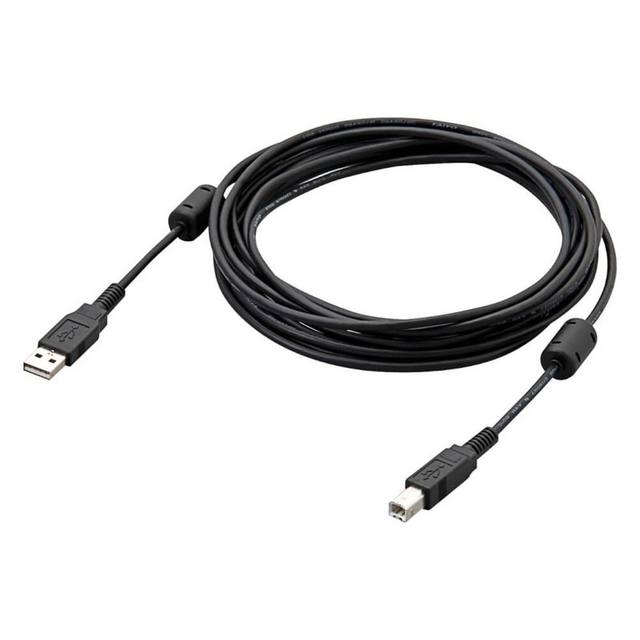
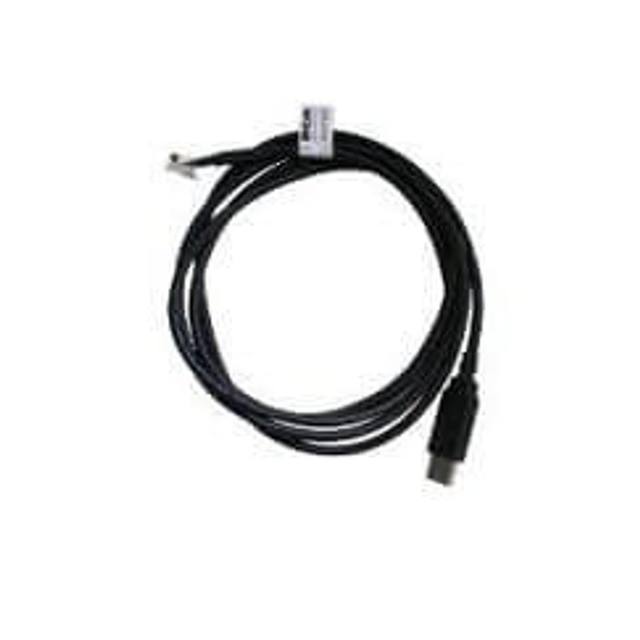
PowerScan PBT9600, Bluetooth, Document Capture & RFID EU, Display/16-key Keypad, Removable Battery, USB kit (Kit includes Scanner PBT9600-DKDCRFEU, cradle BC9630-BT, Cable CAB-552, Power Supply 8-0935 and Power Cord 6003-0940)
PowerScan PBT9600, Bluetooth, Document Capture & RFID US, Display/16-key Keypad, Removable Battery, USB kit (Kit includes Scanner PBT9600-DKSRRFUS, cradle BC9630-BT, Cable CAB-552, Power Supply 8-0935 and Power Cord 6003-0941)
USB kit
On request
Applications this product is commonly selected for. Open one to see the full recommended hardware and approach.
1. Install the IMPACT Software Suite and connect the camera
Install the IMPACT Software Suite on your PC, which provides both the configuration/viewer tools and the SDK. For a GigE Vision model (E100, M or U series), connect it to a dedicated NIC and, for USB3 models, use a certified USB3 cable and port. Power the camera and confirm it enumerates.
2. Bring the camera online and verify the link
For GigE Vision, put the camera and the host NIC on the same subnet (a static IP on the camera matching the NIC range is the most reliable starting point); for USB3, confirm the device is recognized. Open the IMPACT viewer/device tool, discover the camera, and verify a stable connection before streaming. Enabling jumbo frames on the NIC helps GigE throughput.
3. Set exposure, gain and trigger, then grab a first image
In the IMPACT tools, start a live stream and adjust exposure and gain until the image is well-lit without saturation; set white balance on color models. Begin in free-run (continuous) mode to confirm imaging, then switch to hardware or software trigger as your application requires. Capture and save a reference image once the scene looks correct.
4. Build a vision tool or move to the SDK/API
Use the IMPACT point-and-click vision tools to assemble an inspection, or use the IMPACT SDK to access the camera and results programmatically and feed them into your HMI/PLC application. As these are GenICam/GenTL-compliant devices, you can alternatively drive them from any GenICam-compliant third-party vision library if your pipeline standardizes on one.
5. Route the stable feed to deep-learning inspection (optional)
Once you have a stable, repeatable image, the feed can be sent to a deep-learning inspection platform such as Rosepetal for defect detection or classification tasks that go beyond rule-based tooling. Keep lighting, optics and trigger timing fixed so the images reaching the model stay consistent.
Frequently asked questions
Up to 1 m (3.2 ft) for UHF read and write, with a configurable range. Real range depends on the tag and on what it is attached to.
It is offered for North America and Europe only, in separate EU and US frequency versions.