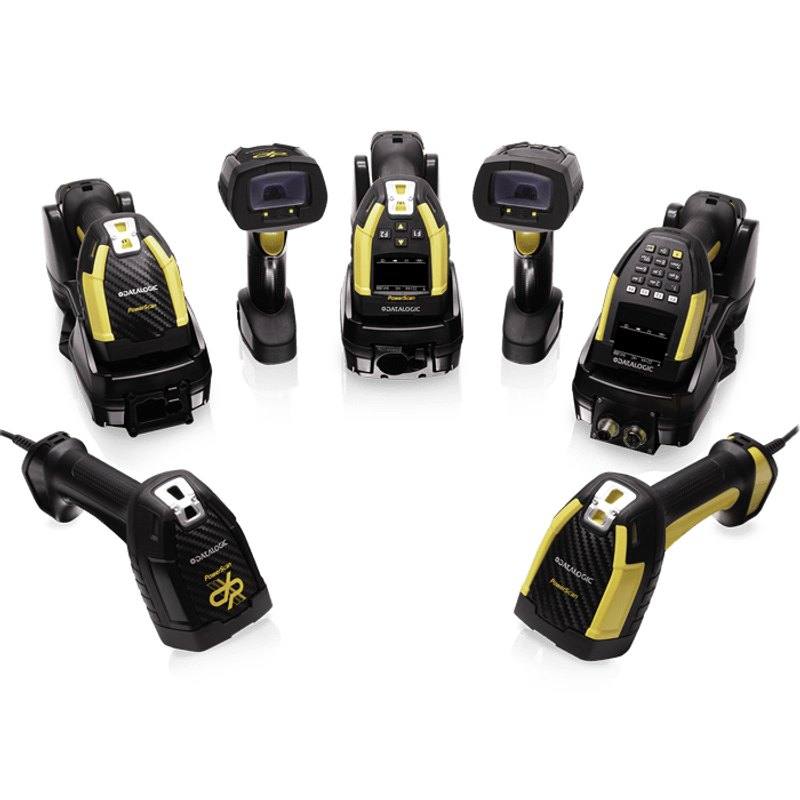
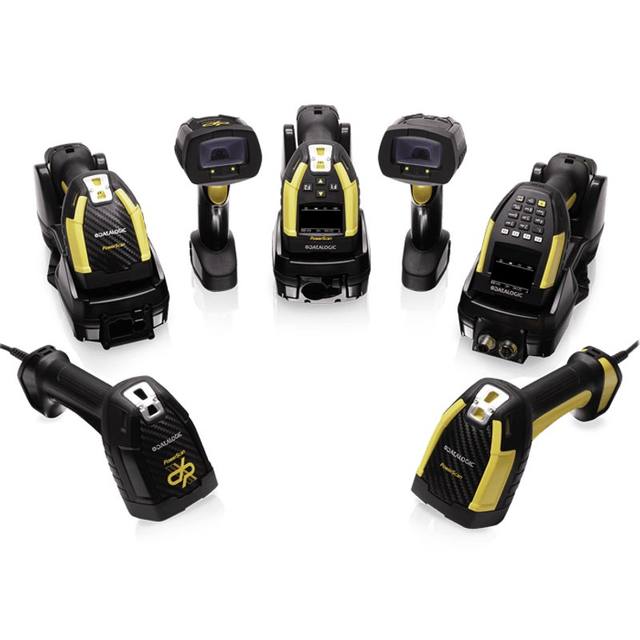
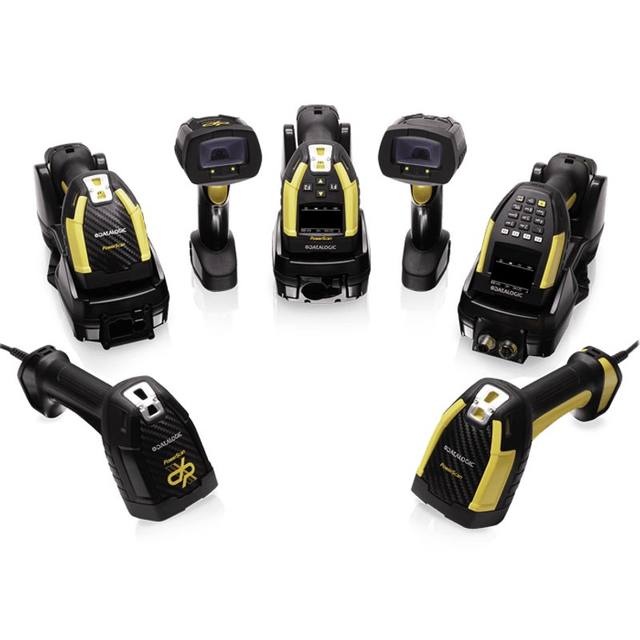
High Performance pairs fine code limits (2.5 mil 1D, 4 mil 2D) with long reach: Code 128 at 40 mils reads out to 242.9 cm, and EAN/UPC at 13 mils from 4 to 120 cm. The PBT9600-SR reads the same EAN/UPC label only to 67.5 cm, so HP goes about 120 ÷ 67.5 ≈ 1.8 times as far, though a 10 mil Data Matrix gains little (32 cm against 30 cm). HP pays off mainly on large 1D labels and on fine codes.
The nominal field of view is 38° horizontal × 24° vertical, so the area seen grows with distance: at an example 30 cm it is 2 × 300 × tan 19° ≈ 207 mm by 2 × 300 × tan 12° ≈ 128 mm, enough to take in a whole 4 × 6 in (152 × 102 mm) shipping label. It also reads Digimarc Barcodes. The light is a white LED with 630–680 nm VLD aiming and Green Spot feedback, and the link is Bluetooth 5.0 (SPP or HID) to a BC96xx base or any Bluetooth host.
Best for
Mixed warehouse labels: 40 mil 1D codes read from as far as 242.9 cm and 10 mil Data Matrix from 4.2 to 32 cm, so one scanner covers pallet and parcel labels.
Stacked codes: PDF417 at 10 mils reads from 0.5 to 46.1 cm, a long window for forms and shipping documents.
Packaging that carries Digimarc Barcodes next to printed codes, which this version reads.
Selection notes
Code 128 at 2.5 mils works only from 6.3 to 11.5 cm, a window of 11.5 − 6.3 = 5.2 cm, so hold the reader steady for such labels.
Mid-size codes gain too: Code 128 at 5 mils reads from 3.8 to 41 cm here, against 6.4 to 30.9 cm on the PBT9600-SR, so HP focuses closer and reaches further.
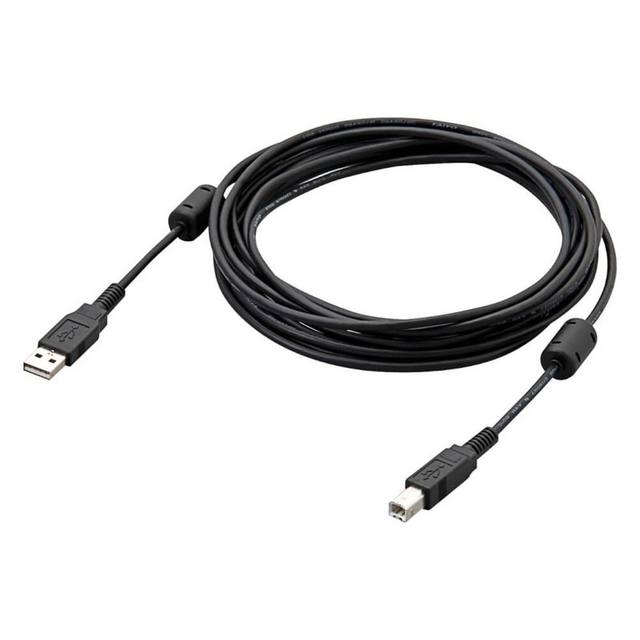
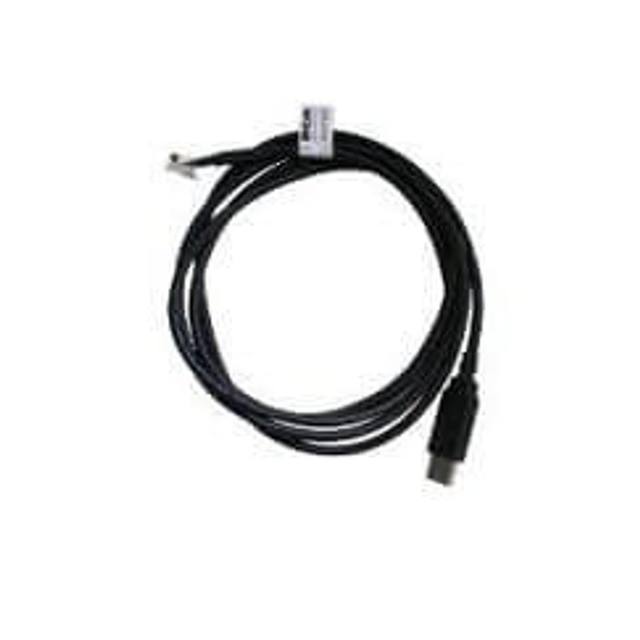
Choose the cradle that fits the host: kits cover USB, RS-232, Ethernet and EtherNet/IP.
Specifications: General
Brand
Datalogic
Reader type
Code reader
Form factor
Cordless handheld
Specifications: Sensor
Resolution
1.02 MP (1280 × 800 px)
Horizontal resolution
1280 px
Specifications: Interface
Cordless
Yes
Communication
Bluetooth 5.0 (SPP / HID, up to 100 m open air) to the BC96xx base or any Bluetooth host; base station interfaces RS-232 / USB / Ethernet and industrial protocols (EtherNet/IP, PROFINET)
Specifications: Optical
Integrated lighting
White LED reading light; 630 – 680 nm VLD aiming; Green Spot good-read feedback
Illumination colour
White
Field of view
38° H × 24° V
Specifications: Electrical
Supply voltage
Base station: host powered 5 VDC ± 5% or 10 – 30 VDC; external power supply 10 – 30 VDC ± 5%
Battery
Li-Ion 3350 mAh, removable; 2.5 h to 95 % / 3.2 h to 100 % (12 VDC, external power); 80,000+ reads per charge; wireless (inductive) charging
Specifications: Environment
Drop resistance
50 drops from 2.5 m at 20 °C; 50 drops from 2.0 m at -20 °C
IP rating
IP65 and IP67 (cradle IP65 on specific models)
Operating temperature
-20 – 50 °C
Specifications: Reading
Scan technology
2D area imager, 1280 × 800 px
Supported codes
1D incl. GS1 DataBar; 2D: Aztec, China Han Xin, Data Matrix, MaxiCode, Micro QR, QR, Dot Code; stacked: PDF417, MicroPDF417, MacroPDF, GS1 DataBar stacked & composites; postal codes; Digimarc Barcodes (HP and DC models)
This product groups every purchasable order code that shares the same sensing method, range and output. Cable length, connector type and operation mode (Light-ON/Dark-ON, NO/NC) vary by order code below.
Family variants with highlighted differences
Model
Communication ●
Availability
PowerScan PBT9600, Bluetooth, High Performance, Display/16-key Keypad, Removable Battery Base
—
On request
PowerScan PBT9600, Bluetooth, High Performance, Display/16-key Keypad, Removable Battery, USB Kit (Kit includes Scanner PBT9600-DKHPRB, Cradle BC9630-BT, Cable CAB-552, Power Supply 8-0935 and Power Cord 6003-0940)
USB kit
On request
PowerScan PBT9600, Bluetooth, High Performance, Ethernet Kit (Kit includes Scanner PBT9600-HP, Cradle BC9680-BT, Power Supply 8-0935 and Power Cord 6003-0940)
Ethernet kit
On request
PowerScan PBT9600, Bluetooth, High Performance, Ethernet/ETH IP Kit (Kit includes Scanner PBT9600-HPRB and Cradle BC9681-BT-N200)
Ethernet / EtherNet/IP kit (cradle BC9681)
On request
PowerScan PBT9600, Bluetooth, High Performance, Removable Battery
—
On request
PowerScan PBT9600, Bluetooth, High Performance, Removable Battery, RS-232 Kit (Kit includes Scanner PBT9600-HP, Cradle BC9630-BT, Cable CAB-548, Power Supply 8-0935 and Power Cord 6003-0940)
RS-232 kit
On request
PowerScan PBT9600, Bluetooth, High Performance, Removable Battery, RS-232 Kit (Kit includes Scanner PBT9600-HP, Cradle BC9630-BT, Cable CAB-548, Power Supply 8-0935 and Power Cord 6003-0941)
RS-232 kit
On request
PowerScan PBT9600, Bluetooth, High Performance, Removable Battery, USB Kit (Kit includes Scanner PBT9600-HP, Cradle BC9630-BT, Cable CAB-552, Power Supply 8-0935 and Power Cord 6003-0940)
USB kit
On request
PowerScan PBT9600, Bluetooth, High Performance, Removable Battery, USB Kit (Kit includes Scanner PBT9600-HP, Cradle BC9630-BT, Cable CAB-552, Power Supply 8-0935 and Power Cord 6003-0941)
USB kit
On request
Applications this product is commonly selected for. Open one to see the full recommended hardware and approach.
1. Install the IMPACT Software Suite and connect the camera
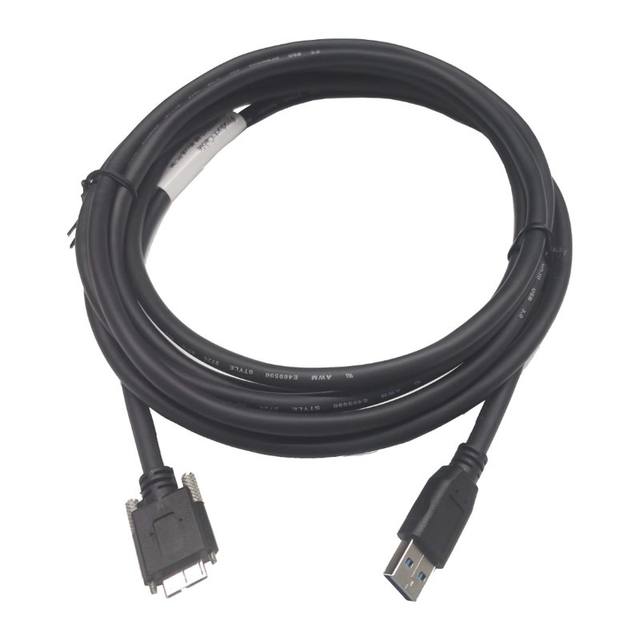
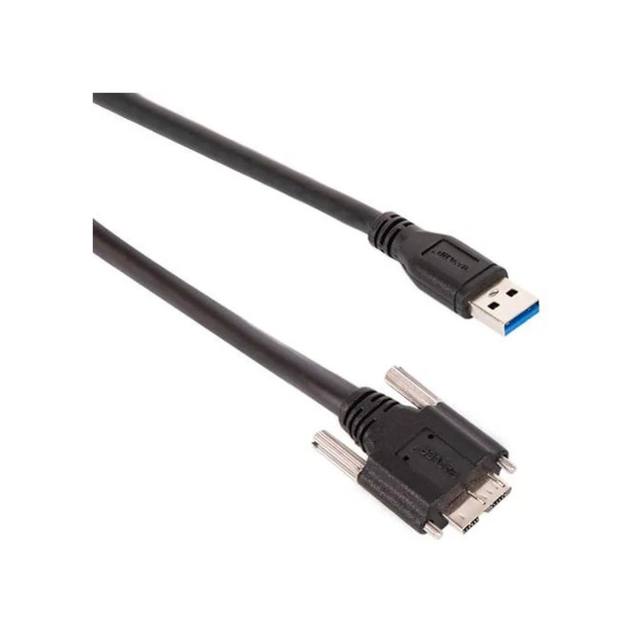
Install the IMPACT Software Suite on your PC, which provides both the configuration/viewer tools and the SDK. For a GigE Vision model (E100, M or U series), connect it to a dedicated NIC and, for USB3 models, use a certified USB3 cable and port. Power the camera and confirm it enumerates.
2. Bring the camera online and verify the link
For GigE Vision, put the camera and the host NIC on the same subnet (a static IP on the camera matching the NIC range is the most reliable starting point); for USB3, confirm the device is recognized. Open the IMPACT viewer/device tool, discover the camera, and verify a stable connection before streaming. Enabling jumbo frames on the NIC helps GigE throughput.
3. Set exposure, gain and trigger, then grab a first image
In the IMPACT tools, start a live stream and adjust exposure and gain until the image is well-lit without saturation; set white balance on color models. Begin in free-run (continuous) mode to confirm imaging, then switch to hardware or software trigger as your application requires. Capture and save a reference image once the scene looks correct.
4. Build a vision tool or move to the SDK/API
Use the IMPACT point-and-click vision tools to assemble an inspection, or use the IMPACT SDK to access the camera and results programmatically and feed them into your HMI/PLC application. As these are GenICam/GenTL-compliant devices, you can alternatively drive them from any GenICam-compliant third-party vision library if your pipeline standardizes on one.
5. Route the stable feed to deep-learning inspection (optional)
Once you have a stable, repeatable image, the feed can be sent to a deep-learning inspection platform such as Rosepetal for defect detection or classification tasks that go beyond rule-based tooling. Keep lighting, optics and trigger timing fixed so the images reaching the model stay consistent.
Frequently asked questions
When labels have fine modules (2.5 mil 1D and 4 mil 2D, against 3 and 6 mil on the PBT9600-SR) or when large 1D labels must be read from far away, up to 242.9 cm for 40 mil Code 128.
Not for the connection to the host: Bluetooth 5.0 pairs it with a BC96xx base or any Bluetooth host, up to 100 m in open air.