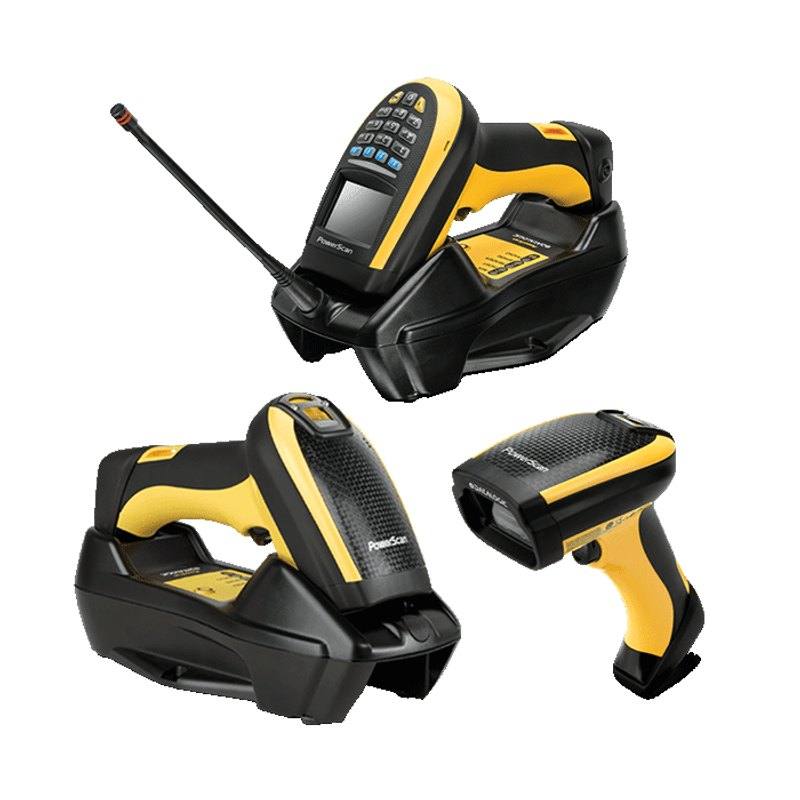
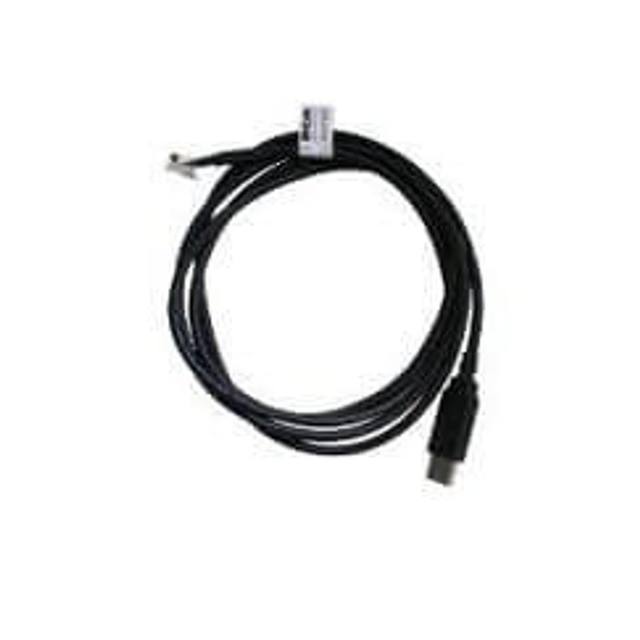
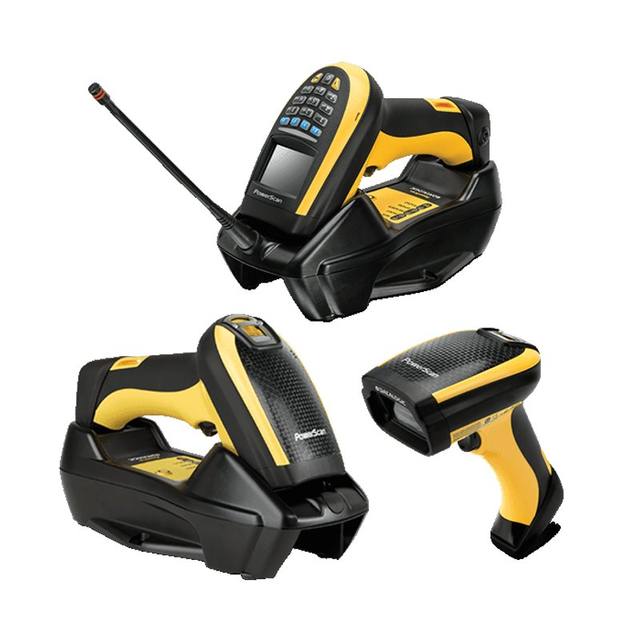
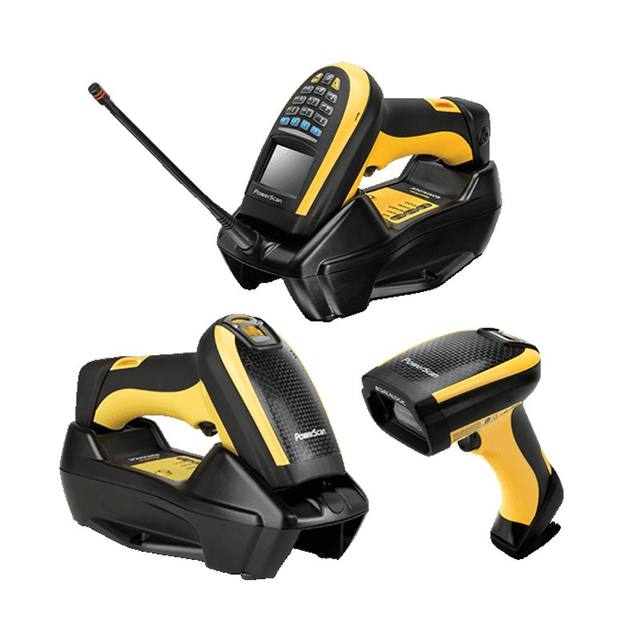
This version swaps the Bluetooth link of the PBT9501-DPM for the Datalogic STAR Cordless System radio at 433 or 910 MHz, which connects to BC9030, BC9130, BC9160 (RS-485) or BC9180 (Ethernet) bases. The bases output Keyboard Wedge, RS-232, RS-485 or USB, with optional Ethernet, and kits pair the scanner with an RS-232, USB or Ethernet base. A display variant exists too: the PM9501-DDPM adds a graphic display with white backlight and 4 configurable keys, at 440 g against 400 g.
Imaging is the 0.47 MP (864 × 544 px) DPM engine. On printed labels, Data Matrix at 10 mils reads from 2.0 to 10.5 cm, PDF at 10 mils from 1.0 to 12.5 cm and EAN-13 at 13 mils from 2.5 to 16.0 cm, while DPM distances change with the marking and the surface. It reads laser-marked, chemical-etched and ink-jet codes plus dot-peened Data Matrix, and Motionix switches scanning modes automatically. The scanner survives 50 drops from 2.0 m onto concrete, the cradle 50 drops from 1.2 m.
Best for
DPM benches where the operator confirms a job or count on the backlit 4-key display while scanning marks at close range.
Cells that report over Ethernet, where the Ethernet kit's BC9180 base puts the radio link straight onto the network.
RS-485 plants served by a BC9160 base, where one controller can poll several bases.
Selection notes
Scanner and base must be on the same STAR frequency, since 433 MHz and 910 MHz versions are not interchangeable.
The imager is 864 px wide. For a higher-resolution imager with autofocus, look at the PM9600-DPX, which has 1280 px and reads EAN/UPC at 13 mils out to 22.5 cm.
The battery is removable and gives 60,000+ reads per charge; a charge takes 4.5 h on external power or 10 h on host power, so stock a spare for round-the-clock use.
Specifications: General
Brand
Datalogic
Reader type
Code reader
Form factor
Cordless handheld
Specifications: Sensor
Resolution
0.47 MP (864 × 544 px)
Horizontal resolution
864 px
Specifications: Interface
Cordless
Yes
Communication
Datalogic STAR Cordless System radio (433 or 910 MHz) to BC9030 / BC9130 / BC9160 (RS-485) / BC9180 (Ethernet) bases; Keyboard Wedge, RS-232, RS-485, USB; optional Ethernet
Specifications: Optical
Integrated lighting
White LED illumination; 630 – 680 nm VLD aiming
Illumination colour
White
Specifications: Electrical
Supply voltage
Base: external power 10 – 30 VDC; POT 5 VDC ± 10%
Battery
Li-Ion 3350 mAh; 60,000+ reads per charge (continuous); charge time 4.5 h (external power) / 10 h (host power)
Specifications: Environment
IP rating
IP65
Operating temperature
-20 – 50 °C
Drop resistance
50 drops from 2.0 m onto concrete (scanner); cradle 50 drops from 1.2 m
Specifications: Reading
Scan technology
2D area imager, 864 × 544 px
Supported codes
DPM: laser / chemical-etched or ink-jet printed codes, dot-peened Data Matrix; 1D incl. GS1 DataBar; 2D: Aztec, China Han Xin, Data Matrix, MaxiCode, Micro QR, QR; stacked: PDF417, MicroPDF417, MacroPDF, composites; postal: Postnet, RM4SCC
Min. code resolution
1D: 4 mil; 2D: 7.5 mil
Read distance
Typical DOF (printed labels): 2 mils 2.8 – 6.3 cm; 5 mils 1.2 – 9.0 cm; Data Matrix 10 mils 2.0 – 10.5 cm; PDF 10 mils 1.0 – 12.5 cm; EAN-13 13 mils 2.5 – 16.0 cm (DPM ranges vary with marking and surface)
Specifications: Mechanical
Dimensions
21.2 x 11.0 x 7.4 cm
Weight
400 g (PM9501-DPM), 440 g (PM9501-DDPM with display)
This product groups every purchasable order code that shares the same sensing method, range and output. Cable length, connector type and operation mode (Light-ON/Dark-ON, NO/NC) vary by order code below.
Family variants with highlighted differences
Model
Communication ●
Availability
PowerScan PM9501, 433 MHz, Direct Part Marking Evo, 4-Key Display, Removable Battery Base
—
On request
PowerScan PM9501, 433 MHz, Direct Part Marking Evo, Ethernet Kit, Removable Battery (Kit inc. Scanner, Base Station BC9180-433, Power Brick 8-0935 and Power Cord 6003-0940.)
Ethernet kit
On request
PowerScan PM9501, 433 MHz, Direct Part Marking Evo, Removable Battery
—
On request
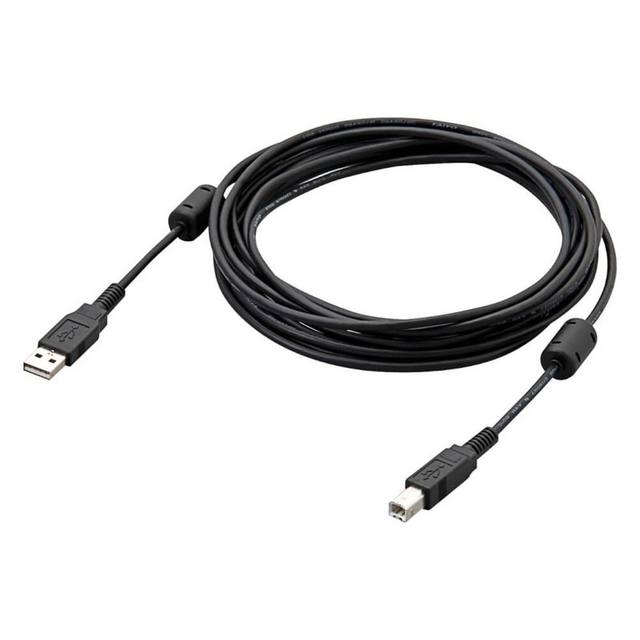
PowerScan PM9501, 433 MHz, Direct Part Marking Evo, RS-232 Kit, Removable Battery (Kit inc. Scanner, Base Station BC9030-433, Cable CAB-433, Power Brick 8-0935 and Power Cord 6003-0940.)
RS-232 kit
On request
PowerScan PM9501, 433 MHz, Direct Part Marking Evo, USB Kit, Removable Battery (Kit inc. Scanner, Base Station BC9030-433, Cable CAB-438, Power Brick 8-0935 and Power Cord 6003-0940.)
USB kit
On request
PowerScan PM9501, 910 MHz, Direct Part Marking Evo, 4-Key Display, Removable Battery
—
On request
PowerScan PM9501, 910 MHz, Direct Part Marking Evo, Ethernet Kit, Removable Battery (Kit inc. Scanner, Base Station BC9180-910, Power Brick 8-0935 and Power Cord 6003-0941.)
Ethernet kit
On request
PowerScan PM9501, 910 MHz, Direct Part Marking Evo, Removable Battery
—
On request
PowerScan PM9501, 910 MHz, Direct Part Marking Evo, RS-232 Kit, Removable Battery (Kit inc. Scanner, Base Station BC9030-910, Cable CAB-433, Power Brick 8-0935 and Power Cord 6003-0941.)
RS-232 kit
On request
PowerScan PM9501, 910 MHz, Direct Part Marking Evo, USB Kit, Removable Battery (Kit inc. Scanner, Base Station BC9030-910, Cable CAB-438, Power Brick 8-0935 and Power Cord 6003-0941.)
USB kit
On request
Applications this product is commonly selected for. Open one to see the full recommended hardware and approach.
1. Install the IMPACT Software Suite and connect the camera
Install the IMPACT Software Suite on your PC, which provides both the configuration/viewer tools and the SDK. For a GigE Vision model (E100, M or U series), connect it to a dedicated NIC and, for USB3 models, use a certified USB3 cable and port. Power the camera and confirm it enumerates.
2. Bring the camera online and verify the link
For GigE Vision, put the camera and the host NIC on the same subnet (a static IP on the camera matching the NIC range is the most reliable starting point); for USB3, confirm the device is recognized. Open the IMPACT viewer/device tool, discover the camera, and verify a stable connection before streaming. Enabling jumbo frames on the NIC helps GigE throughput.
3. Set exposure, gain and trigger, then grab a first image
In the IMPACT tools, start a live stream and adjust exposure and gain until the image is well-lit without saturation; set white balance on color models. Begin in free-run (continuous) mode to confirm imaging, then switch to hardware or software trigger as your application requires. Capture and save a reference image once the scene looks correct.
4. Build a vision tool or move to the SDK/API
Use the IMPACT point-and-click vision tools to assemble an inspection, or use the IMPACT SDK to access the camera and results programmatically and feed them into your HMI/PLC application. As these are GenICam/GenTL-compliant devices, you can alternatively drive them from any GenICam-compliant third-party vision library if your pipeline standardizes on one.
5. Route the stable feed to deep-learning inspection (optional)
Once you have a stable, repeatable image, the feed can be sent to a deep-learning inspection platform such as Rosepetal for defect detection or classification tasks that go beyond rule-based tooling. Keep lighting, optics and trigger timing fixed so the images reaching the model stay consistent.
Frequently asked questions
Keyboard Wedge, RS-232, RS-485 and USB, with Ethernet optional or built into the BC9180 base.
The PM9501-DDPM weighs 440 g against 400 g for the PM9501-DPM, 40 g more, for a backlit graphic display and 4 configurable keys.