
- Rosepetal compatible
- Recommended by AIS Vision
On request
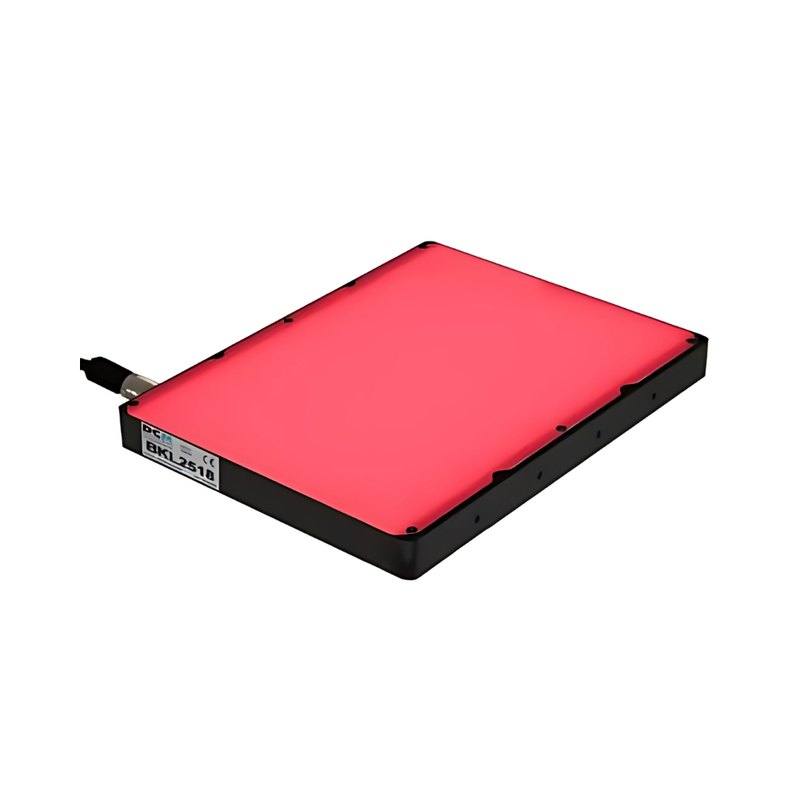
BKL2518A
The BKL2518A is part of DCM Sistemes' BKL area-backlight series, providing a uniform diffuse 180x250 mm emitting surface in a 198x255x22 mm black anodized aluminium housing (1125 g). It runs on 24 VDC (+/-3%) through a 2-pin male chassis connector and is offered in Blue 470 nm, Green 525 nm, Red 630 nm, IR 850 nm, White (W00) and RGB. It supports continuous (Type C) and strobed (Type S) operation, with continuous consumption around 19-28 W depending on colour and much higher peak current in strobe mode driven by a DCM strobe controller. It is rated IP40 (optional IP65 modifier) and operates from 0 to 40 C.
The DCM Sistemes BKL2518A is a posterior-diffuse LED area backlight built to do one job extremely well: produce a uniform, high-contrast silhouette of a part placed in front of it. Its active emitting surface measures 180 x 250 mm, which sets a hard ceiling on the part footprint you can backlight in a single field of view. Because the emission is diffuse rather than directional, light leaves the panel across a wide cone, filling the lens aperture evenly from edge to edge. That uniformity is what makes backlighting the go-to geometry for dimensional and edge work: the part blocks light to create a near-black outline against a bright, saturated field, so edge-detection and blob algorithms see a clean, high-gradient transition that is largely immune to surface texture, colour or print on the part itself. The panel sits in a 198 x 255 x 22 mm black anodized aluminium housing weighing 1125 g, and at only 22 mm thick it is shallow enough to tuck under a conveyor, a glass plate or a part-presentation nest without consuming much vertical envelope.
| Brand | DCM Sistemes |
|---|---|
| Lighting type | Backlight (posterior diffuse area) |
| Connection | chassis_2p (2-pin male chassis connector; PIN1 +24V +/-3%, PIN2 0V) |
|---|
| Color / wavelength | Red 630 nm (representative; also blue/green/IR/white/RGB) |
|---|---|
| Available wavelengths | Blue 470 nm, Green 525 nm, Red 630 nm, IR 850 nm, White W00, RGB |
| Diffuser | Yes (posterior diffuse emitting surface) |
| Emission angle | Diffuse |
| Mode | Continuous (Type C) and strobe (Type S) |
|---|---|
| Controller required | No for continuous (24 VDC direct); strobe mode requires DCM VS-series strobe controller |
| Supply voltage | 24 VDC +/-3% |
| Power consumption | 19-28 W continuous (Type C, by colour); peak strobe up to ~317 W |
| IP rating | IP40 (optional IP65 modifier) |
|---|---|
| Operating temperature | 0 to 40 C (storage 0 to 60 C) |
| Illuminated area | Active surface 180 x 250 mm |
|---|
| Housing material | Black anodized aluminium |
|---|---|
| Dimensions | 198 x 255 x 22 mm |
| Weight | 1125 g |
A practical guide to choosing machine vision lighting: geometry, wavelength, strobe vs continuous, ambient control and how to maximise feature contrast for reliable inspection.
A practical guide to machine vision lighting geometries — ring, bar, backlight, coaxial, dome and dark field — explaining what each reveals, the surfaces it suits, and how to choose the right one directly from your inspection problem.
A practical guide to continuous, strobed, and overdrive LED lighting in machine vision: why a short pulse freezes motion, why overdrive (not strobing alone) adds brightness, how to synchronize the pulse to camera exposure, the duty-cycle limits that protect LED life, and how to size and select a lighting controller.
Rosepetal · AI
Validate your visual inspection with AI: send us sample images and we evaluate the case on your hardware.
AIS Vision · Integration
AIS Vision defines and tests the optimal combination of camera, optics and lighting for your application before you buy.