
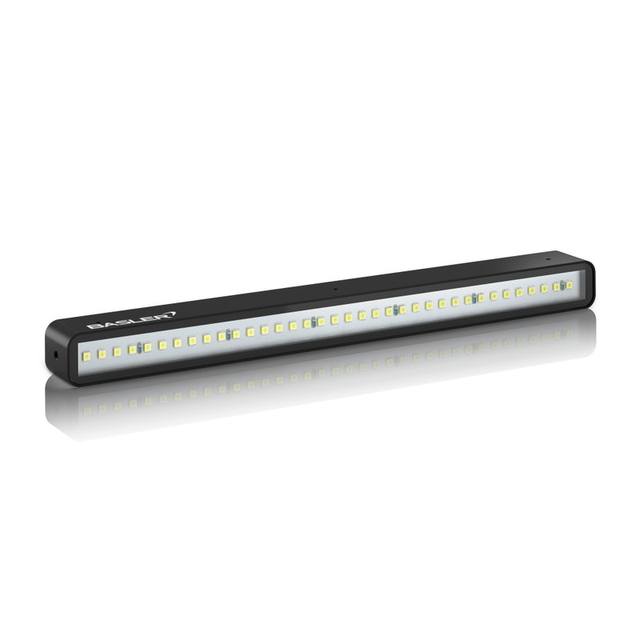
- Rosepetal compatible
- Recommended by AIS Vision
On request
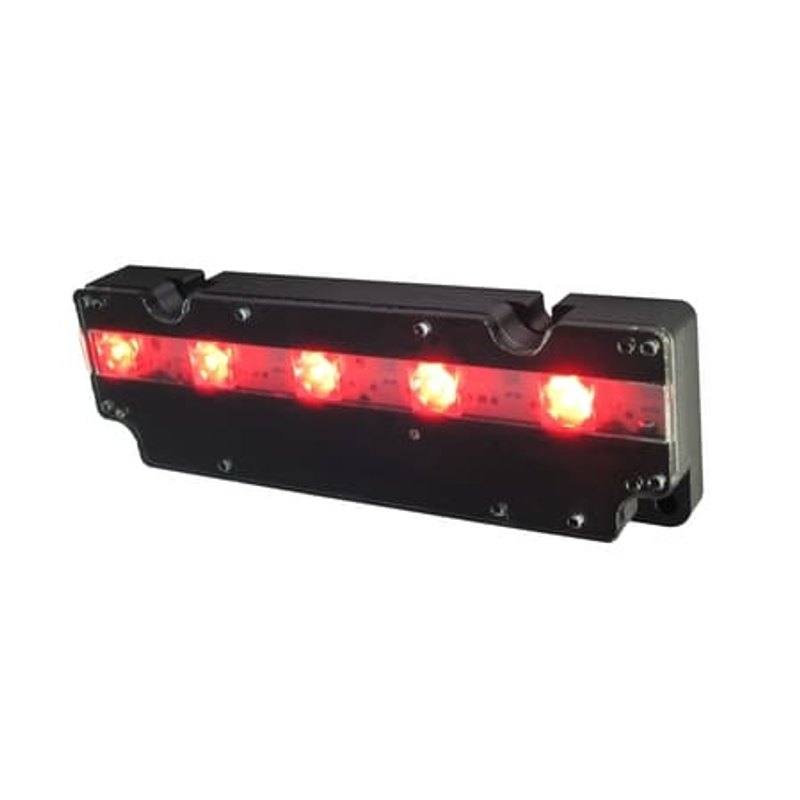
PLA0513A
The PLA0513A is a 130x40x16 mm directional bar projector from the DCM PLA "high power linear lights projectors" family, with a 130x10 mm active emitting surface and a recommended working distance greater than 50 mm. It runs from 24 VDC +/-8 with a maximum instantaneous consumption of about 230 mA (roughly 5-5.5 W) and connects via a 3-pin aerial connector on a 150 mm cable; this Continuous-type ("C") model needs no external driver and offers an optional PNP control input (/P modifier). It is offered in 365 nm and 400 nm UV, 470 nm blue, 525 nm green, 630 nm red, 850 nm IR and W00 white, each with Narrow 18 degrees, Medium 21 degrees, Wide 40 degrees or Diffuse emission optics. The anodized-aluminium housing is rated IP40 and specified for 0-40 C operation, with these high-intensity directional beams highlighting textures, reliefs and surface defects.
The PLA0513A is a directional bar light from DCM Sistemes' PLA "high power linear lights projectors" family: a compact 130 x 40 x 16 mm anodized-aluminium housing with a 130 x 10 mm active emitting surface. Its defining trait is the selectable beam optics, Narrow 18 degrees, Medium 21 degrees, Wide 40 degrees or Diffuse, which let you tune how concentrated the light is at the part. A narrow 18- or 21-degree beam concentrates flux into a tight stripe for grazing, low-angle illumination that throws long shadows across the surface and pops textures, reliefs, scratches, dents and embossing into high contrast; the 40-degree Wide and the Diffuse variants spread the light to cover a broader band more evenly. The light is offered across a wide wavelength range, UV at 365 and 400 nm, blue 470 nm, green 525 nm, red 630 nm, IR 850 nm and a W00 white (with 455/730/940 nm available on request), so you can match the emission to your task and sensor: monochromatic light for highest contrast and filterability, white for color work, and IR or UV for materials that respond outside the visible band.
| Brand | DCM Sistemes |
|---|---|
| Lighting type | Bar / linear light projector (direct) |
| Connection | 3-pin aerial connector, cable length 150 mm |
|---|
| Color / wavelength | Available in UV 365/400 nm, blue 470 nm, green 525 nm, red 630 nm, IR 850 nm, white (W00) |
|---|---|
| Available wavelengths | 365 nm (UV), 400 nm (UV), 470 nm (blue), 525 nm (green), 630 nm (red), 850 nm (IR), W00 (white); also 455/730/940 nm on request |
| Working distance | Recommended working distance >50 mm |
| Emission angle | Selectable: Narrow 18°, Medium 21°, Wide 40° or Diffuse emission |
| Mode | Continuous (type C); optional PNP control input (/P) |
|---|---|
| Controller required | No external driver required (powered directly from 24 VDC; VCC-series cable, not included) |
| Power consumption | ~5.5 W (max. instantaneous consumption ~230 mA @ 24 VDC; ~5 W for 850 nm IR) |
| Supply voltage | 24 VDC ±8% |
| IP rating | IP40 |
|---|---|
| Operating temperature | Operating temperature 0–40 °C |
| Illuminated area | Active surface 130 x 10 mm |
|---|
| Housing material | Anodized aluminium |
|---|---|
| Dimensions | External dimensions 130 x 40 x 16 mm |
A practical guide to choosing machine vision lighting: geometry, wavelength, strobe vs continuous, ambient control and how to maximise feature contrast for reliable inspection.
A practical guide to machine vision lighting geometries — ring, bar, backlight, coaxial, dome and dark field — explaining what each reveals, the surfaces it suits, and how to choose the right one directly from your inspection problem.
A practical engineering guide to choosing LED wavelength in machine vision lighting. Learn how monochromatic red, blue, green, IR and UV light change contrast, how to exploit complementary colors, and how to match wavelength to your camera, lens and optical filters.
Rosepetal · AI
Validate your visual inspection with AI: send us sample images and we evaluate the case on your hardware.
AIS Vision · Integration
AIS Vision defines and tests the optimal combination of camera, optics and lighting for your application before you buy.