Skip to content
DCM Sistemes PLC0307A machine vision lighting
  • Rosepetal compatible
  • Recommended by AIS Vision

DCM Sistemes PLC0307A Compact Linear Bar Light

PLC0307A

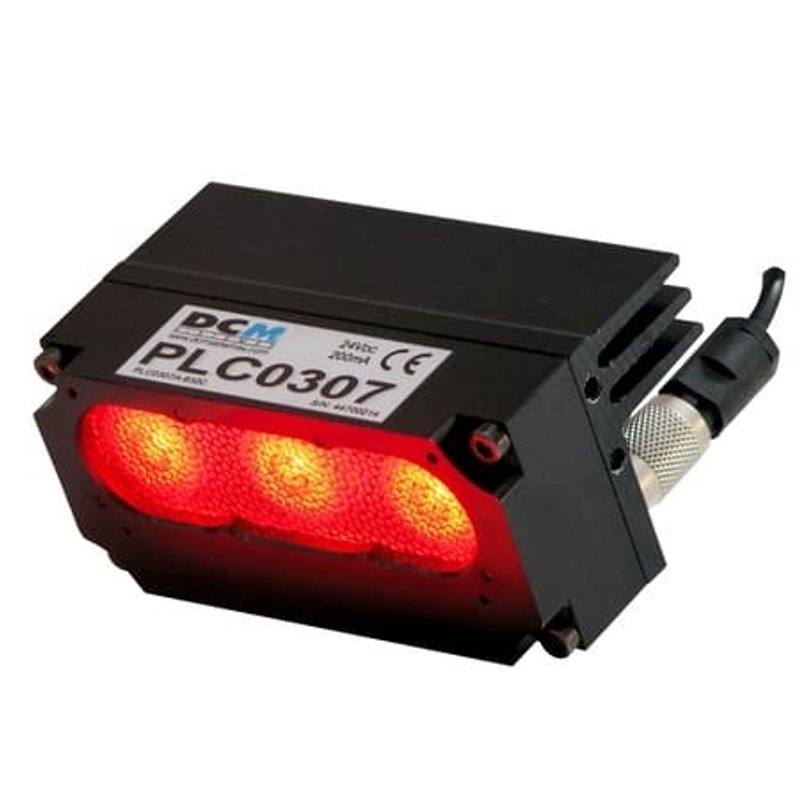
The DCM Sistemes PLC0307A is a compact linear light projector from the PLC "Compact linear lights projectors" series, measuring 87 x 40 x 48 mm with 3 LEDs and a recommended working distance greater than 50 mm. It operates in continuous mode (Type C, no controller required) on 24VDC ±8% with a maximum consumption of 5 W, drawing power through a 3-pin male chassis (aerial) connector. The anodized-aluminium housing carries an IP40 rating and weighs 220 g. The light is available in multiple monochromatic wavelengths (365 nm UV, 400 nm, 470 nm blue, 525 nm green, 630 nm red, 850 nm IR) plus white, and in narrow, medium (default), wide and diffuse emission-angle variants.

Brand
DCM Sistemes
Lighting type
Bar / linear light projector
Color / wavelength
Red 630 nm (default; also UV 365, 400, blue 470, green 525, IR 850, white)
Available wavelengths
365 nm UV, 400 nm, 470 nm blue, 525 nm green, 630 nm red, 850 nm IR, W00 white
Mode
Continuous (Type C, no controller required)
Working distance
RWD >50 mm
Controller required
No (continuous Type C)
Diffuser
Optional diffuser filter (VDF accessory / /FDR modifier)
IP rating
IP40
Emission angle
Medium (default); narrow /AN, wide /AW, diffuse /AD options
Driver technology
Continuous DC drive (Type C, no iBlueDrive)
Power consumption
5 W max

Technical overview

The PLC0307A is a compact 3-LED linear bar light from DCM Sistemes' PLC "Compact linear lights projectors" series, built to throw high directional illumination across a strip of the scene rather than flood it evenly. At 87 x 40 x 48 mm and 220 g in an anodized-aluminium housing, it is a small, rigid projector whose recommended working distance is greater than 50 mm (an open-ended minimum, so it is suited to longer standoffs as well as larger areas). The bar geometry concentrates light along a line, which is what makes it well suited to directional setups where you want to rake light across a surface to lift relief, scratches and embossing. Because the emission is a directional projector beam rather than a wide diffuse panel, aiming and standoff matter; DCM offers narrow (/AN), medium (default), wide (/AW) and diffuse (/AD) emission-angle variants so you can match the beam spread to your field of view, and an optional diffuser filter (VDF accessory / /FDR modifier) to soften the output when specular glare on shiny parts becomes a problem.

Electrically this is a 'Type C' continuous light: it runs straight off 24 VDC (±8%) at up to 5 W with no controller or strobe driver required, drawing power through a 3-pin male chassis (aerial) connector wired PIN1 +24 V, PIN2 0 V, PIN3 control. That simplicity is the design trade. You get a fixture you can power from the same 24 V rail as the rest of the cell and switch on continuously, with no iBlueDrive or external controller to specify, wire or program. In exchange you forgo overdriven strobing, so for fast-moving lines you control motion blur with the camera's exposure and trigger rather than with a pulsed flash. For steady or slow-indexing inspection, continuous DC drive keeps integration trivial and avoids any controller as a failure point or cost line.

The light is monochromatic and offered in a wide spread of wavelengths from a single mechanical platform: 365 nm UV, 400 nm, 470 nm blue, 525 nm green, 630 nm red (the default), 850 nm IR, plus a W00 white option. Choosing the wavelength is the main optical decision, because each colour reveals different things — red/IR for penetration and contrast on many plastics and for suppressing ambient, blue/green for fine surface detail and crisper edges, UV for fluorescence and certain coating or adhesive checks. Pairing a monochromatic source with a matching bandpass filter on the lens lets you reject ambient room light and stabilise contrast, which is the typical reason to pick a single-colour bar over white. Environmentally the unit is rated IP40, so it is protected against solid objects but not against water or washdown, and it operates from 0 to 40 C (storage 0 to 60 C); plan it into a dry, enclosed cell rather than a wet or outdoor station.

Best for

  • Grazing / directional surface inspection where a raking line of light is needed to bring out scratches, dents, embossing or print relief, with the part positioned at the recommended working distance of greater than 50 mm
  • Defect and surface-finish checks on electronics, metal and automotive components where a single monochromatic wavelength (e.g. 630 nm red or 470 nm blue) plus a matching lens filter stabilises contrast against ambient light
  • Reading printed or marked codes and text (OCR/OCV and 1D/2D code traceability) on packaging and printed media, using the bar to light a strip of the web or label
  • Dimensional / edge measurement tasks that benefit from crisp, directional edge contrast on a defined inspection line
  • Simple cells that need a controller-free 24 VDC light: continuous Type C operation lets it run from the existing 24 V rail with no strobe driver to specify or wire

Selection notes

  • Pick the wavelength deliberately: the default is 630 nm red, but the same fixture ships in 365 nm UV, 400 nm, 470 nm blue, 525 nm green, 850 nm IR and W00 white — the colour choice (and a matching bandpass filter) drives contrast and ambient rejection more than anything else, and it is fixed at order time.
  • Match the emission angle to your field of view and standoff. Default is medium; specify /AN narrow for tighter, farther throws, /AW wide for broader coverage, or /AD diffuse to soften the beam. Hold the recommended working distance of greater than 50 mm — it is a directional projector, so standoff and aim affect the result.
  • This is a continuous Type C light with no strobing. For high-speed or fast-indexing lines, control motion blur through camera exposure and triggering rather than expecting an overdriven flash; if you need pulsed/strobed output you would need a different (controller-driven) light.
  • Verify the environment against IP40 and the 0-40 C operating range. It is not sealed for washdown, humidity or outdoor use, and it has no high-temperature headroom — keep it in a dry, climate-controlled enclosure.
  • Plan the electrical interface: 24 VDC ±8%, 5 W max, through a 3-pin male chassis (aerial) connector (PIN1 +24 V, PIN2 0 V, PIN3 control). Confirm your 24 V supply tolerance and source the mating cable for that 3-pin aerial connector.

Specifications: General
BrandDCM Sistemes
Lighting typeBar / linear light projector

Specifications: Interface
Connection3-pin male chassis connector (PIN1 +24V, PIN2 0V, PIN3 control)

Specifications: Optical
Color / wavelengthRed 630 nm (default; also UV 365, 400, blue 470, green 525, IR 850, white)
Available wavelengths365 nm UV, 400 nm, 470 nm blue, 525 nm green, 630 nm red, 850 nm IR, W00 white
Working distanceRWD >50 mm
DiffuserOptional diffuser filter (VDF accessory / /FDR modifier)
Emission angleMedium (default); narrow /AN, wide /AW, diffuse /AD options

Specifications: Electrical
ModeContinuous (Type C, no controller required)
Controller requiredNo (continuous Type C)
Driver technologyContinuous DC drive (Type C, no iBlueDrive)
Power consumption5 W max
Supply voltage24VDC ±8%

Specifications: Environment
IP ratingIP40
Operating temperature0 to 40 C (storage 0 to 60 C)

Specifications: Mechanical
Housing materialAnodized aluminium
Dimensions87 x 40 x 48 mm (L x W x H)
Weight220 g

Frequently asked questions

Related technical guides

Rosepetal · AI

Test this camera with Rosepetal

Validate your visual inspection with AI: send us sample images and we evaluate the case on your hardware.

AIS Vision · Integration

We validate camera + lens + lighting

AIS Vision defines and tests the optimal combination of camera, optics and lighting for your application before you buy.