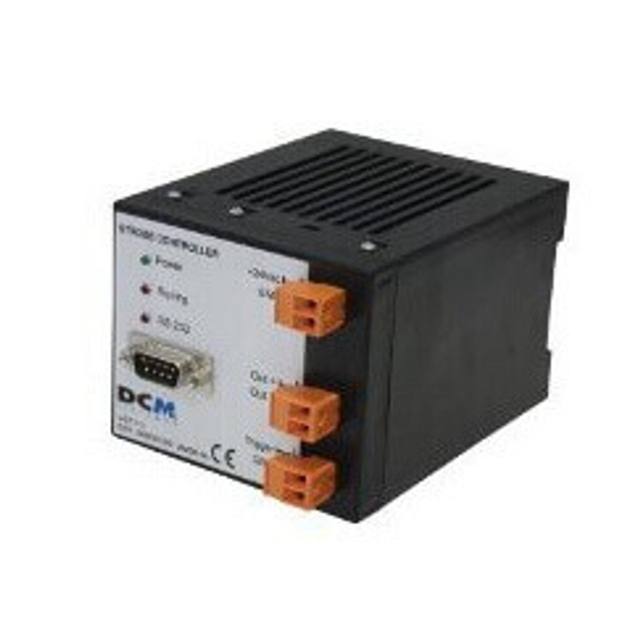
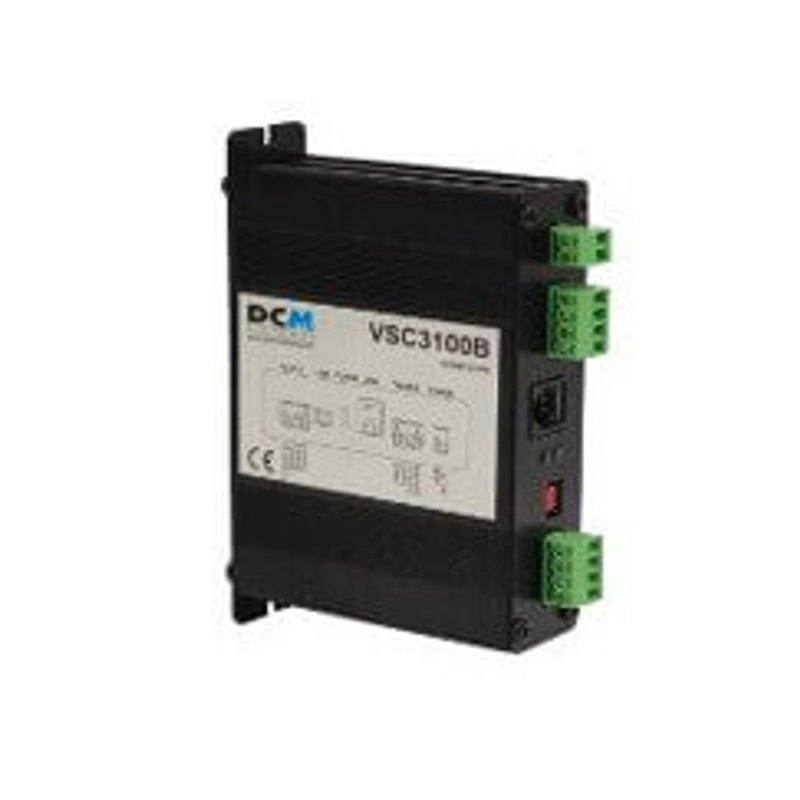
The DCM Sistemes VSC3100B is an advanced RGB strobe lighting controller with 3 outputs of 6A each (up to 18A when channels are combined), powered from +24VDC +/-3%. Each output offers 255 independent current levels, with configurable pulse width from 24us to 2ms (1us steps) and pulse delay from 30us to 13.1ms, reaching a maximum trigger rate of 1000 pulses/s at full power. It has an opto-isolated trigger input with selectable edge and a camera trigger output, 16 memory banks for preset currents, thermal protection, and is programmed over USB (VCP100 cable, with RS232/RS485/Ethernet adapters); it measures 109x86x30mm and is scalable up to 24 outputs.
Brand
DCM Sistemes
Mode
Strobe (stroboscopic) drive mode, per-shot current regulation
Color / wavelength
RGB (drives RGB / mixed colour lighting via 3 channels)
Controller required
This is the controller itself (drives external strobe/RGB lighting)
The DCM Sistemes VSC3100B is a dedicated strobe lighting controller, not a light itself. Its job is to drive external DCM Sistemes machine-vision illumination through three independent 6A outputs, which can be combined to deliver up to 18A on a single load. Because it is built around three channels and targets RGB and mixed-colour lighting, you can drive each channel at its own current level to balance a tri-colour light, run a mixed-colour source, or simply power three separate monochrome lights from one box. Each output is regulated to one of 255 discrete current levels, so the controller is effectively setting precise brightness per channel rather than just switching power on and off. The whole unit runs from a single +24 VDC supply held to a tight +/-3 percent, and in a compact 109 x 86 x 30 mm enclosure, which makes it straightforward to mount inside a control cabinet alongside the camera and PLC wiring.
The defining feature for an inspection engineer is per-shot current regulation in strobe mode. Rather than running the lights continuously, the VSC3100B pulses them in sync with the camera so the LEDs can be driven hard for a very short window. Pulse width is configurable from 24 microseconds up to 2 milliseconds in 1 microsecond steps, and a separate pulse delay from 30 microseconds to 13.1 milliseconds lets you slide the flash precisely against the camera exposure or a sensor trigger. At full power the controller will accept trigger rates up to 1000 pulses per second, which is what allows it to freeze motion on a fast line without motion blur and without overheating the lights. Triggering comes in on an opto-isolated input with a selectable active edge, so the controller is electrically decoupled from the triggering source, and a dedicated camera trigger output lets the controller orchestrate the camera-to-light timing rather than the other way around.
Configuration and recall are handled in software and memory rather than with trimpots. Sixteen memory banks store preset current sets, so a multi-product line or a multi-colour inspection recipe can switch lighting conditions between parts by recalling a stored bank. Programming is done over USB using the VCP100 cable, with RS232, RS485 and Ethernet adapters available if the controller needs to sit on an existing fieldbus or be addressed remotely. Thermal protection guards the outputs when the lights are pushed hard, and the architecture is scalable up to 24 outputs, so a single-station three-channel setup can grow into a multi-light, multi-angle inspection cell without changing platforms. In short, this is the timing-and-power brain you place between a triggered camera and one or more colour or mixed-colour lights when you need repeatable, precisely-timed, high-current strobe illumination.
Best for
Freezing motion on fast packaging lines by strobing the light in sync with the camera, using sub-millisecond pulses up to 1000 pulses per second to capture blur-free images of moving cartons, blisters or bottles
Reading 1D/2D codes and printed text for traceability and OCR/OCV, where short high-current flashes deliver consistent illumination shot after shot for reliable decoding and verification
Surface and defect inspection in automotive and electronics, where three independently regulated channels let you tune colour and intensity to bring out scratches, dents or coating flaws
Multi-recipe inspection cells in food, beverage and pharma packaging, switching between stored lighting presets across products via the 16 memory banks without rewiring or recalibrating
Multi-light, multi-angle stations driven from one platform, combining channels for an 18A load or scaling out toward 24 outputs to feed several lights in a single coordinated inspection station
Selection notes
Confirm your lights match the outputs: each channel sources up to 6A (18A combined) at +24 VDC, so size the controller to the LED light's current draw and use channel combining only when a single light needs more than 6A
Plan the timing budget around the camera: the controller offers 24 us to 2 ms pulse width and 30 us to 13.1 ms delay, so the camera exposure must fall within the flash window and the trigger source must hold below 1000 pulses/s at full power
Decide who triggers what: wire the inspection trigger into the opto-isolated input with the correct active edge, then use the controller's camera trigger output to gate the camera, so light and exposure stay synchronised
Use the memory banks for product changeover: pre-store per-channel currents (255 levels each) in the 16 banks for each recipe rather than adjusting brightness live, which keeps inspections repeatable across parts
Pick the right programming interface and supply: it is set up over USB with the VCP100 cable, with RS232/RS485/Ethernet adapters if it must join a fieldbus, and it needs a clean +24 VDC supply held to +/-3 percent; for a simpler single-colour continuous job a basic non-strobe driver may suffice, while RGB, multi-colour or motion-freezing work is where this controller earns its place
Specifications: General
Brand
DCM Sistemes
Specifications: Performance
Resolution
255 levels per independent output
Specifications: Interface
Connection
Cable
Specifications: Optical
Color / wavelength
RGB (drives RGB / mixed colour lighting via 3 channels)
Specifications: Electrical
Mode
Strobe (stroboscopic) drive mode, per-shot current regulation
Controller required
This is the controller itself (drives external strobe/RGB lighting)
Supply voltage
+24 VDC ±3%
Specifications: Mechanical
Dimensions
109 x 86 x 30 mm
Applications this camera is commonly selected for. Open one to see the full recommended hardware and approach.
It is the controller only. It drives external DCM Sistemes strobe/RGB machine-vision lighting through its three outputs; the light heads are separate and you match them to the channels and current ratings.
It has three independent outputs of 6A each, which can be combined for up to 18A on a single load. Each output is independently regulated, and the architecture is scalable up to 24 outputs for larger multi-light cells.
It reaches up to 1000 pulses per second at full power. Pulse width is adjustable from 24 us to 2 ms in 1 us steps, and pulse delay from 30 us to 13.1 ms, so you can align the flash precisely with the camera exposure to freeze motion.
Triggering uses an opto-isolated input with a selectable active edge, which keeps it electrically isolated from the trigger source. It also provides a dedicated camera trigger output, so the controller can synchronise the camera with the light pulse.
It is programmed over USB using the VCP100 cable, with RS232, RS485 and Ethernet adapters available. It provides 16 memory banks for preset currents and 255 independent current levels per output, so you can store and recall per-channel brightness for different products.