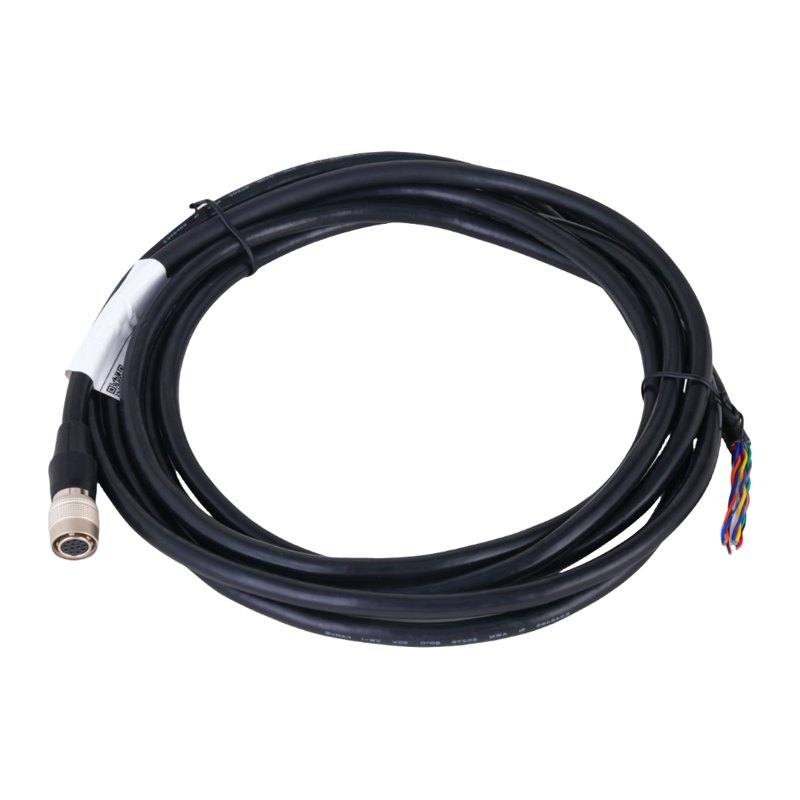
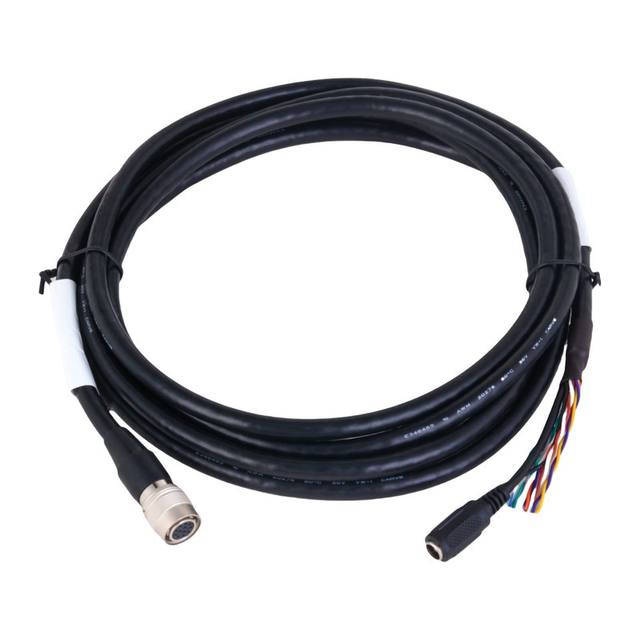
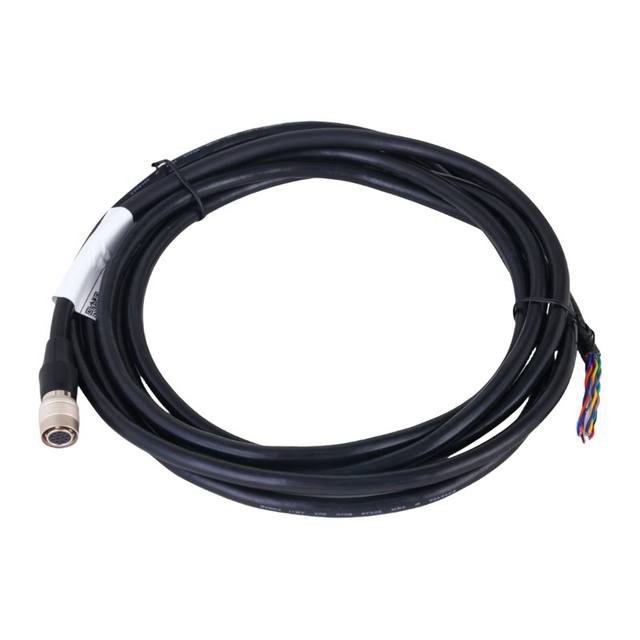
Fixed cameras with a 12-pin power and I/O connector get a choice of 3, 5, 7, 10, 15 and 20 m here, in a 7.0 mm PVC jacket with an open end. Conductors follow the distance: six 26 AWG pairs at 3, 5, 7 and 10 m, and five 26 AWG pairs plus one 24 AWG pair at 15 m and 20 m.
Count the volts before choosing a length. As an example, a 0.5 A camera current through one 24 AWG conductor (typically about 0.084 Ω/m) and back over 15 m drops 2 × 15 m × 0.084 Ω/m × 0.5 A ≈ 1.3 V; through 26 AWG (about 0.134 Ω/m) the same run would drop 2 × 15 m × 0.134 Ω/m × 0.5 A ≈ 2.0 V. That advantage exists only when the camera's supply pins sit on the heavier pair, so confirm the pin-to-conductor mapping and measure at the camera.
Best for
A camera on a fixed bracket whose supply and I/O are wired once to cabinet terminals, anywhere from 3 to 20 m away.
Long fixed runs at 15 m and 20 m, where one 24 AWG pair gives a supply a lower-resistance path than 26 AWG.
Replacing a worn static 12-pin loom that ends in open-wire terminations, where the length can be matched from six options.
Selection notes
A moving camera needs C01-IO-12PIN-FC (TPE jacket, drag-chain rated) instead.
C01/C02/C03-IO-12PIN-DC has the same lengths, conductors, jacket and bending radius, so order the part number your camera documentation names.
The 30 VDC maximum fits typical 12 V and 24 V supplies.
Specifications: General
Brand
iRAYPLE
Cable type
12Pin Power&I/O Static Cable
Compatible with
Industrial cameras with a 12-pin power & I/O connector (power the camera, I/O signal wiring)
Specifications: Interface
Connector A
12-pin, Female
Connector B
Open
Specifications: Electrical
Supply voltage
30 VDC
Specifications: Environment
Operating temperature
-20 °C to +80 °C
Specifications: Mechanical
Cable length
3–20 m (3, 5, 7, 10, 15, 20 m)
High-flex / drag chain
No — static scenes
This product groups every purchasable order code that shares the same sensing method, range and output. Cable length, connector type and operation mode (Light-ON/Dark-ON, NO/NC) vary by order code below.
Follow these steps to bring up your iRAYPLE camera, capture a first image, and move from the viewer to your own application. The flow is the same across the A, AE, AX and L series; only the physical interface differs.
Download and install the iRAYPLE machine-vision SDK together with its viewer client for your operating system. The installer provides the camera drivers, the GenTL producer, and the viewer you will use for first light. For GigE Vision models, also install or enable the bundled filter/performance driver on the network adapter to maximize throughput.
2. Connect the camera to the correct interface
Wire the camera to its matching host interface: a dedicated Gigabit (or 10 GigE) NIC for GigE Vision models, a USB3 Vision port with a quality cable for USB3 models, or a frame grabber for CoaXPress models. Power the camera (PoE, USB bus power, or PoCXP / external supply as applicable). For GigE Vision, put the NIC and camera on the same subnet and, where supported, enable jumbo frames.
3. Detect and open the camera in the viewer
Launch the iRAYPLE viewer, run device enumeration, and select your camera from the discovered list. Open it to load the device feature tree (GenICam node map). If a GigE camera is found but cannot be opened, correct the IP configuration so the camera and NIC are in the same address range.
4. Set exposure, gain and trigger, then grab a first image
Start with continuous (free-run) acquisition under stable lighting. Adjust exposure time and gain for a well-exposed, low-noise image, set the pixel format (e.g. Mono8 or a Bayer/RGB format), and tune white balance on color models. Once the live image looks correct, switch trigger mode to hardware or software trigger to synchronize capture with your process, and verify a single triggered frame.
5. Move from the viewer to the SDK or a GenICam library
With imaging confirmed, reproduce the same settings in code using the SDK's C/C++ or Python API: enumerate, open, configure the relevant GenICam features, register a frame callback or grab loop, and convert frames to your pipeline's buffer format. Since the cameras are GenICam/GenTL-compliant, you can alternatively drive them from a third-party GenICam vision library. From here a stable image stream can feed a deep-learning inspection step such as Rosepetal for automated quality control.
Frequently asked questions
The 15 m and 20 m lengths have one 24 AWG pair; 3–10 m use 26 AWG throughout.
No, static installation only. C01-IO-12PIN-FC is the drag-chain version.