
- Rosepetal compatible
- Recommended by AIS Vision
On request
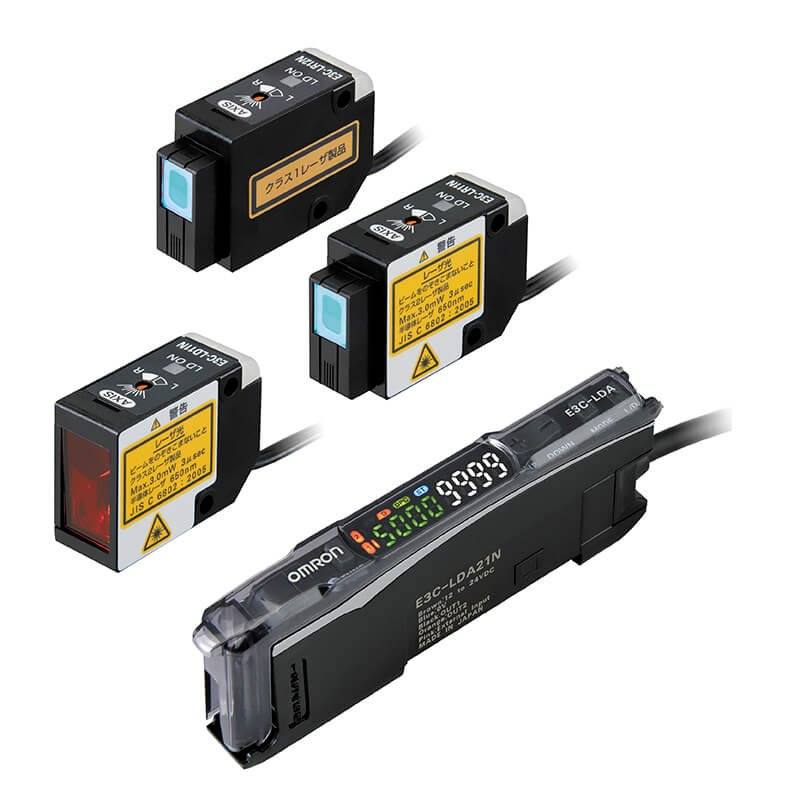
E3C-LDA_N
The Omron E3C-LDA_N is a photoelectric sensor system that pairs interchangeable laser sensor heads with a separate digital amplifier unit. Heads use a visible 650 nm semiconductor laser (3 mW max; 1 mW max for E3C-LR12N) and cover diffuse-reflective detection up to 1,000 mm (E3C-LD11N) and coaxial retro-reflective detection up to 7 m (E3C-LR11N/LR12N, with MSR function), with selectable spot, line, or area beams via add-on Beam Units. The amplifier provides switchable Super-High-Speed (80 us), High-Speed (250 us), Standard (1 ms), and Giga (4 ms) detection modes with Smart Tuning, NPN or PNP open-collector outputs (100 mA max), and a dual 7-segment display. Powered at 12-24 VDC, heads carry IP40 protection while amplifiers mount on DIN track with optical inter-unit communication for up to 16 joined units.
The Omron E3C-LDA_N is a laser-class photoelectric sensor system built around a separate-amplifier architecture: an interchangeable laser sensor head does the optics, while a separate digital amplifier handles the timing, thresholding, and output. The heads run a visible 650 nm semiconductor laser (3 mW max, 1 mW max on the E3C-LR12N), so the beam is a red spot you can see and aim by eye - a real advantage when you are positioning detection over a moving line or a small target. Two sensing principles are offered. The diffuse-reflective E3C-LD11N detects the target's own surface return out to 1,000 mm, which makes it a presence/edge trigger that needs no reflector behind the part. The coaxial retro-reflective E3C-LR11N/LR12N heads, equipped with the MSR function, reach out to 7 m, suited to long gaps, wide conveyors, or detecting shiny and specular parts that would confuse a plain retro sensor. With a minimum spot diameter of 0.8 mm (typ. ~950 um at 1,000 mm), this is a sensor you specify when the feature you are catching is small - a thin lead, a label edge, a small bottle neck - rather than a bulk object. Selectable spot, line, or area beams are available via add-on Beam Units.
| Brand | Omron / Sentech |
|---|---|
| Sensor type | Photoelectric (laser-type) with separate digital amplifier |
| Range / distance | Up to 1,000 mm diffuse (E3C-LD11N, Giga mode); up to 7 m retro-reflective (E3C-LR11N/LR12N) |
|---|---|
| Response time | 80 us (Super-High-Speed); 250 us (High-Speed); 1 ms (Standard); 4 ms (Giga) |
| Resolution | Min. beam/spot diameter 0.8 mm (at up to 1,000 mm); 950 um typical at 1,000 mm |
| Communication | Optical inter-unit communication; IO-Link variant available (E3C-LDA5_N-IL3) |
|---|---|
| Connection | Head: connector (2 m standard cable); Amplifier: pre-wired (2 m) or wire-saving connector (E3X-CN21/CN22) |
| Supply voltage | 12 to 24 VDC +/-10%, ripple (p-p) 10% max |
|---|---|
| Power consumption | 1080 W |
| Operating temperature | Head operating: -10 to 55 C; Amplifier operating: -25 to 55 C (1-2 units), down to -25 to 45 C (11-16 units) |
|---|---|
| IP rating | IP40 (IEC 60529) |
| Sensing method | Diffuse-reflective (E3C-LD11N) and coaxial retro-reflective with MSR function (E3C-LR11N/LR12N) |
|---|---|
| Light source | Visible semiconductor laser, 650 nm, 3 mW max (1 mW max for E3C-LR12N) |
| Output type | NPN or PNP open-collector (model dependent), 100 mA max |
|---|
| Housing material | Head case/cover: ABS; front filter: methacrylic resin (glass on LR11N/LR12N). Amplifier case/cover: polycarbonate (PC) |
|---|---|
| Dimensions | Amplifier body approx. 83.4 mm (L) x 32.1 mm (H) x 10 mm (W), DIN-track mount; head E3C-LD11N approx. 33 x 18.8 x 18 mm |
| Weight | Sensor head approx. 85 g (LD11N) / 100 g (LR11N/LR12N); pre-wired amplifier approx. 75 g (sensor only) |
A practical guide to selecting discrete sensors that trigger cameras, index parts and gate inspection on a vision station. Covers sensing principle, range, target, PNP/NPN/IO-Link outputs, response time and IP rating, plus wiring the trigger to the camera.
A practical guide to the core photoelectric sensing principles, through-beam, retroreflective, diffuse and background suppression, covering range, reliability, target and surface dependence, light source choice, output options and how to pick the right one for your application.
A practical guide to laser displacement and distance sensors: how triangulation, confocal and time-of-flight measure distance, height and profile, how resolution trades against range and target reflectivity, and when a dedicated measurement sensor beats a vision system.
AIS Vision · Integration
AIS Vision defines and tests the optimal combination of camera, optics and lighting for your application before you buy.