
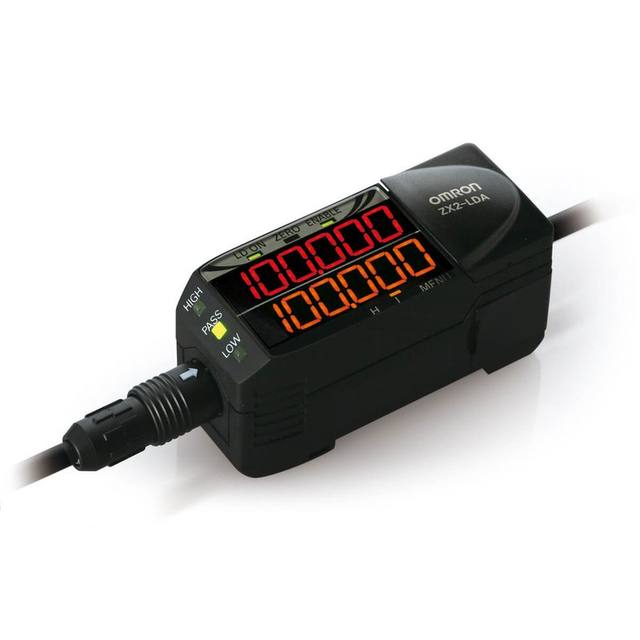
Omron / SentechOmron / Sentech ZX2-LDA11 / ZX2-LDA41 Laser Displacement Sensor Amplifier UnitsZX2-LDA11
- Recommended by AIS Vision
On request
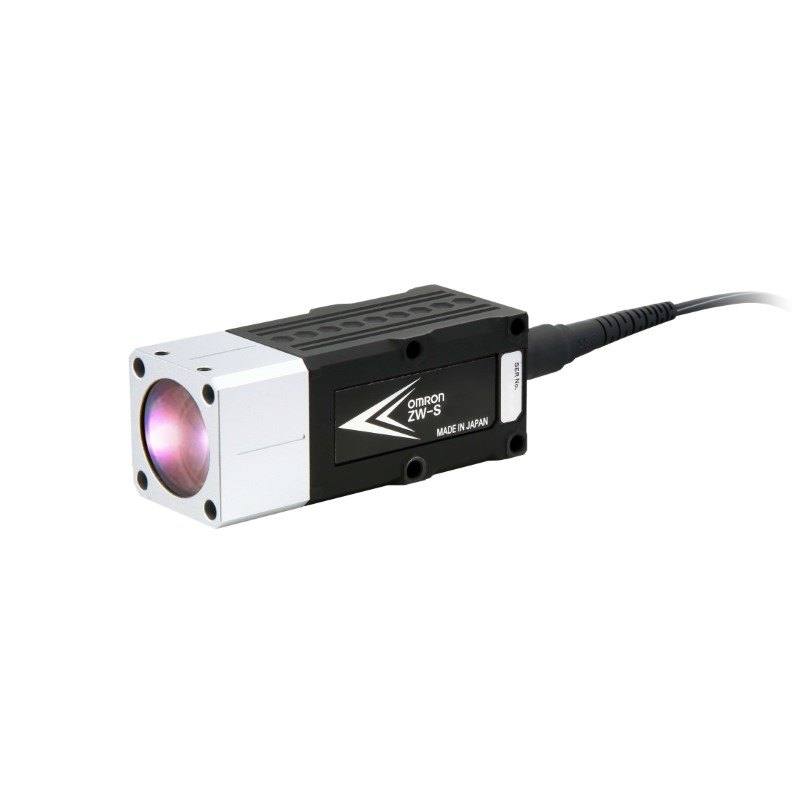
ZW-S8010
The ZW-8000 series sensor heads use the white light confocal (chromatic confocal) principle, directing broadband white light through an OCFL (Optical Chromatic Focal Lens) module that focuses each wavelength at a different focal distance; the wavelength reflected in focus encodes the displacement. Available in three form factors — square-shaped straight (ZW-S8010/20/30), pen-shaped straight (ZW-SP8007/8010), and pen-shaped right-angle (ZW-SPR8007/8010) — with measurement center distances from 7 to 30 mm, measuring ranges from ±0.3 mm to ±2 mm, and spot diameters down to 4 µm. All heads achieve 0.25 µm static resolution and linearity as tight as ±0.3 µm when paired with the ZW-8000T controller. The heads connect via fiber cable (0.3 m or 2 m) to the ZW-8000T controller, which provides EtherCAT, EtherNet/IP, Ethernet, RS-232C, analog, and parallel interfaces.
The ZW-8000 series sensor heads operate on the white light confocal (chromatic confocal) principle: broadband LED-based white light passes through an OCFL (Optical Chromatic Focal Lens) module that intentionally introduces longitudinal chromatic aberration, focusing each wavelength at a distinct depth. Only the wavelength whose focal plane coincides with the target surface returns in focus to the detector, so the reflected wavelength directly encodes the displacement. This physics-based encoding is inherently insensitive to target reflectance variation, enabling reliable measurement on surfaces ranging from mirror-finish metals to matte ceramics without recalibration. Static resolution reaches 0.25 µm across every model in the family — an unusually consistent figure that reflects the maturity of the chromatic confocal engine rather than sensor-to-sensor tuning.
| Brand | Omron / Sentech |
|---|---|
| Sensor type | Confocal displacement sensor |
| Resolution | 0.25 µm static resolution (all models, with ZW-8000T controller) |
|---|---|
| Linearity | ZW-S8010: ±0.3 µm; ZW-S8020: ±0.6 µm; ZW-S8030: ±1.3 µm; ZW-SP8007: ±0.3 µm; ZW-SP8010: ±0.45 µm; ZW-SPR8007: ±0.45 µm; ZW-SPR8010: ±0.7 µm |
| Range / distance | ZW-S8010: 10 mm ±0.5 mm; ZW-S8020: 20 mm ±1 mm; ZW-S8030: 30 mm ±2 mm; ZW-SP8007: 7 mm ±0.3 mm; ZW-SP8010: 10 mm ±0.7 mm; ZW-SPR8007: 7 mm ±0.3 mm; ZW-SPR8010: 10 mm ±0.7 mm |
| Response time | 60 µs to 7,500 µs (measurement cycle, with ZW-8000T) |
| Communication | EtherNet/IP, Ethernet, RS-232C, EtherCAT, analog, parallel (via ZW-8000T controller) |
|---|---|
| Connection | Fiber cable 0.3 m or 2 m (flex-resistant, 3.0 mm dia.) |
| Supply voltage | 24 VDC (21.6–26.4 VDC including ripple, ZW-8000T controller) |
|---|
| Operating temperature | Operation: 0 to 50°C; Storage: -15 to +60°C (no freezing/condensation) |
|---|---|
| IP rating | IP40 (IEC60529) |
| Sensing method | White light confocal (chromatic confocal) |
|---|---|
| Light source | White light (broadband white light, LED-based) |
| Output type | Analog voltage/current, parallel (via ZW-8000T controller) |
|---|
| Housing material | ZW-S8010/20/30: Aluminum die cast; ZW-SP8007/8010: SUS; ZW-SPR8007/8010: SUS + aluminum |
|---|---|
| Dimensions | ZW-S8010/20/30: 46.7 × 26.8 × 24.5 mm; ZW-SP8007: 42.9 × 9 × 8.5 mm body; pen-shaped 11 mm dia. |
| Weight | ZW-S80xx: ~170 g (0.3 m cable), ~180 g (2 m); ZW-SP80xx: ~27 g (0.3 m), ~37 g (2 m); ZW-SPR80xx: ~31 g (0.3 m), ~41 g (2 m) |
A practical guide to laser displacement and distance sensors: how triangulation, confocal and time-of-flight measure distance, height and profile, how resolution trades against range and target reflectivity, and when a dedicated measurement sensor beats a vision system.
A practical guide to selecting discrete sensors that trigger cameras, index parts and gate inspection on a vision station. Covers sensing principle, range, target, PNP/NPN/IO-Link outputs, response time and IP rating, plus wiring the trigger to the camera.
A field checklist to de-risk a machine vision project before you buy hardware: define defects and tolerances, collect representative samples, prove the imaging, budget resolution and field of view, lock motion and triggers, then run a structured proof of concept against measurable acceptance criteria.
Rosepetal · AI
Validate your visual inspection with AI: send us sample images and we evaluate the case on your hardware.
AIS Vision · Integration
AIS Vision defines and tests the optimal combination of camera, optics and lighting for your application before you buy.