
- Recommended by AIS Vision
On request
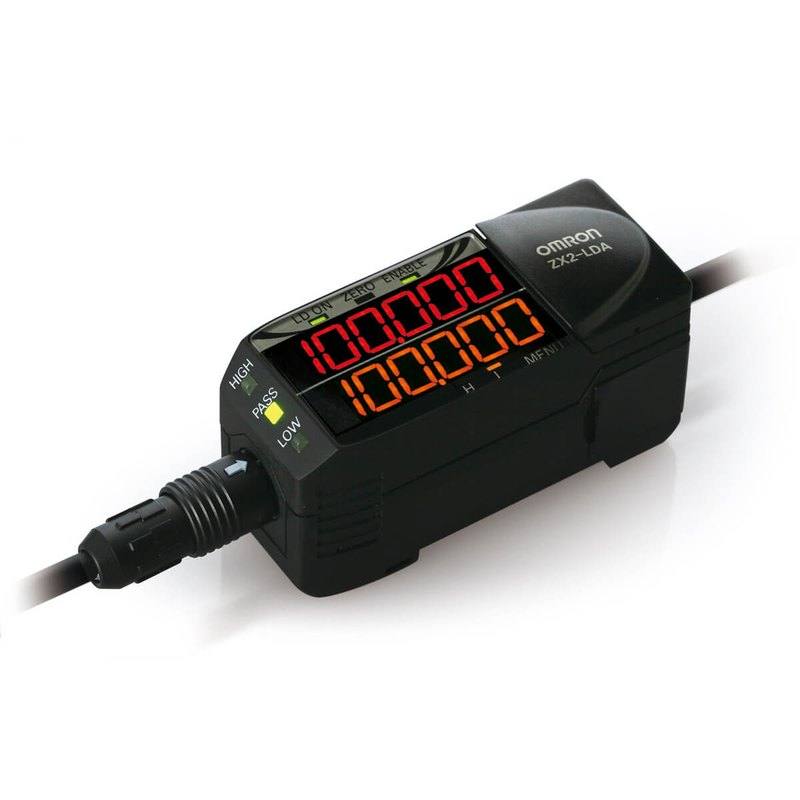
ZX2-LDA11
The ZX2-LDA11 and ZX2-LDA41 are DIN-rail-mounted amplifier units for the Omron ZX2 series CMOS laser displacement sensor system, differing only in transistor polarity (NPN vs PNP). They accept input from ZX2-LD sensor heads (ZX2-LD50, LD50L, LD100, LD100L, LD50V) and provide analog output switchable between 4–20 mA current or ±5 V / 1–5 V voltage, plus three open-collector judgment outputs (HIGH/PASS/LOW). The minimum measurement period is 30 µs with 15 selectable response times from 60 µs to 500 ms, and an 11-segment display allows on-unit configuration. Advanced functions include smart tuning, peak/bottom hold, zero reset, mutual interference prevention for up to five units, and a 4-bank switching function.
The ZX2-LDA11 (NPN) and ZX2-LDA41 (PNP) are DIN-rail-mounted amplifier units at the heart of Omron's ZX2 modular laser displacement system. They accept input from any ZX2-LD series sensor head — the LD50, LD50L, LD100, LD100L, or LD50V — and translate raw CMOS triangulation data into industrially actionable signals. The core measurement engine achieves a minimum measurement period of 30 µs and exposes 15 selectable response-time steps spanning 60 µs to 500 ms (60 µs, 120 µs, 240 µs, 500 µs, 1 ms, 2 ms, 4 ms, 8 ms, 12 ms, 20 ms, 36 ms, 66 ms, 128 ms, 250 ms, 500 ms). This wide range is deliberately chosen: steps in the 60–240 µs band suit high-speed part detection on fast-moving conveyor lines, while steps in the 8–66 ms band provide heavier averaging that improves stability on vibrating fixtures or rough surfaces. Installers can select the fastest step whose noise floor still meets their tolerance budget — the 11-segment front-panel display and smart tuning function make this on-unit, tool-free calibration straightforward.
| Brand | Omron / Sentech |
|---|---|
| Sensor type | Laser displacement (CMOS type) |
| Response time | 60 µs to 500 ms (15 selectable steps: 60 µs, 120 µs, 240 µs, 500 µs, 1 ms, 2 ms, 4 ms, 8 ms, 12 ms, 20 ms, 36 ms, 66 ms, 128 ms, 250 ms, 500 ms) |
|---|
| Connection | Prewired; standard cable length 2 m; vinyl insulated round cable, 5.2 mm dia., 11 conductors |
|---|---|
| Communication | Digital I/O (laser OFF, zero reset, timing, reset, bank inputs) |
| Supply voltage | 10 to 30 VDC, including 10% ripple (p-p) |
|---|---|
| Power consumption | 3000 W |
| Operating temperature | Operating: 0 to +50°C; Storage: –15 to +70°C |
|---|---|
| IP rating | IP40 (IEC60529) |
| Sensing method | Laser triangulation (CMOS) |
|---|---|
| Light source | Red semiconductor laser (Class 2) |
| Output type | NPN open-collector (ZX2-LDA11) / PNP open-collector (ZX2-LDA41); analog: 4–20 mA or ±5 VDC / 1–5 VDC |
|---|
| Housing material | Case: PBT (polybutylene terephthalate); Cover: Polycarbonate; Buttons: Polyacetal; Cable: PVC |
|---|---|
| Dimensions | 72 mm (W) × 47.6 mm (H) × 36.8 mm (D); cover open: 84.6 mm wide |
| Weight | Approx. 200 g (packed); main unit only approx. 135 g |
A practical guide to selecting discrete sensors that trigger cameras, index parts and gate inspection on a vision station. Covers sensing principle, range, target, PNP/NPN/IO-Link outputs, response time and IP rating, plus wiring the trigger to the camera.
A practical guide to laser displacement and distance sensors: how triangulation, confocal and time-of-flight measure distance, height and profile, how resolution trades against range and target reflectivity, and when a dedicated measurement sensor beats a vision system.
A practical guide to the core photoelectric sensing principles, through-beam, retroreflective, diffuse and background suppression, covering range, reliability, target and surface dependence, light source choice, output options and how to pick the right one for your application.
AIS Vision · Integration
AIS Vision defines and tests the optimal combination of camera, optics and lighting for your application before you buy.