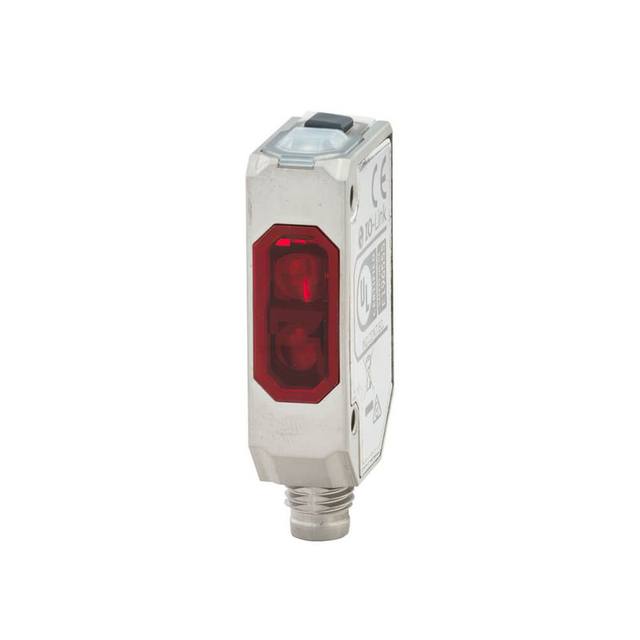
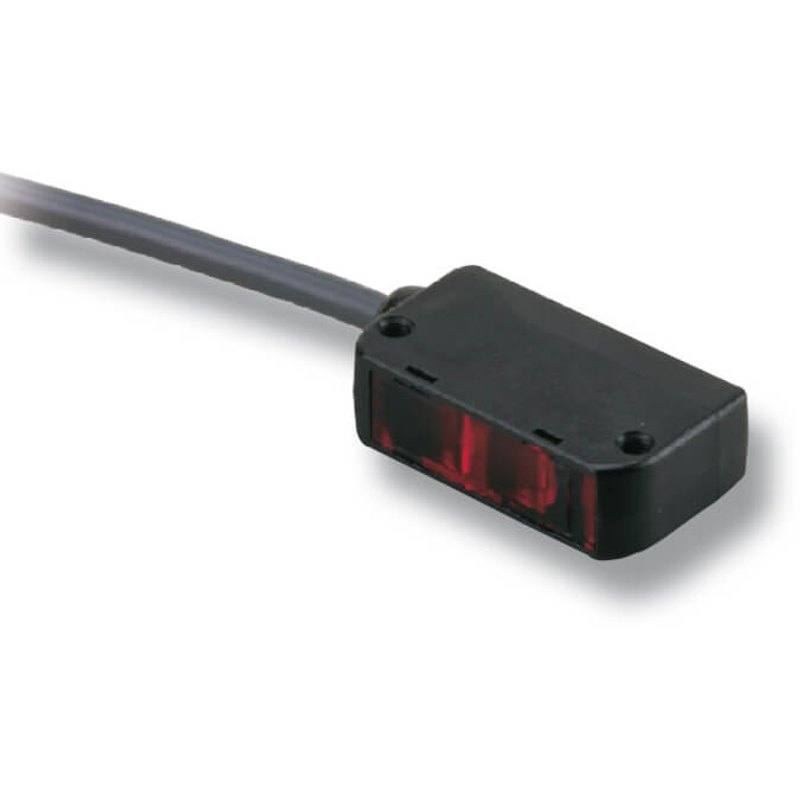
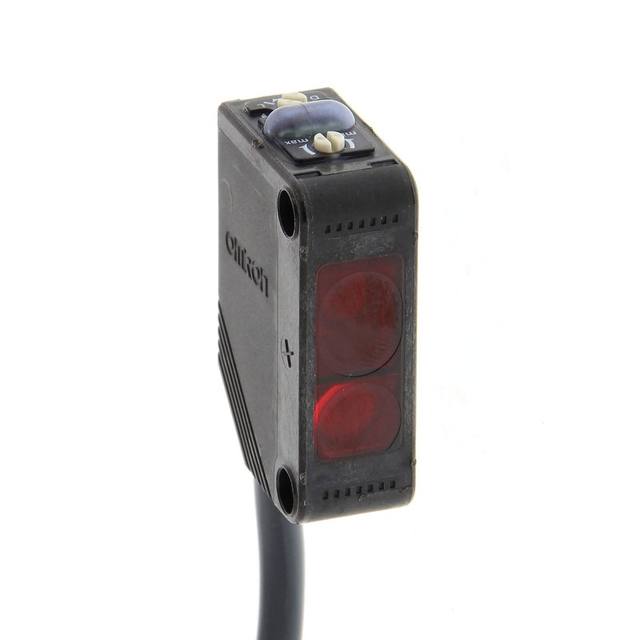
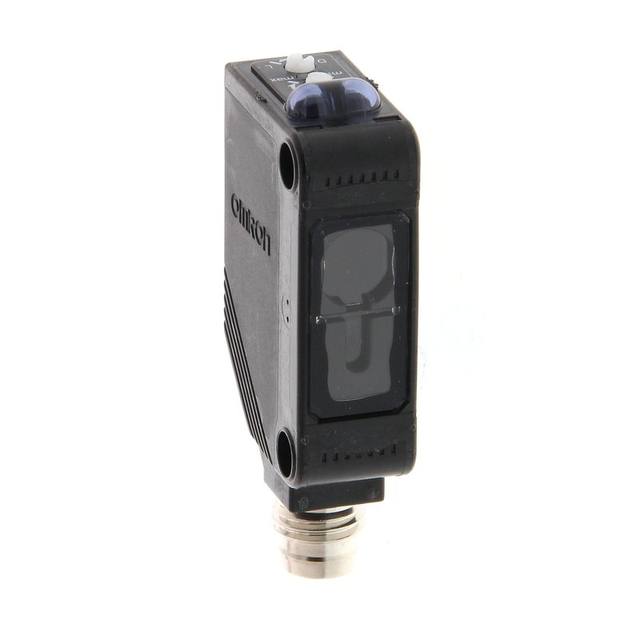
The Omron E3S-LS3 is a limited-reflective (diffuse) photoelectric sensor with a red LED (660 nm) light source and special wide-beam optics for stable detection of structured PCBs and component boards without being affected by holes or notches. Standard models (E3S-LS3@) sense at 20 to 35 mm while wide-range models (E3S-LS3@W) sense at 10 to 60 mm, both with a 1 ms max response time. It is available with NPN (E3S-LS3N) or PNP (E3S-LS3P) Light-ON outputs, optional 0.1-1.0 s timer function on T-models, runs on 12 to 24 VDC, and is housed in an ABS case rated IP40 with an acrylic lens. Connection is by pre-wired 2 m cable or pre-wired M8 connector (0.3 m).
Brand
Omron / Sentech
Sensor type
Photoelectric sensor
Sensing method
Limited reflective (diffuse-type)
Light source
Red LED (660 nm)
Range / distance
20 to 35 mm (standard); 10 to 60 mm (W wide-range), white art paper
Response time
1 ms max (operation and reset)
Output type
NPN or PNP (Light-ON); NPN = E3S-LS3N/NW, PNP = E3S-LS3P series
Communication
Discrete transistor output (no fieldbus)
Supply voltage
12 to 24 VDC ±10%, ripple (p-p) 10% max
Connection
Pre-wired (2 m) or pre-wired M8 3-pin/4-pin connector (0.3 m)
Housing material
Case: ABS; Lens: Acrylic
Weight
Approx. 80 g (pre-wired); approx. 45 g (M8 connector), packed
The Omron E3S-LS3 is a limited-reflective (diffuse-type) photoelectric sensor built specifically to detect structured objects such as printed circuit boards. Unlike an ordinary diffuse sensor that responds to any return light, the limited-reflective principle restricts the active sensing zone to a defined band of working distance, so the device only switches when a surface sits inside that window. Paired with special wide-beam optics, this lets the sensor see a PCB as a continuous object and ignore the holes and notches that would normally cause an ordinary diffuse sensor to drop out as the board passes. Standard E3S-LS3 models hold their sensing window at 20 to 35 mm, while the wide-range E3S-LS3W variants open it up to 10 to 60 mm (rated against white art paper), so you choose the model around the gap between the sensor face and the part being conveyed.
As a sensing element the E3S-LS3 uses a red LED at 660 nm, which gives a visible spot that makes alignment straightforward during setup. Its 1 ms maximum response time (operation and reset) means it is fast enough to act as a presence or edge trigger on moderately quick conveyor lines, gating a downstream camera or pick-and-place station as each board arrives. The output is a discrete transistor stage available as NPN (E3S-LS3N/NW) or PNP (E3S-LS3P) in a Light-ON configuration, with no fieldbus or analog measurement value, so this is a switch, not a distance sensor: it tells a PLC or vision controller 'board present / not present' rather than reporting a position. Selected T-models add an on-board 0.1 to 1.0 s timer, useful for stretching a brief detection into a usable pulse without burdening the controller.
Electrically and mechanically the sensor is undemanding: it runs on 12 to 24 VDC (plus or minus 10 percent, with 10 percent max peak-to-peak ripple) and connects either by a 2 m pre-wired cable or a 0.3 m pre-wired pigtail terminated in an M8 3-pin or 4-pin connector, so it drops directly into standard M8 sensor cabling. The body is an ABS case with an acrylic lens, weighing roughly 80 g pre-wired or 45 g in the connector version, and it carries an IP40 rating. That ingress rating, together with the -10 to 55 C operating range (no icing or condensation), marks this as a clean-environment device intended for indoor electronics assembly and handling, not for washdown or coolant-laden cells.
Best for
Detecting the leading or trailing edge of printed circuit boards on a conveyor so holes and notches do not cause false drop-outs
Presence confirmation of populated component boards before a downstream pick-and-place, soldering or inspection step
Triggering a vision camera or PLC input as each board enters a station, using the fast 1 ms response and Light-ON transistor output
Counting or indexing boards through electronics assembly and packaging lines within the fixed 20-35 mm (standard) or 10-60 mm (wide-range) window
Position or stop confirmation of structured board-like parts in clean indoor handling cells where IP40 is acceptable
Selection notes
Pick the variant by working distance: standard E3S-LS3 senses at 20-35 mm, wide-range E3S-LS3W at 10-60 mm (white art paper). Mount the sensor so the target surface falls inside that limited-reflective band, since the device only switches within it.
Match the output polarity to your controller input: NPN (E3S-LS3N/NW) sinking or PNP (E3S-LS3P) sourcing, both Light-ON. There is no fieldbus or analog output, so treat this strictly as a discrete trigger, not a measurement sensor.
Confirm the power rail is 12-24 VDC within plus/minus 10 percent and peak-to-peak ripple under 10 percent; choose the 2 m pre-wired lead or the 0.3 m pre-wired M8 (3-pin or 4-pin) connector version to suit your harnessing.
If you need a stretched or delayed pulse, specify a T-model for the built-in 0.1-1.0 s timer rather than implementing timing in the PLC.
The IP40 ABS case with acrylic lens and -10 to 55 C range (no icing or condensation) limit this to clean, dry indoor environments; it is not suited to washdown, coolant spray or dusty cells.
Specifications: General
Brand
Omron / Sentech
Sensor type
Photoelectric sensor
Specifications: Performance
Range / distance
20 to 35 mm (standard); 10 to 60 mm (W wide-range), white art paper
Response time
1 ms max (operation and reset)
Specifications: Interface
Communication
Discrete transistor output (no fieldbus)
Connection
Pre-wired (2 m) or pre-wired M8 3-pin/4-pin connector (0.3 m)
Specifications: Electrical
Supply voltage
12 to 24 VDC ±10%, ripple (p-p) 10% max
Specifications: Environment
Operating temperature
-10 to 55 °C (no icing or condensation)
IP rating
IP40 (IEC 60529)
Specifications: Sensing
Sensing method
Limited reflective (diffuse-type)
Light source
Red LED (660 nm)
Specifications: Output
Output type
NPN or PNP (Light-ON); NPN = E3S-LS3N/NW, PNP = E3S-LS3P series
Specifications: Mechanical
Housing material
Case: ABS; Lens: Acrylic
Weight
Approx. 80 g (pre-wired); approx. 45 g (M8 connector), packed
Applications this camera is commonly selected for. Open one to see the full recommended hardware and approach.
These steps take an Omron Sentech (STC) camera from the box to a stable first image and on to your own application. They apply across the GigE Vision, USB3 Vision and CoaXPress STC families; the interface only changes how you cable and power the camera.
Download and install the Sentech SDK on the host PC. The package provides StViewer, the viewing and configuration software you use to bring the camera up, and StApi, the programming SDK you integrate later. Because the cameras are GenICam/GenTL-compliant, StApi also registers a GenTL producer, so any GenICam-compliant third-party vision software can discover and drive the camera as an alternative front end.
2. Cable, power and connect the camera
Connect according to the interface. GigE Vision: link to a Gigabit NIC (use PoE or the separate power input) and put the camera and host on the same subnet; for USB3 Vision use a USB 3.x port and a certified cable; for CoaXPress (STC) connect to a CoaXPress frame grabber, which also supplies Power-over-Coax. Then open StViewer and let it enumerate the camera. If a GigE camera does not appear, check the IP configuration and firewall, and on USB3 confirm the host bandwidth and driver.
3. Configure exposure, gain and white balance
Open the device in StViewer and start a live stream. Set exposure and gain for a well-exposed, low-noise image: raise exposure first and only add gain when more light or a faster shutter is not an option, keeping exposure short enough to freeze motion on global-shutter models. On colour cameras, run white balance under your actual production lighting. Adjust the lens aperture and focus on a representative target before tuning anything else.
4. Set the trigger and grab a first image
Start in free-run (continuous) acquisition to confirm a clean, stable image. For inline inspection switch to hardware or software triggering: select the trigger source, set the active edge and any delay, and wire the strobe or illumination to the camera's I/O so lighting fires with each exposure. Acquire and save a frame in StViewer; this saved image is your reference for the SDK stage and for downstream inspection.
5. Move to the StApi SDK (or any GenICam software)
Once the image is stable, reproduce the same settings in code. Use StApi to open the device, apply the GenICam features you validated in StViewer (exposure, gain, trigger, pixel format) and grab frames into your application via the bundled C++, C, C#/.NET or Python interfaces; the included samples are the fastest starting point. Prefer a different stack? The same GenICam/GenTL camera works with third-party vision libraries. With a reliable feed, you can route it into a deep-learning inspection such as Rosepetal for AI-based defect detection.
Frequently asked questions
It uses a limited-reflective (diffuse-type) principle combined with special wide-beam optics. The sensing zone is restricted to a defined distance band and the wide beam covers the structured surface, so the board reads as one continuous object and holes or notches do not break detection.
Standard E3S-LS3 models sense from 20 to 35 mm, and the wide-range E3S-LS3W models from 10 to 60 mm, both rated against white art paper. The sensor switches only when the target is inside that limited-reflective window.
It is a switch, not a measurement device. The output is a discrete transistor stage (NPN or PNP, Light-ON) with no analog or fieldbus output, so it signals board present / not present rather than an actual distance value.
It runs on 12 to 24 VDC (plus/minus 10 percent, peak-to-peak ripple 10 percent max) and connects via a 2 m pre-wired cable or a 0.3 m pre-wired pigtail with an M8 3-pin or 4-pin connector.
No. The housing is ABS with an acrylic lens rated only IP40, and the operating range is -10 to 55 C with no icing or condensation, so it is intended for clean, dry indoor electronics lines rather than washdown or coolant-exposed cells.
The maximum response time is 1 ms for both operation and reset, which is fast enough to gate a camera, PLC input or pick-and-place station as boards index through at moderate conveyor speeds.