
- Recommended by AIS Vision
On request
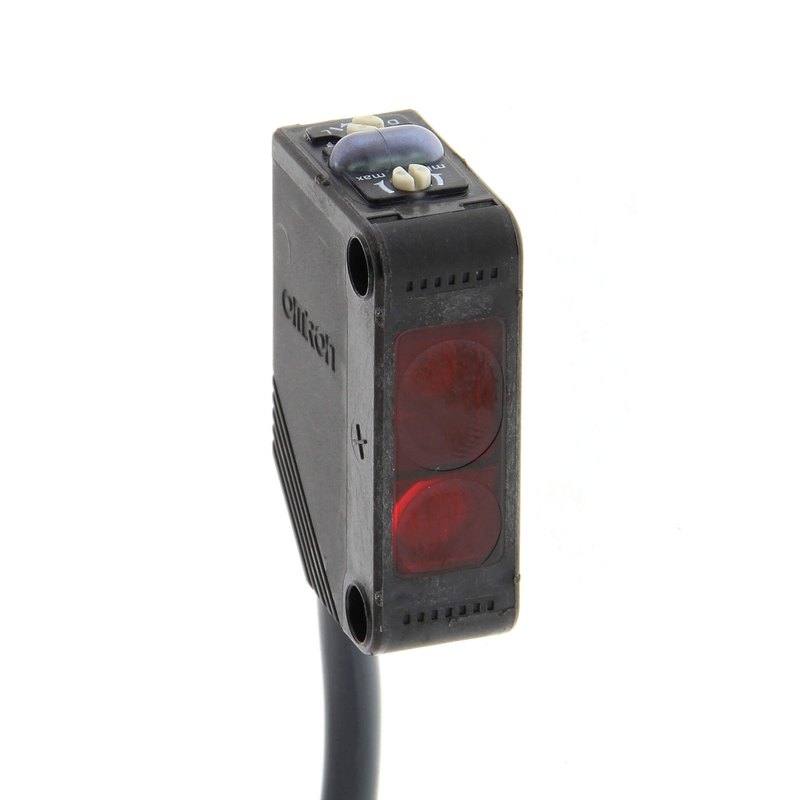
E3Z-LS61
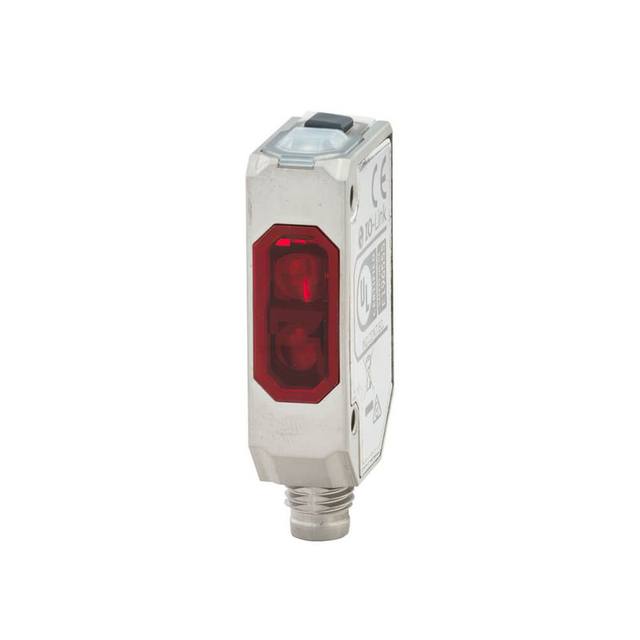
The E3Z-LS is a diffuse-reflective photoelectric sensor that uses adjustable background/foreground suppression to detect targets regardless of their color or size by setting a fixed sensing distance via a 5-turn adjuster. It uses a 680 nm red LED, has a maximum BGS setting range of 20 to 200 mm (white or black 100x100 mm paper) and a response time of 1 ms max for both operation and reset. Models with suffix 6x are NPN open-collector and 8x are PNP open-collector outputs (100 mA max load), with Light-ON/Dark-ON selectable; LS61/LS81/LS66/LS86 cover the 200 mm range while LS63/LS83/LS68/LS88 cover the 80 mm range. The sensor is rated IP67 with a PBT housing and polyarylate lens, operates from 12-24 VDC and -25 to 55 degrees C, and is available pre-wired (0.5 m / 2 m cable) or with an M8 connector.
The Omron E3Z-LS is a diffuse-reflective photoelectric sensor built around distance-settable background suppression (BGS) and foreground suppression (FGS), with a built-in amplifier in a compact PBT housing. Unlike a standard diffuse sensor that simply measures returned light intensity, BGS uses the angle of the reflected beam to fix a sensing threshold at a set distance: anything closer than the set point triggers, anything beyond it is ignored. That geometry is what lets this sensor detect targets largely independent of color or surface reflectivity, the headline benefit called out in its spec sheet, where the maximum BGS setting range is quoted as 20 to 200 mm against both white and black 100x100 mm paper. Distance is dialed in mechanically with a 5-turn adjuster, so the same part can be tuned to ignore a conveyor belt, a fixture, or a back wall while still reliably catching a part in the foreground.
| Brand | Omron / Sentech |
|---|---|
| Sensor type | Photoelectric |
| Range / distance | BGS setting 20 to 200 mm (white/black paper); FGS 40-200 mm white, 40-160 mm black; 80 mm models (LS63/LS83/LS68/LS88) |
|---|---|
| Response time | 1 ms max (operation or reset) |
| Communication | Discrete digital output (open-collector switching), no fieldbus |
|---|---|
| Connection | Pre-wired (0.5 m / 2 m cable) or M8 connector |
| Supply voltage | 12 to 24 VDC +/-10%, ripple (p-p) 10% max |
|---|
| Operating temperature | -25 to 55 degrees C (operating, no icing/condensation) |
|---|---|
| IP rating | IEC 60529 IP67 |
| Sensing method | Background suppression (BGS) / foreground suppression (FGS), distance-settable diffuse |
|---|---|
| Light source | Red LED: 680 nm (LS61/66/81/86, 200 mm models); 650 nm (LS63/68/83/88, 80 mm models) |
| Output type | NPN open-collector (LS61/63/66/68) or PNP open-collector (LS81/83/86/88), 100 mA max |
|---|
| Housing material | Case: PBT (polybutylene terephthalate); Lens: polyarylate |
|---|---|
| Weight | Approx. 65 g (pre-wired 2 m); approx. 20 g (connector model) |
How to build a high-speed machine-vision system: balance frame rate against resolution, freeze motion with short exposure and strobe lighting, and size the interface and frame grabber for sustained throughput.
How to choose between all-in-one smart cameras and PC/embedded vision with a separate camera, based on inspection complexity, throughput, flexibility, AI needs and total cost of ownership.
A practical, application-first method for selecting an industrial camera: derive resolution from field of view and smallest detail, then match shutter, speed, interface, lens and lighting.
AIS Vision · Integration
AIS Vision defines and tests the optimal combination of camera, optics and lighting for your application before you buy.