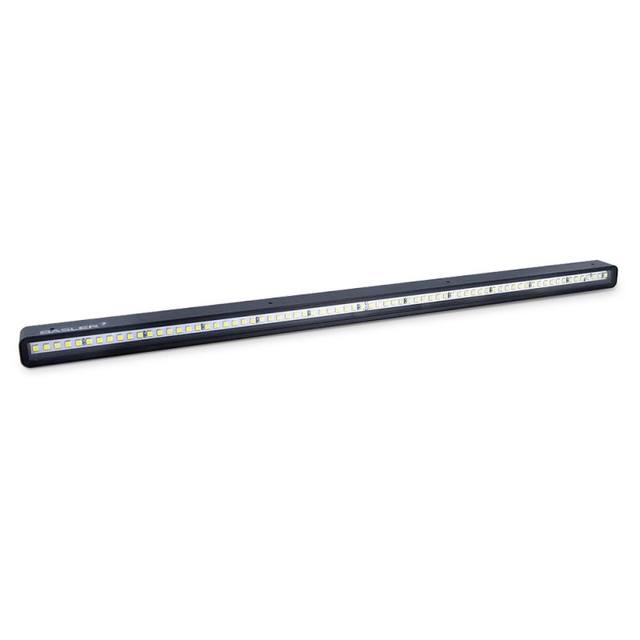
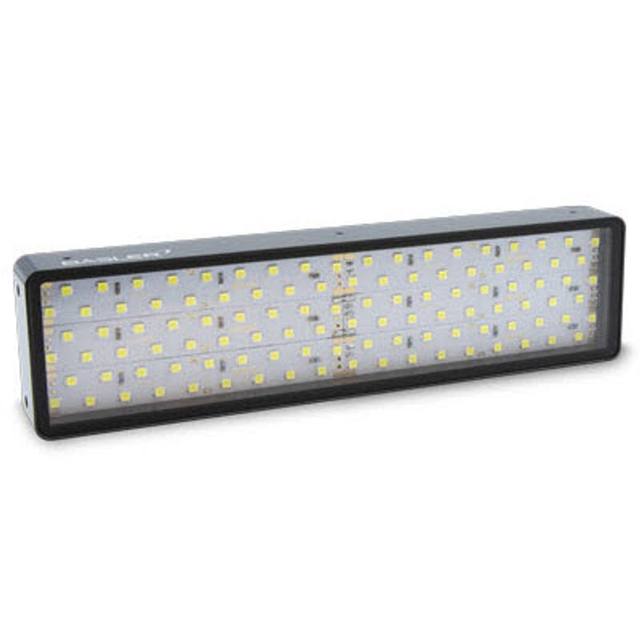
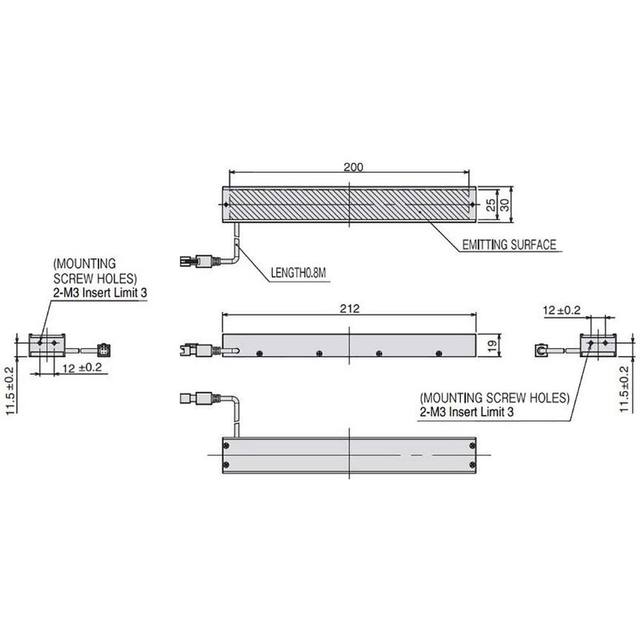
The FLV-BR6424UV is a ultraviolet bar light in Omron's FLV-BR light-unit series, with a 53x20 mm lighting area, 64x24 mm outside dimensions, 17 mm height, and a weight of approximately 70 g. It draws 1.8 W and is driven by the constant-voltage method, requiring an Omron FLV-series lighting controller (FLV-TCC camera-mount or FLV-ATC stationary type) that supplies 24 VDC and connects to the light via cable. The aluminium-alloy-cased unit is rated IP20, operates from 0 to +50 C, and accepts an optional diffusion plate (drawing pattern J) for more uniform illumination. UV illumination suits fluorescence-based and surface defect/marking inspection on wide or long workpieces.
Brand
Omron / Sentech
Lighting type
Bar light
Color / wavelength
UV (ultraviolet), peak approx. 385 nm
Mode
Continuous and trigger lighting (set via controller)
Controller required
Yes - requires FLV-series controller (FLV-TCC or FLV-ATC)
Diffuser
Optional diffusion plate available (drawing J)
IP rating
IP20 (IEC 60529)
Illuminated area
Lighting area 53 x 20 mm
Emission angle
Wide / uniform area illumination
Available wavelengths
UV (this model); FLV-BR series also offers White, Red, Blue, IR
The FLV-BR6424UV is a UV bar light from Omron's FLV-BR light-unit series, putting a 53 x 20 mm emitting surface inside a compact 64 x 24 mm aluminium-alloy housing that stands just 17 mm tall and weighs about 70 g. Its UV LEDs peak at roughly 385 nm in the near-UV, and the bar geometry is built to wash a wide, rectangular footprint with uniform light rather than concentrate it on a single point. For an installer this is fundamentally a fluorescence and surface-emphasis tool: at 385 nm it can excite fluorescent inks, adhesives, coatings and security markings so they emit visible light a standard camera can capture, and it accentuates fine surface texture, scratches and contamination that wash out under broadband white light. The optional diffusion plate (drawing pattern J) sits in front of the emitter to smooth hotspots and spread the field more evenly across the 53 x 20 mm window when the application needs a softer, more homogeneous wash.
Electrically the unit is deliberately simple and dependent on Omron's ecosystem. It draws only 1.8 W, runs on 24 VDC (+/-10%), and uses the constant-voltage drive method, which means it is not meant to be wired directly to a bench supply. Instead it cables back to an FLV-series lighting controller, either the FLV-TCC camera-mount type or the FLV-ATC stationary type, which supplies the 24 V and sets the operating mode. That controller is also where the light mode is chosen: the bar supports both continuous illumination and trigger (strobe) operation, selected at the controller rather than on the head itself. Pairing the head with the right FLV controller is therefore a required design decision, not an optional accessory, and the controller choice is what lets you synchronise the light to a moving line or pulse it for triggered capture.
Environmentally the FLV-BR6424UV is an indoor, dry-environment fixture. It carries an IP20 rating per IEC 60529, so it offers no protection against water or dust ingress and belongs inside an enclosure or a clean inspection cell, away from washdown. The operating window is 0 to +50 C (storage -15 to +60 C), comfortable for typical factory and lab benches but worth confirming against any heat from nearby process equipment. Because UV output at 385 nm is invisible and can affect eyes and skin, the install should treat the bar as a UV source: shield the beam, keep it inside the inspection station, and account for that in operator safety even though the published optical spec states the UV wavelength and lighting area, not irradiance.
Best for
Fluorescence-based inspection where UV at ~385 nm excites fluorescent inks, adhesives, glues or coatings so a standard camera can confirm presence, coverage and continuity
Surface defect and contamination inspection on wide or long workpieces, using the bar wash to reveal scratches, residue and texture across the 53 x 20 mm field
Verification of UV-fluorescent security marks, date codes and traceability features in packaging, printing and pharmaceutical lines
Reading or validating UV-reactive printed marks (OCR/OCV and code areas) that are low-contrast or invisible under white light
Bench and in-cell electronics and semiconductor inspection where a small, lightweight 70 g head must fit a tight fixture and run at low 1.8 W power
Selection notes
Budget for an FLV-series controller from the start: the head uses the constant-voltage drive method and requires either the FLV-TCC (camera-mount) or FLV-ATC (stationary) controller to supply 24 VDC and set continuous vs trigger mode; it is not designed to run on its own
Decide continuous vs trigger (strobe) early, because the mode is configured at the FLV controller and dictates how you synchronise the light to camera capture and any conveyor motion
Confirm the 53 x 20 mm lighting area and bar geometry cover your field of view at the intended working distance, and add the optional diffusion plate (drawing J) if you need a more uniform, hotspot-free wash
Plan for IP20: this is an indoor, no-washdown fixture with no dust or water protection, so mount it inside an enclosure or clean inspection cell and keep it within the 0 to +50 C operating range
Treat 385 nm UV as a safety item: the output is invisible, so shield the beam and contain it within the inspection station, and pair the light with a camera (and any optical filter) suited to capturing the fluorescent or surface response you expect
Specifications: General
Brand
Omron / Sentech
Lighting type
Bar light
Specifications: Interface
Connection
Cable to FLV lighting controller
Specifications: Optical
Color / wavelength
UV (ultraviolet), peak approx. 385 nm
Diffuser
Optional diffusion plate available (drawing J)
Emission angle
Wide / uniform area illumination
Available wavelengths
UV (this model); FLV-BR series also offers White, Red, Blue, IR
Specifications: Electrical
Mode
Continuous and trigger lighting (set via controller)
Controller required
Yes - requires FLV-series controller (FLV-TCC or FLV-ATC)
Driver technology
LED, constant-voltage drive method
Power consumption
1.8 W
Supply voltage
24 VDC +/-10% supplied via lighting controller
Specifications: Environment
IP rating
IP20 (IEC 60529)
Operating temperature
Operating 0 to +50 C (storage -15 to +60 C)
Specifications: Geometry
Illuminated area
Lighting area 53 x 20 mm
Specifications: Mechanical
Housing material
Aluminium-alloy case
Dimensions
Outside 64 x 24 mm, height 17 mm
Weight
Approx. 70 g
Applications this camera is commonly selected for. Open one to see the full recommended hardware and approach.
These steps take an Omron Sentech (STC) camera from the box to a stable first image and on to your own application. They apply across the GigE Vision, USB3 Vision and CoaXPress STC families; the interface only changes how you cable and power the camera.
Download and install the Sentech SDK on the host PC. The package provides StViewer, the viewing and configuration software you use to bring the camera up, and StApi, the programming SDK you integrate later. Because the cameras are GenICam/GenTL-compliant, StApi also registers a GenTL producer, so any GenICam-compliant third-party vision software can discover and drive the camera as an alternative front end.
2. Cable, power and connect the camera
Connect according to the interface. GigE Vision: link to a Gigabit NIC (use PoE or the separate power input) and put the camera and host on the same subnet; for USB3 Vision use a USB 3.x port and a certified cable; for CoaXPress (STC) connect to a CoaXPress frame grabber, which also supplies Power-over-Coax. Then open StViewer and let it enumerate the camera. If a GigE camera does not appear, check the IP configuration and firewall, and on USB3 confirm the host bandwidth and driver.
3. Configure exposure, gain and white balance
Open the device in StViewer and start a live stream. Set exposure and gain for a well-exposed, low-noise image: raise exposure first and only add gain when more light or a faster shutter is not an option, keeping exposure short enough to freeze motion on global-shutter models. On colour cameras, run white balance under your actual production lighting. Adjust the lens aperture and focus on a representative target before tuning anything else.
4. Set the trigger and grab a first image
Start in free-run (continuous) acquisition to confirm a clean, stable image. For inline inspection switch to hardware or software triggering: select the trigger source, set the active edge and any delay, and wire the strobe or illumination to the camera's I/O so lighting fires with each exposure. Acquire and save a frame in StViewer; this saved image is your reference for the SDK stage and for downstream inspection.
5. Move to the StApi SDK (or any GenICam software)
Once the image is stable, reproduce the same settings in code. Use StApi to open the device, apply the GenICam features you validated in StViewer (exposure, gain, trigger, pixel format) and grab frames into your application via the bundled C++, C, C#/.NET or Python interfaces; the included samples are the fastest starting point. Prefer a different stack? The same GenICam/GenTL camera works with third-party vision libraries. With a reliable feed, you can route it into a deep-learning inspection such as Rosepetal for AI-based defect detection.
Frequently asked questions
It is a UV (ultraviolet) bar light with a peak of approximately 385 nm. UV illumination suits fluorescence-based inspection, where it excites fluorescent inks, adhesives and coatings, and surface defect or marking inspection on wide or long workpieces.
Yes. It uses the constant-voltage drive method and requires an Omron FLV-series lighting controller, either the FLV-TCC camera-mount type or the FLV-ATC stationary type, which supplies 24 VDC (+/-10%) and connects to the head by cable. It is not designed to run without one.
Both. The light supports continuous and trigger (strobe) operation, and the mode is selected at the FLV-series controller rather than on the head itself.
The lighting area is 53 x 20 mm. The outside dimensions are 64 x 24 mm with a height of 17 mm, and the aluminium-alloy unit weighs approximately 70 g.
No. It is rated IP20 per IEC 60529, which provides no protection against water or dust ingress, so it is an indoor fixture. It operates from 0 to +50 C (storage -15 to +60 C) and draws only 1.8 W. An optional diffusion plate (drawing J) is available for more uniform illumination.