Skip to content
Omron / Sentech ZS-LD20T / ZS-LD20ST / ZS-LD40T / ZS-LD50 / ZS-LD50S / ZS-LD80 / ZS-LD130 / ZS-LD200 / ZS-LD350S (ZS-L heads) machine vision sensor
  • Rosepetal compatible
  • Recommended by AIS Vision

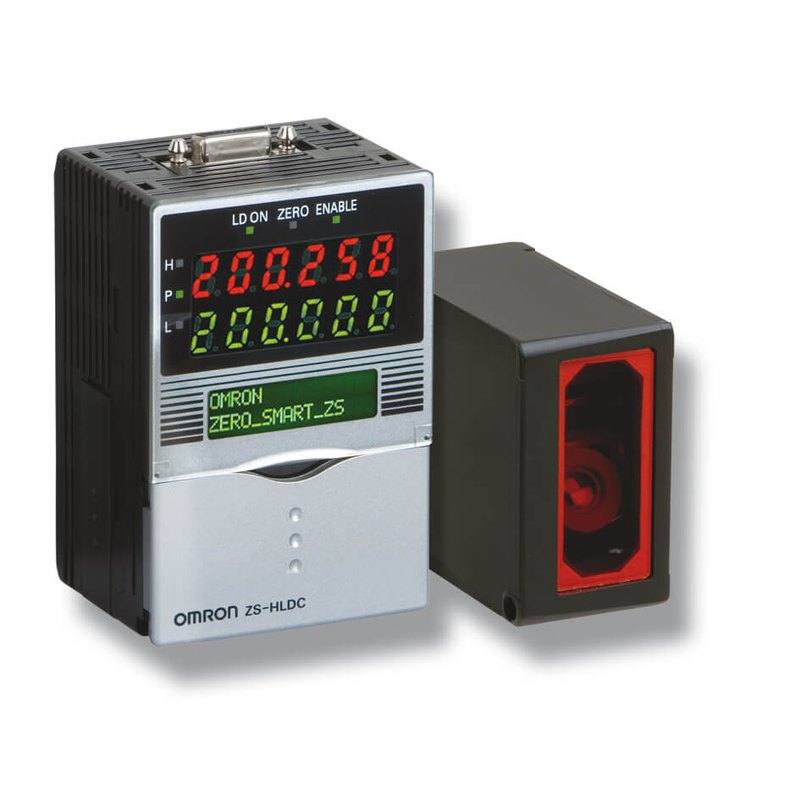
Omron / Sentech ZS-L Series Laser Displacement Sensor Heads (ZS-LD)

ZS-LD20T

The ZS-L (ZS-LD) family are high-precision 1D laser displacement measurement heads that operate with the ZS-series multi-function controller using the CMOS laser-triangulation principle. They use a JIS Class 2 visible red semiconductor laser (650 nm, 1 mW max.) in either line-beam or spot-beam form, covering measuring center distances of 20, 40, 50, 80, 130, 200 and 350 mm with measuring ranges from ±1 mm to ±135 mm and resolution from 0.25 µm to 20 µm. Sampling cycle is selectable at 110 µs (high-speed), 500 µs (standard), 2.2 ms (high-precision) or 4.4 ms (high-sensitivity), with typical linearity of ±0.1% F.S. The aluminum die-cast heads with glass front cover are rated IP66 (0.5 m cable) or IP67 (2 m cable) and operate from 0 to 50°C.

Brand
Omron / Sentech
Sensor type
Distance (laser displacement) sensor head
Sensing method
CMOS laser triangulation (regular + diffuse reflection)
Light source
Visible semiconductor red laser, 650 nm, 1 mW max., JIS Class 2
Range / distance
Measuring center distance 20 / 40 / 50 / 80 / 130 / 200 / 350 mm (representative: ZS-LD350S 350±135 mm)
Response time
Sampling cycle 110 µs (high-speed) / 500 µs / 2.2 ms / 4.4 ms (selectable)
Resolution
Resolution 0.25 µm (LD20T/LD20ST) up to 20 µm (LD350S)
Linearity
Linearity ±0.1% F.S. typical (±0.25% F.S. for LD200 diffuse)
Output type
Analog via ZS controller: voltage -10 to 10 V / current 4 to 20 mA
Communication
Via ZS controller: RS-232C, USB, plus analog and discrete I/O
Operating temperature
Operating 0 to 50°C; storage -15 to 60°C
IP rating
IP66 (0.5 m cable) / IP67 (2 m cable); connector area IP40

Technical overview

The Omron ZS-L (ZS-LD) family are 1D laser-displacement measurement heads that work as the sensing front-end of Omron's ZS-series multi-function controller, using the CMOS laser-triangulation principle. A visible red semiconductor laser (650 nm, 1 mW max., JIS Class 2) is projected onto the target as either a line beam or a spot beam, and the diffuse/regular reflection is imaged onto a CMOS array whose position encodes the target distance. Because the laser is visible red, you can see and aim the spot during alignment, and because it is JIS Class 2 it is a relatively low-hazard source, though you still avoid direct beam viewing. This is a measurement device, not a presence detector: the head reports a continuous distance value rather than a simple on/off, so it is designed into a system as a gauging or profiling element, with the ZS controller doing the math and producing the output.

The defining selection variable across this family is the measuring center distance: 20, 40, 50, 80, 130, 200 or 350 mm, with measuring ranges that scale from about plus/minus 1 mm on the close heads up to plus/minus 135 mm on the ZS-LD350S. Resolution scales the opposite way, from 0.25 micrometres on the close-range ZS-LD20T/LD20ST out to roughly 20 micrometres on the long-range ZS-LD350S, with typical linearity of plus/minus 0.1% of full scale (plus/minus 0.25% F.S. quoted for the ZS-LD200 diffuse head). In practice that means you pick the head by how close you can physically mount to the part and how fine a measurement you need: the short-distance heads give sub-micrometre resolution over a tight window, while the long-distance heads trade resolution for standoff and a much larger capture range. The sampling cycle is selectable in the controller at 110 microseconds (high-speed), 500 microseconds (standard), 2.2 ms (high-precision) or 4.4 ms (high-sensitivity), letting you trade speed against stability and dark/low-reflectance signal recovery on the same head.

Mechanically and electrically these are rugged, integrated heads: an aluminum die-cast case with a glass front cover, IP66 with the 0.5 m cable or IP67 with the 2 m cable (the connector area is only IP40, so it must stay in the enclosure), and an operating range of 0 to 50 degrees C. The head connects to the ZS controller over an integral 0.5 m or 2 m cable, and all I/O comes from that controller: analog output as -10 to 10 V voltage or 4 to 20 mA current, plus RS-232C and USB for setup and data, and discrete I/O for triggering and judgement signals. So when you wire this in, you are wiring the controller, not the head; the head itself carries no terminal block. The roughly 350 g, sealed body is built to sit on a fixture or robot tooling close to the process and survive coolant and splash, while the precision optics stay protected behind glass.

Best for

  • High-precision dimensional measurement such as height, thickness, step, warpage or runout, using the sub-micrometre resolution of the short-range ZS-LD20T/LD20ST heads
  • Surface inspection and profiling of flatness, gaps and coplanarity where the line-beam variant averages across a strip of the target
  • Robot-guidance and in-line gauging where the sealed head mounts on tooling and feeds a continuous distance value back through the ZS controller
  • Long-standoff position and displacement measurement (e.g. ZS-LD200/LD350S) where the part cannot be approached closely but a large plus/minus capture range is needed
  • Fast in-motion measurement on indexing or moving product, exploiting the 110 microsecond high-speed sampling cycle for height or edge checks at line speed

Selection notes

  • Choose the head by mounting standoff first: the measuring center distance (20 to 350 mm) sets how far the head sits from the part, and each model has a fixed plus/minus measuring range around that center, so confirm the part stays inside that window through all of its motion and tolerance.
  • There is a direct resolution-versus-range trade: 0.25 micrometre resolution belongs to the close ZS-LD20T/LD20ST heads, while the 350 mm ZS-LD350S resolves only to about 20 micrometres. Do not specify a long-standoff head and expect short-head precision.
  • Pick line-beam versus spot-beam to match the target: a spot suits small features and the finest gauging, while a line beam averages over surface texture and is more forgiving on rough, grooved or patterned parts.
  • Plan the sampling cycle around your real constraint: 110 microseconds for fast-moving product, but step to 2.2 ms (high-precision) or 4.4 ms (high-sensitivity) for low-reflectance, dark or unstable targets to recover signal and stability.
  • Budget for the ZS controller as a separate, required item: the head has no standalone output. All analog (-10 to 10 V / 4 to 20 mA), RS-232C, USB and discrete I/O come from the controller, and the head's connector area is only IP40, so keep the connection inside a protected enclosure even though the head body is IP66/IP67.

Specifications: General
BrandOmron / Sentech
Sensor typeDistance (laser displacement) sensor head

Specifications: Performance
Range / distanceMeasuring center distance 20 / 40 / 50 / 80 / 130 / 200 / 350 mm (representative: ZS-LD350S 350±135 mm)
Response timeSampling cycle 110 µs (high-speed) / 500 µs / 2.2 ms / 4.4 ms (selectable)
ResolutionResolution 0.25 µm (LD20T/LD20ST) up to 20 µm (LD350S)
LinearityLinearity ±0.1% F.S. typical (±0.25% F.S. for LD200 diffuse)

Specifications: Interface
CommunicationVia ZS controller: RS-232C, USB, plus analog and discrete I/O
ConnectionIntegral cable, 0.5 m or 2 m, to ZS controller

Specifications: Environment
Operating temperatureOperating 0 to 50°C; storage -15 to 60°C
IP ratingIP66 (0.5 m cable) / IP67 (2 m cable); connector area IP40

Specifications: Sensing
Sensing methodCMOS laser triangulation (regular + diffuse reflection)
Light sourceVisible semiconductor red laser, 650 nm, 1 mW max., JIS Class 2

Specifications: Output
Output typeAnalog via ZS controller: voltage -10 to 10 V / current 4 to 20 mA

Specifications: Mechanical
Housing materialCase: aluminum die-cast; front cover: glass
WeightApprox. 350 g (LD350S approx. 350 g; varies by model)

Frequently asked questions

Related technical guides

Rosepetal · AI

Test this camera with Rosepetal

Validate your visual inspection with AI: send us sample images and we evaluate the case on your hardware.

AIS Vision · Integration

We validate camera + lens + lighting

AIS Vision defines and tests the optimal combination of camera, optics and lighting for your application before you buy.