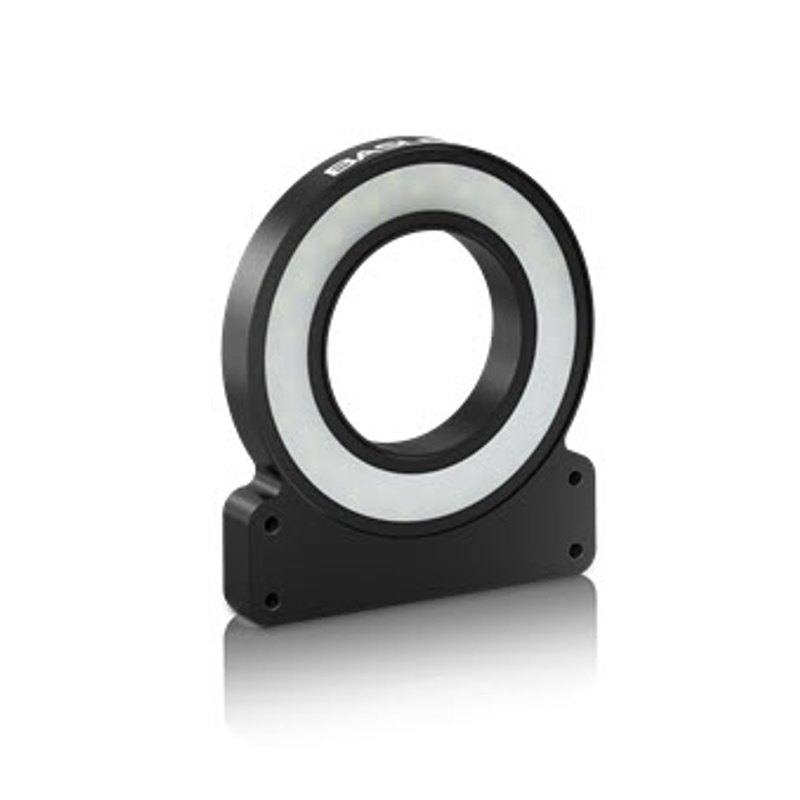
The Basler Standard Light Ring-100OD-x is a ring light for bright-field machine-vision illumination with a 67–101 mm luminous area and a recommended light working distance of 100–250 mm. It is offered in four SKUs: White (5000 K, 1255 lm), Red (625 nm, 1710 mW radiant), Blue (465 nm, 2650 mW radiant) and Infrared (850 nm, 1640 mW radiant). It features an internal LED controller with two operating modes (voltage-control continuous and current/strobe), runs on 24 VDC ±10 % at 9 W, and connects via an M8 4-pin male connector. The black anodized aluminum housing with PMMA cover is offered in both IP54 and IP67 (separate order numbers) and is CE/FCC/UKCA conformant.
Brand
Basler
Lighting type
Ring light
Color / wavelength
White / Red (625 nm) / Blue (465 nm) / IR (850 nm)
Available wavelengths
White (5000 K), Red (625 nm), Blue (465 nm), Infrared (850 nm)
Color temperature
5000 K (White variant)
Mode
Continuous (voltage-control) and strobe/overdrive (current-control); internal controller with 2 operating modes
Working distance
Recommended light working distance 100–250 mm
Controller required
No external controller required (internal LED controller); compatible with Basler SLP Strobe Controller
Diffuser
PMMA light cover / diffuser
IP rating
IP54 (standard) or IP67 (separate order numbers)
Inner diameter
Inner luminous diameter 67 mm (luminous area 67–101 mm)
The Basler Standard Light Ring-100OD-x is a bright-field ring illuminator built to mount coaxially around the lens, with a 100 mm outer diameter and a 67-101 mm luminous ring that throws light onto the scene from the camera's own line of sight. Geometrically this is the classic general-purpose ring: it floods the part with near-axial light through its PMMA cover, which makes flat, matte, and moderately textured surfaces read evenly and keeps shadows shallow. The recommended light working distance of 100-250 mm is the band where the ring's illuminated cone overlaps the field of view well, so plan the camera-to-part standoff inside that window. The luminous area starts at a 67 mm inner diameter, so confirm your lens sits within the ring's central opening before designing the bracket.
Four single-wavelength SKUs let you tune contrast to the task without changing the fixture. The White variant runs 5000 K at 1255 lm for true-color and general inspection; Red (625 nm, 1710 mW radiant) lifts contrast on red-reflective features and is forgiving on many materials; Blue (465 nm, 2650 mW radiant) shortens the wavelength to sharpen edges and small-feature detail; and Infrared (850 nm, 1640 mW radiant) is the choice for monochrome cameras with NIR sensitivity where you want to suppress visible-color variation. Pick a wavelength that maximizes contrast between the feature you are inspecting and its background, and pair monochrome cameras with monochromatic SKUs rather than the White unit when you need maximum repeatability.
Integration is deliberately simple because the controller is built in. The fixture runs on 24 VDC +/-10 percent at 9 W through an M8 4-pin male connector, and its internal LED controller offers two operating modes: voltage-control continuous for steady illumination, and a current-control strobe/overdrive mode for short, bright pulses synchronized to fast or moving parts. No external driver is mandatory, though it is compatible with the Basler SLP Strobe Controller if you want centralized strobe timing. The black anodized aluminum housing with PMMA cover ships in IP54 (standard) or IP67 (separate order numbers) for washdown or dusty cells, and the body measures 110 x 121 x 14 mm at 205 g, so it is light and shallow enough to mount on a compact gantry. Note the operating-temperature limit: 10-30 C normally, and only up to 45 C if you add mandatory heat-dissipation measures, which matters when running strobe overdrive or installing near hot machinery. The fixture is CE, FCC, and UKCA conformant.
Best for
Bright-field surface and defect inspection of flat or matte parts where near-axial, even illumination minimizes shadows (electronics, metal, automotive components)
OCR/OCV and 1D/2D code reading on printed or marked surfaces, using the wavelength SKU that best contrasts the print against its substrate
Dimensional measurement and presence/absence checks on parts presented within the 100-250 mm working-distance window
High-speed or moving-line inspection using the internal strobe/overdrive mode to freeze motion with short, bright pulses
Color-insensitive inspection on NIR-capable monochrome cameras using the 850 nm Infrared variant
Selection notes
Confirm the lens fits within the ring's 67 mm inner luminous diameter and design the camera standoff to fall inside the recommended 100-250 mm light working distance so the ring's cone covers the field of view.
Choose the wavelength to match the inspection: White (5000 K) for true color, Red 625 nm for forgiving general contrast, Blue 465 nm for fine-edge/small-feature detail, IR 850 nm for color-suppressed monochrome imaging.
Select the IP rating up front, IP54 (standard) or IP67 (separate order numbers), since the two are different order numbers and washdown or dusty cells need the sealed version.
Plan the electrical interface around 24 VDC +/-10 percent at 9 W via the M8 4-pin male connector, and decide between the internal voltage-continuous mode and current-strobe mode based on whether parts are static or moving.
Respect the thermal limits: rated for 10-30 C operation and only up to 45 C with mandatory heat-dissipation measures, which is especially relevant when driving the strobe/overdrive mode or mounting near heat sources.
Specifications: General
Brand
Basler
Lighting type
Ring light
Specifications: Interface
Connection
M8 socket, 4-pin male connector
Specifications: Optical
Color / wavelength
White / Red (625 nm) / Blue (465 nm) / IR (850 nm)
Available wavelengths
White (5000 K), Red (625 nm), Blue (465 nm), Infrared (850 nm)
Color temperature
5000 K (White variant)
Working distance
Recommended light working distance 100–250 mm
Diffuser
PMMA light cover / diffuser
Emission angle
Bright-field ring illumination
Specifications: Electrical
Mode
Continuous (voltage-control) and strobe/overdrive (current-control); internal controller with 2 operating modes
Controller required
No external controller required (internal LED controller); compatible with Basler SLP Strobe Controller
Driver technology
Internal LED controller with 2 operating modes (voltage / current-strobe)
Power consumption
9 W (voltage control mode)
Supply voltage
24 VDC ± 10 %
Specifications: Environment
IP rating
IP54 (standard) or IP67 (separate order numbers)
Operating temperature
10–30 °C operation (up to 45 °C with mandatory heat dissipation measures)
Specifications: Geometry
Inner diameter
Inner luminous diameter 67 mm (luminous area 67–101 mm)
Illuminated area
Luminous area 67–101 mm (ring)
Specifications: Mechanical
Housing material
Black anodized aluminum housing with PMMA light cover
Dimensions
110 x 121 x 14 mm (H x W x D)
Weight
205 g
Applications this camera is commonly selected for. Open one to see the full recommended hardware and approach.
Get a first image quickly with the pylon Viewer, then move into the pylon SDK for your application. These cameras are GenICam/GenTL-compliant, so any compliant vision software can drive them as well.
Download and install the pylon Camera Software Suite for your OS from Basler. This provides the pylon Viewer, the GenTL transport-layer producers and the pylon SDK (C/C++/.NET/Python). On Windows the installer adds the needed drivers; on Linux follow the included setup notes for USB and network permissions.
2. Connect the camera and check the link
Cable the camera to its matching interface: GigE Vision to a GigE port (use a quality cable and, ideally, a dedicated NIC with jumbo frames enabled), USB3 Vision to a USB 3.x port with the supplied cable, or CoaXPress to the frame grabber. Provide power where required (PoE, USB bus power, or PoCXP). Open the pylon Viewer and confirm the camera appears in the device list; for GigE, make sure the camera and NIC are on the same subnet.
3. Grab a first image and set exposure, gain and pixel format
Select the camera in the pylon Viewer and start a continuous grab. Adjust exposure time and gain until the image is well exposed (avoid clipped highlights), set the pixel format (e.g. Mono8 or a Bayer/RGB format), and focus the lens. Use a test pattern if the lens or scene is not ready yet.
4. Configure triggering and acquisition
Decide between free-run and triggered acquisition. For synchronized capture, set the trigger source (software or a hardware line on the I/O connector), trigger mode and any debounce or exposure mode, then verify timing. Note the parameter names you change in the Viewer feature tree, as you will reuse them in code.
5. Move to the SDK or a GenICam-compliant library
Recreate your settings in code with the pylon SDK (C, C++, .NET or Python) to open the device, apply the same features and pull frames into your pipeline; pylon vTools and pylon AI can add processing blocks. Because the cameras are GenICam/GenTL standard, third-party vision libraries work too. Once the image stream is stable, you can route frames to a deep-learning inspection such as Rosepetal for automated defect detection.
Frequently asked questions
No. It has an internal LED controller with two operating modes (voltage-control continuous and current-control strobe/overdrive), so no external driver is required. It is, however, compatible with the Basler SLP Strobe Controller if you want centralized strobe timing.
Four single-wavelength SKUs: White (5000 K, 1255 lm), Red (625 nm, 1710 mW radiant), Blue (465 nm, 2650 mW radiant), and Infrared (850 nm, 1640 mW radiant). Each is a separate variant of the same fixture.
The recommended light working distance is 100-250 mm, and the luminous area is a 67-101 mm ring. Position the camera and part within that distance band so the illuminated cone overlaps your field of view.
It runs on 24 VDC +/-10 percent at 9 W (in voltage-control mode) and connects through an M8 socket with a 4-pin male connector.
It is offered in both IP54 (standard) and IP67 (separate order numbers). For washdown or dusty cells, order the IP67 version. The housing is black anodized aluminum with a PMMA light cover, and it is rated for 10-30 C operation, up to 45 C only with mandatory heat-dissipation measures.