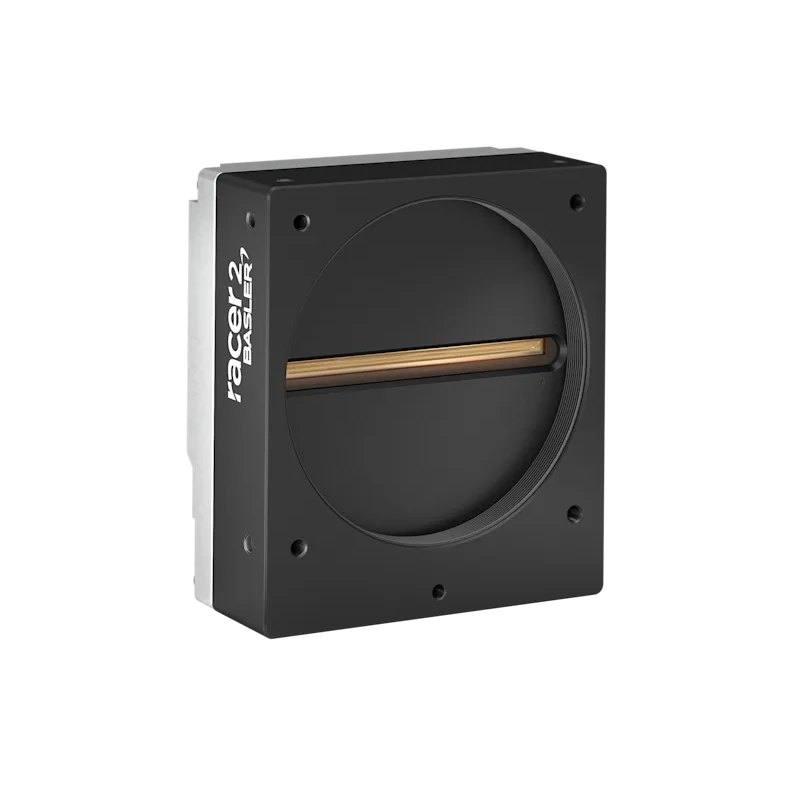
The Basler racer 2 r2L8192-240cm is a CoaXPress 2.0 (CXP-12) line scan camera with an 8192-pixel (8k) Gpixel GL7008 CMOS line sensor, 7 um pixels, monochrome, running at up to 240 kHz line rate. Selectable 10/12-bit pixel depth, M72x0.75 mount, free-run or hardware/software trigger.
The Basler racer 2 r2L8192-240cm is a monochrome line scan camera that captures imagery one line at a time, building a continuous two-dimensional image as the object (or the camera) moves past the sensor. Its single row of 8192 pixels (8k horizontal resolution) is paired with a Gpixel GL7008 sensor on 7 um pixels, giving a long, high-resolution scan line well suited to imaging wide webs or continuously moving products without the seams or perspective distortion that tiling multiple area-scan views would introduce. As a line scan device, its effective vertical resolution and aspect ratio are not fixed by the sensor but are set by the relationship between line rate and the speed of the moving target.
Image data is carried over a CoaXPress interface at the CXP-12 grade, the high-bandwidth, low-latency standard designed precisely for the data throughput that a fast, high-pixel-count line scan camera generates. With a line rate of up to 240 kHz, the camera can keep pace with fast-moving production lines while preserving spatial resolution along the direction of travel, provided lighting and optics deliver sufficient signal at the resulting short per-line exposure. CoaXPress also delivers configuration and triggering over coaxial cabling, simplifying cabling over longer distances than many alternative interfaces allow.
Operationally the camera is built on the GenICam standard for a vendor-neutral programming and configuration model, uses an M72 lens mount to accommodate the large image circle a long line sensor requires, and is powered from an external supply. Together these traits position it as a high-throughput acquisition front end for demanding continuous-inspection tasks rather than for discrete, snapshot-style imaging of static scenes.
Best for
Continuous surface inspection of moving webs such as film, paper, foil, textiles or coated materials, where a wide seamless scan line is needed
High-speed defect detection on fast-moving production lines that exceed the throughput of typical area-scan setups
Inspection of wide or long products where 8k horizontal resolution provides fine detail across the full width in a single pass
Roll-to-roll and conveyor-based imaging synchronised to the moving target for consistent geometry regardless of line speed
Monochrome contrast-based inspection (scratches, dents, print/coating uniformity) where colour information is not required
Selection notes
Line scan imaging requires controlled relative motion between camera and target; synchronise the line rate to the conveyor or web to keep the image geometry stable as speed varies, and rely on a constant-speed assumption only where speed is genuinely constant.
Lighting is the primary constraint at high line rates: the very short per-line exposure demands intense, uniform illumination focused on the scan line, typically a high-output line light, so budget for adequate lighting before assuming the full 240 kHz line rate is usable.
Specify a lens that covers the large image circle of the long 8k sensor and matches the M72 mount; verify resolving power across the full line width and account for the 7 um pixel pitch when calculating working distance, magnification and field of view.
Plan the CoaXPress side of the system as a pair: a CXP-12-capable frame grabber and correctly rated coaxial cabling within supported length limits, plus provision for the external power supply, since this camera is not a plug-and-play USB/GigE device.
If the application images discrete static parts, does not involve continuous motion, or only needs modest throughput, an area-scan camera or a slower/lower-resolution model is likely a simpler and more cost-effective choice than this high-speed line scan camera.
Specifications: General
Camera type
Line scan
Specifications: Sensor
Horizontal resolution
8k (8192 px)
Mono / color
Monochrome
Sensor manufacturer
Gpixel
Sensor model
GL7008
Pixel size
7 µm
Specifications: Performance
Line rate
240 kHz
Specifications: Interface
Interface
CoaXPress, CXP-12
Protocols
GenICam
Specifications: Optics
Mount
M72
Specifications: Electrical
Power
External supply
This product groups every purchasable order code that shares the same sensing method, range and output. Cable length, connector type and operation mode (Light-ON/Dark-ON, NO/NC) vary by order code below.
Family variants with highlighted differences
Model
Mono / color
Interface
Availability
8k (8192 px) Monochrome CoaXPress Base
Monochrome
CoaXPress
On request
Applications this camera is commonly selected for. Open one to see the full recommended hardware and approach.
Get a first image quickly with the pylon Viewer, then move into the pylon SDK for your application. These cameras are GenICam/GenTL-compliant, so any compliant vision software can drive them as well.
Download and install the pylon Camera Software Suite for your OS from Basler. This provides the pylon Viewer, the GenTL transport-layer producers and the pylon SDK (C/C++/.NET/Python). On Windows the installer adds the needed drivers; on Linux follow the included setup notes for USB and network permissions.
2. Connect the camera and check the link
Cable the camera to its matching interface: GigE Vision to a GigE port (use a quality cable and, ideally, a dedicated NIC with jumbo frames enabled), USB3 Vision to a USB 3.x port with the supplied cable, or CoaXPress to the frame grabber. Provide power where required (PoE, USB bus power, or PoCXP). Open the pylon Viewer and confirm the camera appears in the device list; for GigE, make sure the camera and NIC are on the same subnet.
3. Grab a first image and set exposure, gain and pixel format
Select the camera in the pylon Viewer and start a continuous grab. Adjust exposure time and gain until the image is well exposed (avoid clipped highlights), set the pixel format (e.g. Mono8 or a Bayer/RGB format), and focus the lens. Use a test pattern if the lens or scene is not ready yet.
4. Configure triggering and acquisition
Decide between free-run and triggered acquisition. For synchronized capture, set the trigger source (software or a hardware line on the I/O connector), trigger mode and any debounce or exposure mode, then verify timing. Note the parameter names you change in the Viewer feature tree, as you will reuse them in code.
5. Move to the SDK or a GenICam-compliant library
Recreate your settings in code with the pylon SDK (C, C++, .NET or Python) to open the device, apply the same features and pull frames into your pipeline; pylon vTools and pylon AI can add processing blocks. Because the cameras are GenICam/GenTL standard, third-party vision libraries work too. Once the image stream is stable, you can route frames to a deep-learning inspection such as Rosepetal for automated defect detection.
Frequently asked questions
It is a line scan camera. It images a single 8192-pixel (8k) row at a time and builds a full 2D image from continuous relative motion between the camera and the target, which is why it suits moving webs and conveyor-based inspection rather than static snapshots.
It uses CoaXPress at the CXP-12 grade. You will need a CXP-12-capable frame grabber and appropriately rated coaxial cabling; CoaXPress carries image data, control and triggering over coax.
It is a monochrome camera, optimised for contrast and grey-level detail such as surface defects. If your application depends on distinguishing colours, you would need a colour model instead.
It supports a line rate of up to 240 kHz. In practice the usable rate is governed by available light and optics, because higher line rates mean shorter per-line exposure; sufficient intense, uniform line lighting is required to reach the top of that range.
It is powered from an external supply and follows the GenICam standard for vendor-neutral configuration and control, giving a programming model that is consistent across compliant machine-vision software and frame grabbers.