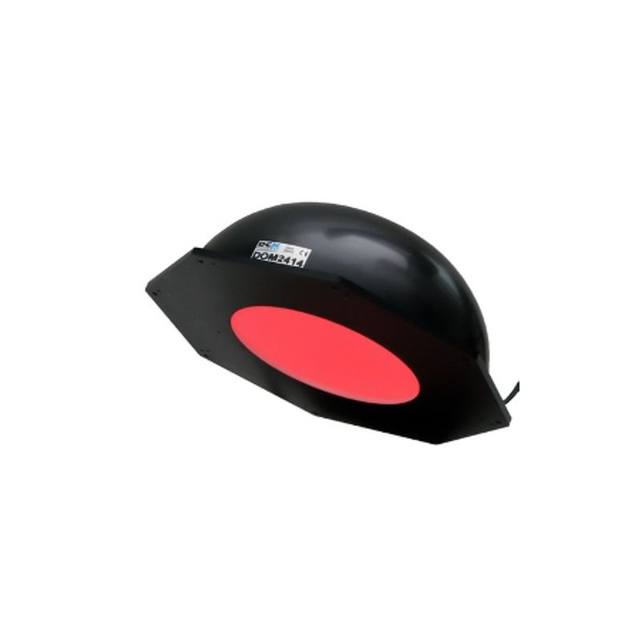
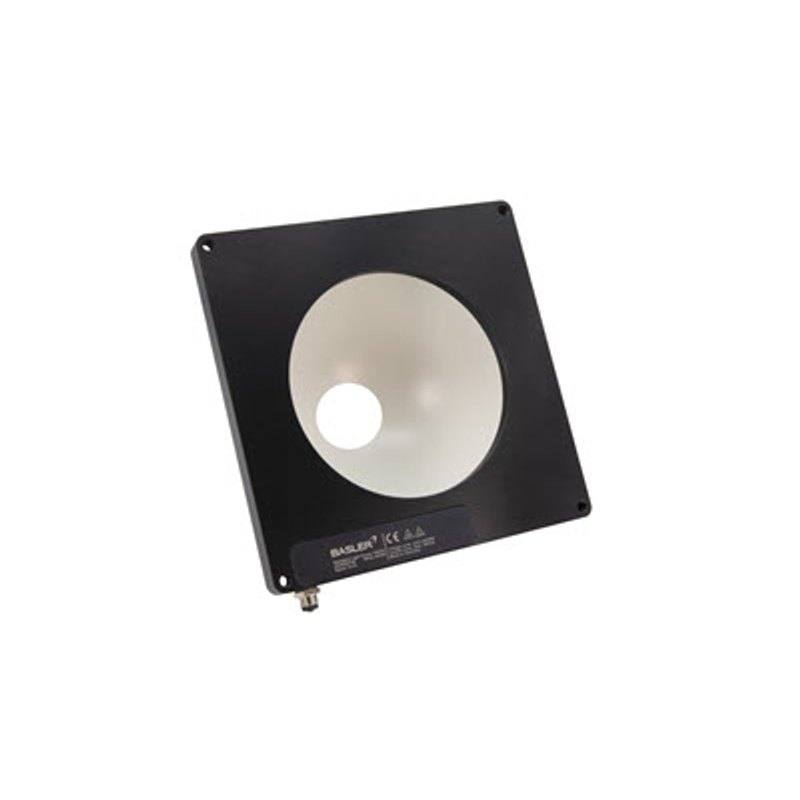
The Basler Standard Light Dome-200OD-x is a machine-vision dome light with a 200 mm luminous area diameter and a 30 mm lens hole, offered in four LED colors: White (5000 K), Red (625 nm), Blue (465 nm) and Infrared (850 nm). It integrates an internal LED controller with two operating modes (continuous and strobe) and is also compatible with the Basler SLP Strobe Controller. The light operates from 24 VDC (Voltage Control Mode, 16 W) or in Current Control Mode, has an IP54-rated black anodized aluminum housing with a plastic dome, and connects via an M8 4-pin connector. Recommended light working distance is 1-30 mm.
Brand
Basler
Lighting type
Dome light
Color / wavelength
White (5000 K), Red (625 nm), Blue (465 nm), IR (850 nm)
Available wavelengths
White / Red / Blue / Infrared
Mode
Continuous and strobe (internal LED controller, 2 operating modes)
Working distance
1-30 mm recommended light working distance
Controller required
No (internal LED controller; optionally compatible with Basler SLP Strobe Controller)
The Basler Standard Light Dome-200OD-x is a dome (cupola) illuminator built for almost shadow-free bright-field lighting of curved, glossy and highly reflective parts. Its defining geometry is a 200 mm diameter luminous area with a 30 mm lens hole at the apex, so the camera looks straight down through the top while LEDs fire into the diffusing plastic dome. That diffuser scatters light from every angle onto the part, which is exactly what flattens specular hot-spots on shiny surfaces and wraps light evenly around three-dimensional contours. The trade-off baked into a dome of this size is working distance: the recommended light working distance is only 1-30 mm, meaning the part must sit very close to the dome opening. The 200 mm luminous area suits objects up to roughly that footprint, and the 30 mm lens hole sets the upper bound on the field that the camera can image through the top.
Color choice is the second design lever. The unit ships in four LED variants -- White at 5000 K, Red at 625 nm, Blue at 465 nm and Infrared at 850 nm -- and you pick the variant at order time rather than switching on the fly. The 5000 K white version is the general-purpose choice for color inspection and human-readable verification; the monochromatic red, blue and IR versions let an installer pair the wavelength with a matching bandpass filter and a monochrome sensor to lift contrast on specific materials, suppress ambient light, or exploit how a substrate reflects or absorbs at 465, 625 or 850 nm. Because the diffuse dome already removes glare, combining a monochromatic variant with a filter is the standard way to push defect or code contrast even further.
Electrically the dome is largely self-contained, which simplifies the design-in. It carries an internal LED controller with two operating modes, continuous and strobe, so you can run it as steady illumination or pulse it in sync with the camera trigger without an external box; for more demanding pulsed work it is also compatible with the Basler SLP Strobe Controller. It runs from 24 VDC +/-5 % in Voltage Control Mode at 16 W, or in Current Control Mode, and connects through a single M8 socket with a 4-pin male connector. The housing is black anodized aluminum with the plastic dome and is rated IP54, giving dust and splash protection suitable for a guarded production cell. At 250 x 250 x 129 mm and 1000 g it is a substantial fixture that needs proper mechanical support, and the operating window of 10-30 C (extendable to 45 C only with mandatory heat dissipation measures) should be respected when mounting it in a warm enclosure.
Best for
Almost shadow-free bright-field inspection of highly reflective or specular parts such as polished metal, plastic housings and glossy packaging
Surface and AI-based defect inspection on curved or three-dimensional objects where even, wrap-around diffuse light is required
OCR/OCV and code traceability reading on shiny or embossed surfaces, using the monochromatic Red, Blue or IR variant with a matching filter to maximize contrast
Packaging inspection of small glossy items that can be positioned within the 1-30 mm light working distance under the 200 mm dome
Strobed, camera-synchronized imaging on moving lines using the built-in strobe mode or the Basler SLP Strobe Controller
Selection notes
Mind the very short working distance: the recommended light working distance is only 1-30 mm, so the part must sit almost against the dome opening -- this constrains part handling, fixturing and any in-motion clearance
Size the part to the dome: the 200 mm luminous area and 30 mm lens hole set practical limits on object footprint and on the field the camera can image through the apex
Choose the LED color at order time -- White (5000 K), Red (625 nm), Blue (465 nm) or IR (850 nm) -- because the variant is fixed; select the wavelength to suit the material and pair monochromatic versions with a monochrome camera and matching bandpass filter
Plan the power and wiring around 24 VDC +/-5 % at 16 W (Voltage Control Mode) through an M8 4-pin male connector, and decide between Voltage Control and Current Control Mode plus continuous vs. strobe operation; the internal controller covers basic strobing while the SLP Strobe Controller is the option for demanding pulsed setups
Budget for the mechanics and thermals: at 250 x 250 x 129 mm and 1000 g the fixture needs solid mounting, and the 10-30 C operating range (up to 45 C only with mandatory heat dissipation measures) plus IP54 rating define where it can be installed
Specifications: General
Brand
Basler
Lighting type
Dome light
Specifications: Interface
Connection
M8 socket, 4-pin male connector
Specifications: Optical
Color / wavelength
White (5000 K), Red (625 nm), Blue (465 nm), IR (850 nm)
Available wavelengths
White / Red / Blue / Infrared
Working distance
1-30 mm recommended light working distance
Diffuser
Yes (diffusing plastic dome)
Color temperature
5000 K (White variant)
Specifications: Electrical
Mode
Continuous and strobe (internal LED controller, 2 operating modes)
Controller required
No (internal LED controller; optionally compatible with Basler SLP Strobe Controller)
Power consumption
16 W (24 VDC Voltage Control Mode)
Supply voltage
24 VDC ±5 %
Specifications: Environment
IP rating
IP54
Operating temperature
10-30 °C (50-86 °F); up to 45 °C (113 °F) with mandatory heat dissipation measures
Specifications: Geometry
Inner diameter
30 mm lens hole diameter
Illuminated area
200 mm diameter luminous area
Specifications: Mechanical
Housing material
Black anodized aluminum housing with plastic dome
Dimensions
250 x 250 x 129 mm (H x W x D)
Weight
1000 g
Applications this camera is commonly selected for. Open one to see the full recommended hardware and approach.
Get a first image quickly with the pylon Viewer, then move into the pylon SDK for your application. These cameras are GenICam/GenTL-compliant, so any compliant vision software can drive them as well.
Download and install the pylon Camera Software Suite for your OS from Basler. This provides the pylon Viewer, the GenTL transport-layer producers and the pylon SDK (C/C++/.NET/Python). On Windows the installer adds the needed drivers; on Linux follow the included setup notes for USB and network permissions.
2. Connect the camera and check the link
Cable the camera to its matching interface: GigE Vision to a GigE port (use a quality cable and, ideally, a dedicated NIC with jumbo frames enabled), USB3 Vision to a USB 3.x port with the supplied cable, or CoaXPress to the frame grabber. Provide power where required (PoE, USB bus power, or PoCXP). Open the pylon Viewer and confirm the camera appears in the device list; for GigE, make sure the camera and NIC are on the same subnet.
3. Grab a first image and set exposure, gain and pixel format
Select the camera in the pylon Viewer and start a continuous grab. Adjust exposure time and gain until the image is well exposed (avoid clipped highlights), set the pixel format (e.g. Mono8 or a Bayer/RGB format), and focus the lens. Use a test pattern if the lens or scene is not ready yet.
4. Configure triggering and acquisition
Decide between free-run and triggered acquisition. For synchronized capture, set the trigger source (software or a hardware line on the I/O connector), trigger mode and any debounce or exposure mode, then verify timing. Note the parameter names you change in the Viewer feature tree, as you will reuse them in code.
5. Move to the SDK or a GenICam-compliant library
Recreate your settings in code with the pylon SDK (C, C++, .NET or Python) to open the device, apply the same features and pull frames into your pipeline; pylon vTools and pylon AI can add processing blocks. Because the cameras are GenICam/GenTL standard, third-party vision libraries work too. Once the image stream is stable, you can route frames to a deep-learning inspection such as Rosepetal for automated defect detection.
Frequently asked questions
It is a dome light with a 200 mm diameter luminous area, designed for almost shadow-free bright-field illumination of highly reflective, curved or three-dimensional objects. The part should fit within roughly the 200 mm dome footprint and sit within the recommended 1-30 mm light working distance.
Four variants are offered: White at 5000 K, Red at 625 nm, Blue at 465 nm and Infrared at 850 nm. You select one color per unit; the 5000 K white version is general-purpose, while the monochromatic versions are chosen to maximize contrast on specific materials, typically with a matching filter.
No. It includes an internal LED controller with two operating modes, continuous and strobe, so it can run standalone. For more demanding pulsed work it is also compatible with the optional Basler SLP Strobe Controller.
It operates from 24 VDC +/-5 %, drawing 16 W in Voltage Control Mode (Current Control Mode is also supported), and connects through an M8 socket with a 4-pin male connector.
The housing is black anodized aluminum with a plastic dome and is rated IP54 for dust and splash protection. The operating temperature range is 10-30 C, extendable up to 45 C only with mandatory heat dissipation measures. The unit measures 250 x 250 x 129 mm and weighs 1000 g.