Skip to content
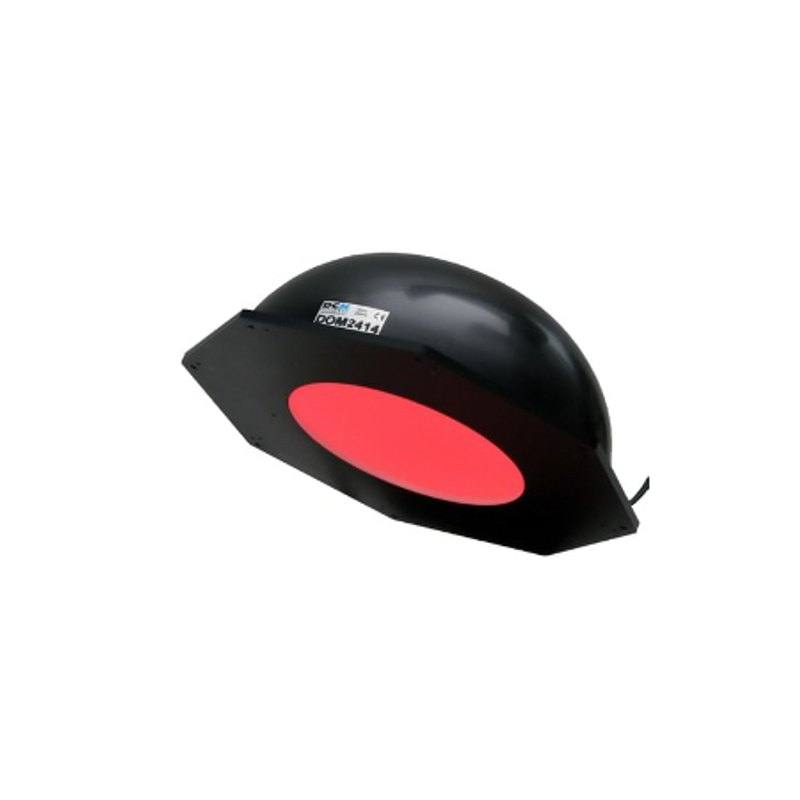
DCM Sistemes DOM2414A machine vision lighting
  • Rosepetal compatible
  • Recommended by AIS Vision

DCM Sistemes DOM2414A Dome Light

DOM2414A

The DOM2414A is part of DCM Sistemes' DOM dome-light series, using an indirect/diffuse "cloudy-day" geometry to illuminate objects from the camera axis to all directions, eliminating glare and shadows on reflective or curved surfaces. It measures 259x259x100 mm with a 144 mm bottom aperture, weighs 690 g, and operates from 24 VDC with a recommended working distance below 20 mm. It is offered in blue (470 nm), green (525 nm), red (630 nm), white (W00) and IR (850 nm); continuous Type-C consumption is 17 W for white/blue/green, 19 W for red and 21 W for IR. The standard housing is anodized aluminium rated IP00 (IP65 available as a modifier), and Type-i variants integrate the iBlueDrive driver for continuous, dimming and strobe operation.

Brand
DCM Sistemes
Lighting type
Dome light
Color / wavelength
White (also 470 nm blue, 525 nm green, 630 nm red, 850 nm IR)
Mode
Continuous / dimming / strobe (strobe & dimming via iBlueDrive Type-i)
Working distance
<20 mm (recommended working distance, RWD)
Controller required
No external controller required (24 VDC direct; Type-i integrates iBlueDrive driver)
Diffuser
Yes - diffuse 'cloudy-day' indirect dome illumination
IP rating
IP00 standard (IP65 available as modifier)
Inner diameter
144 mm bottom aperture diameter
Illuminated area
144 mm diameter illuminated aperture; 259x259 mm body
Emission angle
Diffuse (omnidirectional dome emission)
Available wavelengths
White (W00), Blue 470 nm, Green 525 nm, Red 630 nm, IR 850 nm

Technical overview

The DOM2414A is a dome light, not a directional illuminator, and its whole value comes from the indirect 'cloudy-day' geometry. Light is diffused off the inside of the 259x259x100 mm anodized-aluminium dome and reaches the part from many directions at once, so it arrives from near the camera axis all the way out to grazing angles simultaneously. The spec sheet calls the emission 'diffuse / omnidirectional' for exactly this reason: there is no single emission angle to aim, and that is what kills the specular hot-spots and hard shadows you get from ring or bar lights on shiny or curved surfaces. The camera images down through the 144 mm bottom aperture, which sets your practical part-size and lens field-of-view ceiling, while the part sits under the dome at the recommended working distance of under 20 mm. That very short RWD is intrinsic to dome optics: get too far away and the diffuse wrap-around that defines the 'cloudy-day' effect falls off, so this fixture is designed to sit close over the part, not stand off it.

Wavelength is a configuration choice, not a fixed value. The DOM2414A ships in white (W00) as the default plus blue 470 nm, green 525 nm, red 630 nm and IR 850 nm, and that single choice does a lot of the inspection work before any software runs. White gives you true-color and general defect imaging; a monochromatic color can be paired with a matching bandpass filter to lift contrast on a specific feature or suppress ambient light; and the 850 nm IR option is useful when you want to read structure or codes independent of printed color, with a matching IR-capable mono sensor. Power draw scales with the emitter, and the datasheet is explicit: continuous Type-C consumption is 17 W for white, blue and green, 19 W for red and 21 W for IR, all from a 24 VDC supply held to +24 V plus/minus 3 percent. At 690 g with an anodized-aluminium body, this is a fixture you mount on a fixed bracket over a station rather than something that travels on a fast-moving axis.

Electrically there are two clearly different variants, and choosing between them is the main integration decision. The base unit takes 24 VDC directly through 2P flying leads (180 mm, brown = +24 V, blue = 0 V) and needs no external controller, so it is wired as a simple continuous lamp. The Type-i variant integrates the iBlueDrive driver and brings up a 3P aerial male connector on a longer 715 mm lead, and that is what unlocks dimming and strobe operation in addition to continuous mode. If your line indexes parts and you want to freeze motion or strobe the LEDs in sync with the camera trigger, you need the Type-i build; the plain 24 VDC version runs continuous only. Environmentally the standard housing is rated IP00, which is open and meant for clean, dry, enclosed stations, while an IP65 sealed version is available as an ordering modifier for washdown or dusty environments. Operating temperature is a fairly narrow 0 to 40 degC, consistent with a continuously-driven LED fixture that relies on its aluminium body to shed heat.

Best for

  • Inspecting shiny, reflective or specular surfaces (polished metal, foil, glossy plastic) where directional lighting would throw glare hot-spots that the diffuse dome geometry eliminates
  • Imaging curved or cylindrical parts such as cans, caps, vials and stamped components, where wrap-around 'cloudy-day' illumination keeps the whole surface evenly lit with no hard shadows
  • Surface and AI-based defect inspection on packaging, electronics and metal parts that need shadow-free, uniform light for reliable scratch, dent and contamination detection
  • Reading printed or laser-marked traceability codes on reflective substrates, where even diffuse light improves contrast and an IR (850 nm) or color variant can be matched to the marking
  • Washdown food-and-beverage stations when ordered in the IP65 sealed housing, sitting close over small reflective items like caps, lids or printed films

Selection notes

  • Plan around the very short working distance: dome lights work by close coupling, and the recommended RWD here is under 20 mm, so the part must sit directly under the dome. This is a near-field station light, not a stand-off illuminator.
  • The 144 mm bottom aperture is your real working window. The camera images through it and the part must fit comfortably within that diameter, so confirm your largest part plus lens field of view stays inside 144 mm before committing.
  • Decide strobe vs continuous at order time. Only the Type-i variant with the integrated iBlueDrive driver supports dimming and strobe; the base unit is hard-wired 24 VDC continuous. If you need to freeze motion or sync to the camera trigger, specify Type-i and budget for its 3P aerial connector.
  • Match wavelength to the task and the camera. White (W00) is the safe default for color and general defect work; monochromatic blue/green/red pair with a bandpass filter for contrast; IR 850 nm needs an IR-capable (mono) sensor and is for imaging independent of printed color. The choice is fixed per unit, so order the right emitter.
  • Check the environment rating. The standard housing is IP00 and suits clean, enclosed cells only; specify the IP65 modifier for any washdown, splash or dusty application, and respect the 0 to 40 degC operating window for the continuously-driven LEDs.

Specifications: General
BrandDCM Sistemes
Lighting typeDome light

Specifications: Interface
Connection2P flying leads, L=180 mm (BN=+24V, BU=0V); iBlueDrive Type-i uses 3P aerial male connector, L=715 mm

Specifications: Optical
Color / wavelengthWhite (also 470 nm blue, 525 nm green, 630 nm red, 850 nm IR)
Working distance<20 mm (recommended working distance, RWD)
DiffuserYes - diffuse 'cloudy-day' indirect dome illumination
Emission angleDiffuse (omnidirectional dome emission)
Available wavelengthsWhite (W00), Blue 470 nm, Green 525 nm, Red 630 nm, IR 850 nm

Specifications: Electrical
ModeContinuous / dimming / strobe (strobe & dimming via iBlueDrive Type-i)
Controller requiredNo external controller required (24 VDC direct; Type-i integrates iBlueDrive driver)
Driver technologyiBlueDrive integrated driver on Type-i variants (continuous/dimming/strobe)
Power consumption17 W (Type C, white/blue/green @24 VDC); 19 W red, 21 W IR
Supply voltage24 VDC (+24 V ±3%)

Specifications: Environment
IP ratingIP00 standard (IP65 available as modifier)
Operating temperature0 to 40 degC (operating)

Specifications: Geometry
Inner diameter144 mm bottom aperture diameter
Illuminated area144 mm diameter illuminated aperture; 259x259 mm body

Specifications: Mechanical
Housing materialAnodized aluminium
Dimensions259 x 259 x 100 mm
Weight690 g

Frequently asked questions

Related technical guides

Rosepetal · AI

Test this camera with Rosepetal

Validate your visual inspection with AI: send us sample images and we evaluate the case on your hardware.

AIS Vision · Integration

We validate camera + lens + lighting

AIS Vision defines and tests the optimal combination of camera, optics and lighting for your application before you buy.