Basler Standard Light Flat Dome-100x200-x (W / R / B / IR)
Standard Light Flatdome-100x200-x
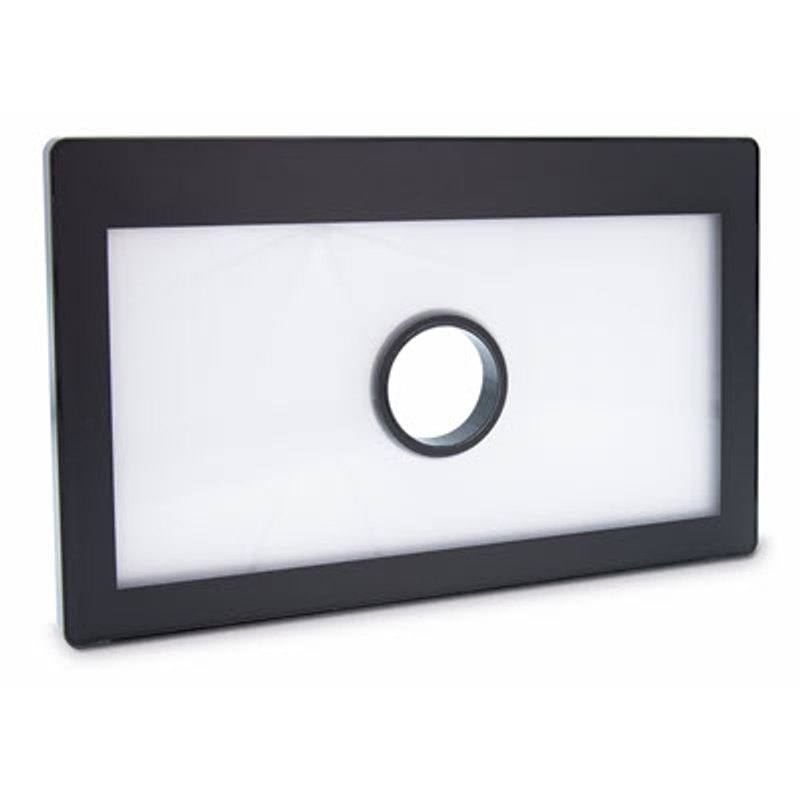
The Basler Standard Light Flat Dome-100x200 is a flat coaxial (diffuse axial) illuminator with a 100 x 200 mm emitting surface and a 36 mm central lens hole, in a black anodized aluminum housing with a PMMA light cover (140 x 230 x 12 mm, 660 g). It runs on 24 VDC +/-10% drawing about 16 W in voltage-control mode and supports both continuous and strobe/overdrive operation (up to 3600 mA at low duty cycle), via an M8 4-pin connector, with or without a Basler Lighting Controller such as the SLP. It is offered in White (5000 K), Red (625 nm), Blue (465 nm) and Infrared (850 nm) variants, with a recommended working distance of 100-450 mm, IP54 rating and an IEC 62471 photobiological "Exempt" classification.
Brand
Basler
Lighting type
Coaxial / axial (flat dome, diffuse)
Color / wavelength
White (5000 K), Red (625 nm), Blue (465 nm), IR (850 nm)
Available wavelengths
White 5000 K, Red 625 nm, Blue 465 nm, Infrared 850 nm
Color temperature
5000 K (White variant)
Mode
Continuous and strobe / overdrive (up to 3600 mA at 10% duty cycle)
Working distance
100-450 mm recommended
Controller required
No - operates with or without a Basler Lighting Controller (e.g. SLP)
The Basler Standard Light Flat Dome-100x200 is a flat coaxial (diffuse axial) illuminator: light is injected through a diffusing PMMA cover and emerges along the same axis as the camera, which views the scene through a 36 mm central lens hole. Across its 100 x 200 mm luminous area this geometry delivers near-shadowless, on-axis illumination, so specular surfaces reflect light straight back into the lens while diffuse areas stay darker. That makes flat-dome coaxial lighting the tool of choice for flat, shiny or partially reflective parts: it suppresses glare hot-spots, evens out the field, and reveals contrast features (engraved marks, etched codes, scratches, print) that side or ring lighting would wash out or break up with reflections.
Electrically the unit runs on 24 VDC +/-10% and draws about 16 W in voltage-control mode. It is an LED light that supports both continuous and strobe/overdrive operation, pushing up to 3600 mA at a 10% duty cycle, and it can run with or without a Basler Lighting Controller such as the SLP. Continuous mode keeps integration simple for steady, lower-speed inspections; strobe/overdrive driven by a controller lets you fire short, bright pulses synchronized to the camera trigger, which freezes motion on moving lines and raises peak intensity above the continuous level. The single M8 4-pin male connector carries power (and, with a controller, the strobe/trigger signaling), keeping wiring tidy on the cell.
Mechanically it is a black anodized aluminum housing with a PMMA light cover, measuring 140 x 230 x 12 mm and weighing 660 g, which is slim enough to mount close above a conveyor or fixture. The recommended working distance is 100-450 mm, giving latitude to trade off coverage uniformity against standoff for guarding and part clearance. It is rated IP54 (dust- and splash-protected, not washdown), with a 10-30 C operating window and 45 C maximum ambient, and carries an IEC 62471 photobiological Exempt classification. The light is offered in four wavelength variants - White 5000 K, Red 625 nm, Blue 465 nm and Infrared 850 nm - so you can pick the spectrum that maximizes contrast for your specific material and defect type.
Best for
On-axis inspection of flat, shiny or specular surfaces (metal plates, foils, laminates, glossy labels) where glare must be suppressed and the field kept shadow-free
Reading and verifying engraved, etched, laser-marked or printed codes and characters (OCR/OCV and 2D/DPM traceability) on reflective substrates through the 36 mm central lens hole
Surface and print-defect inspection - scratches, dents, smudges, missing/shifted print - on packaging, labels and metal where even diffuse axial light maximizes feature contrast
High-speed line inspection using strobe/overdrive pulses (up to 3600 mA at 10% duty cycle) synced to the camera trigger via a Basler Lighting Controller to freeze motion
Material-selective imaging by choosing the wavelength variant: Blue 465 nm, Red 625 nm, Infrared 850 nm or White 5000 K, matched to whichever spectrum gives the best contrast for the substrate and defect type
Selection notes
Coaxial flat-dome geometry suits flat or gently curved specular parts viewed roughly head-on; it is not a substitute for a full hemispherical dome on strongly curved or 3D-textured surfaces, so confirm part topology before designing it in
Frame coverage against the 100 x 200 mm luminous area and the 100-450 mm working distance: shorter standoff gives brighter, more uniform on-axis return; longer standoff buys clearance but reduces intensity and uniformity at the field edges
The camera must look through the 36 mm central lens hole, so check that your lens front diameter and the camera-to-light spacing keep the optical path clear and unvignetted
Decide continuous vs strobe early: continuous is simplest, but moving parts or higher throughput call for strobe/overdrive (up to 3600 mA at 10% duty cycle) driven by a Basler Lighting Controller such as the SLP, plus camera-trigger synchronization
Verify environment and budget fit: IP54 is dust/splash-rated but not washdown, the operating range is 10-30 C (45 C max ambient), supply is 24 VDC +/-10% at ~16 W via M8 4-pin, and the chosen wavelength (White/Red/Blue/IR) should be matched to the camera's spectral response, especially for the IR 850 nm variant
Specifications: General
Brand
Basler
Lighting type
Coaxial / axial (flat dome, diffuse)
Specifications: Interface
Connection
M8 socket, 4-pin male connector
Specifications: Optical
Color / wavelength
White (5000 K), Red (625 nm), Blue (465 nm), IR (850 nm)
Available wavelengths
White 5000 K, Red 625 nm, Blue 465 nm, Infrared 850 nm
Get a first image quickly with the pylon Viewer, then move into the pylon SDK for your application. These cameras are GenICam/GenTL-compliant, so any compliant vision software can drive them as well.
Download and install the pylon Camera Software Suite for your OS from Basler. This provides the pylon Viewer, the GenTL transport-layer producers and the pylon SDK (C/C++/.NET/Python). On Windows the installer adds the needed drivers; on Linux follow the included setup notes for USB and network permissions.
2. Connect the camera and check the link
Cable the camera to its matching interface: GigE Vision to a GigE port (use a quality cable and, ideally, a dedicated NIC with jumbo frames enabled), USB3 Vision to a USB 3.x port with the supplied cable, or CoaXPress to the frame grabber. Provide power where required (PoE, USB bus power, or PoCXP). Open the pylon Viewer and confirm the camera appears in the device list; for GigE, make sure the camera and NIC are on the same subnet.
3. Grab a first image and set exposure, gain and pixel format
Select the camera in the pylon Viewer and start a continuous grab. Adjust exposure time and gain until the image is well exposed (avoid clipped highlights), set the pixel format (e.g. Mono8 or a Bayer/RGB format), and focus the lens. Use a test pattern if the lens or scene is not ready yet.
4. Configure triggering and acquisition
Decide between free-run and triggered acquisition. For synchronized capture, set the trigger source (software or a hardware line on the I/O connector), trigger mode and any debounce or exposure mode, then verify timing. Note the parameter names you change in the Viewer feature tree, as you will reuse them in code.
5. Move to the SDK or a GenICam-compliant library
Recreate your settings in code with the pylon SDK (C, C++, .NET or Python) to open the device, apply the same features and pull frames into your pipeline; pylon vTools and pylon AI can add processing blocks. Because the cameras are GenICam/GenTL standard, third-party vision libraries work too. Once the image stream is stable, you can route frames to a deep-learning inspection such as Rosepetal for automated defect detection.
Frequently asked questions
It is a flat coaxial (diffuse axial) flat-dome light. Illumination passes through a diffusing PMMA cover and emerges on-axis with the camera, which views through a 36 mm central lens hole, giving even, near-shadowless on-axis light over a 100 x 200 mm luminous area.
No controller is strictly required - it operates with or without a Basler Lighting Controller such as the SLP. It runs in continuous mode, and for strobe/overdrive operation (up to 3600 mA at 10% duty cycle) a controller drives the short, synchronized pulses used to freeze motion and boost peak intensity.
Four variants: White (5000 K), Red (625 nm), Blue (465 nm) and Infrared (850 nm). You choose the variant that gives the best contrast for your material and defect type; match it to the camera's spectral sensitivity, particularly for the IR 850 nm option.
The recommended working distance is 100-450 mm and the luminous area is 100 x 200 mm. Shorter standoff gives brighter, more uniform on-axis return; longer standoff adds clearance at the cost of intensity and edge uniformity. The housing is slim at 140 x 230 x 12 mm and weighs 660 g.
It runs on 24 VDC +/-10%, drawing about 16 W in voltage-control mode, connected via an M8 4-pin male connector. It is rated IP54 (dust/splash, not washdown), operates at 10-30 C with a 45 C max ambient, has a black anodized aluminum housing with PMMA cover, and carries an IEC 62471 photobiological Exempt rating.