
- Rosepetal compatible
- Recommended by AIS Vision
On request
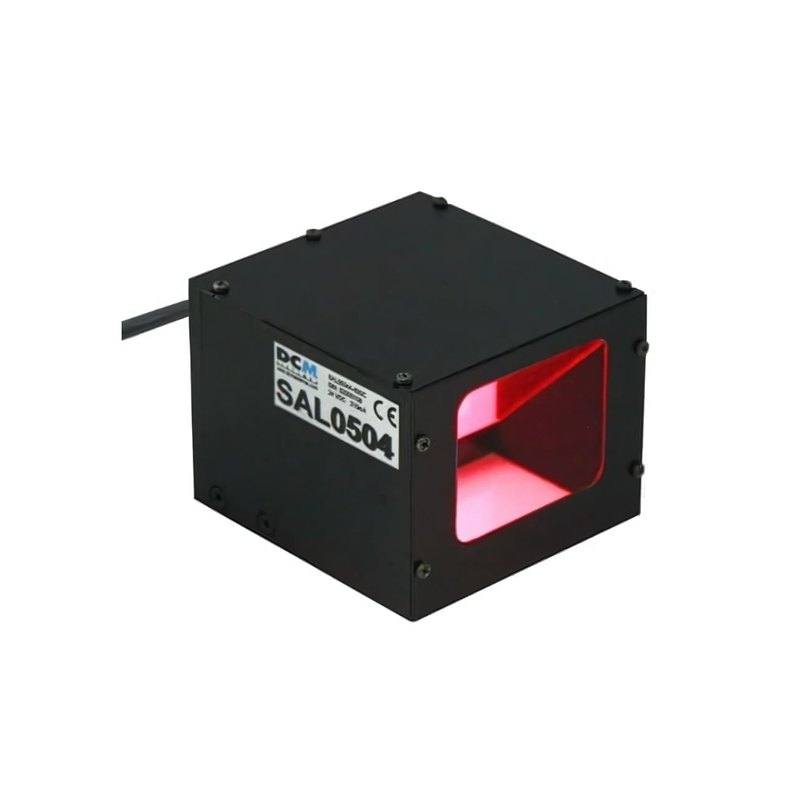
SAL0504A
The SAL0504A is part of DCM Sistemes' SAL series of 90° diffuse axial lights, where the camera views the object reflected on the same beamsplitter through which light enters the part, producing very homogeneous illumination free of shines and shadows while keeping the total setup height low. It has a 49x40 mm active (emission) surface in an 83x63x77 mm anodized-aluminium housing weighing 330 g, rated IP40, with a recommended working distance under 100 mm. It is available in blue (470 nm), green (525 nm), red (630 nm), IR (850 nm) and white wavelengths and in three operating modes: Continuous (Type C, 6.1 W at 24 VDC), Strobe (Type S, e.g. 880 mA/21 W) and Intelligent (Type i) with integrated iBlueDrive strobe-controller technology. Power is 24 VDC; Type C/S units use a 2-pin male chassis connector and Type i units a 3-pin aerial inline connector.
The SAL0504A is a 90 degree diffuse axial (coaxial) illuminator: light from the LED array is folded through an integrated beamsplitter so that it travels along the same optical axis the camera looks through, and the camera in turn views the part reflected in that same beamsplitter. The result is illumination that strikes the part nearly head-on and very uniformly, eliminating the shines and shadows that ringlights and bar lights produce on glossy or specular surfaces. The active emission surface measures 49 x 40 mm, so it is sized to flood a small-to-medium field-of-view directly beneath the camera; because the camera images the part through the beamsplitter, the whole stack stays low-profile, which is the geometric trade you accept for that clean, glare-free wash of light. DCM specifies a recommended working distance under 100 mm, so this is a close-coupled light meant to sit just above the part rather than a long-throw fixture.
| Brand | DCM Sistemes |
|---|---|
| Lighting type | 90° diffuse axial / coaxial |
| Connection | 2-pin male chassis connector (Type C/S); 3-pin aerial inline connector, L=715mm (Type i) |
|---|
| Color / wavelength | Available in white, red (630nm), blue (470nm), green (525nm), IR (850nm) |
|---|---|
| Available wavelengths | White, Blue 470nm, Green 525nm, Red 630nm, IR 850nm |
| Working distance | RWD <100 mm |
| Diffuser | Yes (diffuse axial light via beamsplitter) |
| Emission angle | Diffuse (axial) |
| Mode | Continuous (Type C), Strobe (Type S), Intelligent/iBlueDrive (Type i) |
|---|---|
| Controller required | No for Continuous (Type C); strobe via VST controller (Type S); Type i has integrated iBlueDrive controller |
| Driver technology | iBlueDrive integrated strobe controller (Type i variants) |
| Power consumption | 6.1 W max (Type C continuous, 24VDC); Strobe 21 W (visible) / 50 W (IR) |
| Supply voltage | 24 VDC (±3% Type C/S, ±8% Type i) |
| IP rating | IP40 |
|---|---|
| Operating temperature | 0 - 40 °C (operating) |
| Illuminated area | Active surface 49 x 40 mm |
|---|
| Housing material | Anodized aluminium |
|---|---|
| Dimensions | 83 x 63 x 77 mm |
| Weight | 330 g |
A practical guide to choosing machine vision lighting: geometry, wavelength, strobe vs continuous, ambient control and how to maximise feature contrast for reliable inspection.
A practical guide to machine vision lighting geometries — ring, bar, backlight, coaxial, dome and dark field — explaining what each reveals, the surfaces it suits, and how to choose the right one directly from your inspection problem.
A practical guide to continuous, strobed, and overdrive LED lighting in machine vision: why a short pulse freezes motion, why overdrive (not strobing alone) adds brightness, how to synchronize the pulse to camera exposure, the duty-cycle limits that protect LED life, and how to size and select a lighting controller.
A practical engineering guide to choosing LED wavelength in machine vision lighting. Learn how monochromatic red, blue, green, IR and UV light change contrast, how to exploit complementary colors, and how to match wavelength to your camera, lens and optical filters.

Rosepetal · AI
Validate your visual inspection with AI: send us sample images and we evaluate the case on your hardware.
AIS Vision · Integration
AIS Vision defines and tests the optimal combination of camera, optics and lighting for your application before you buy.