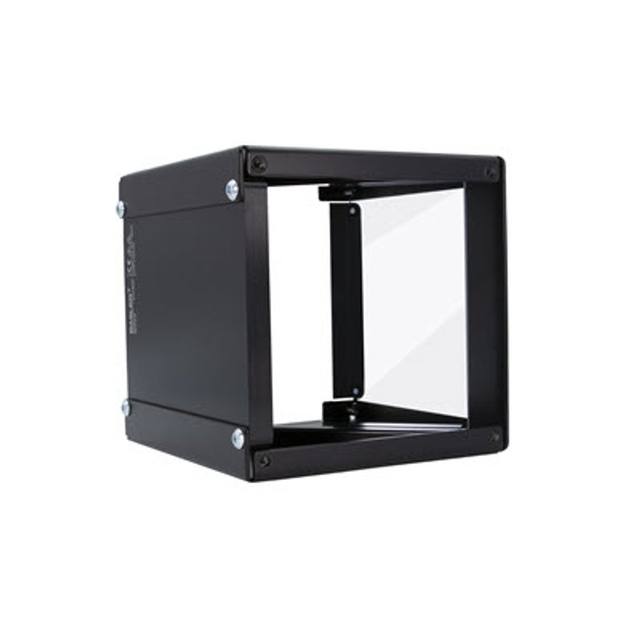
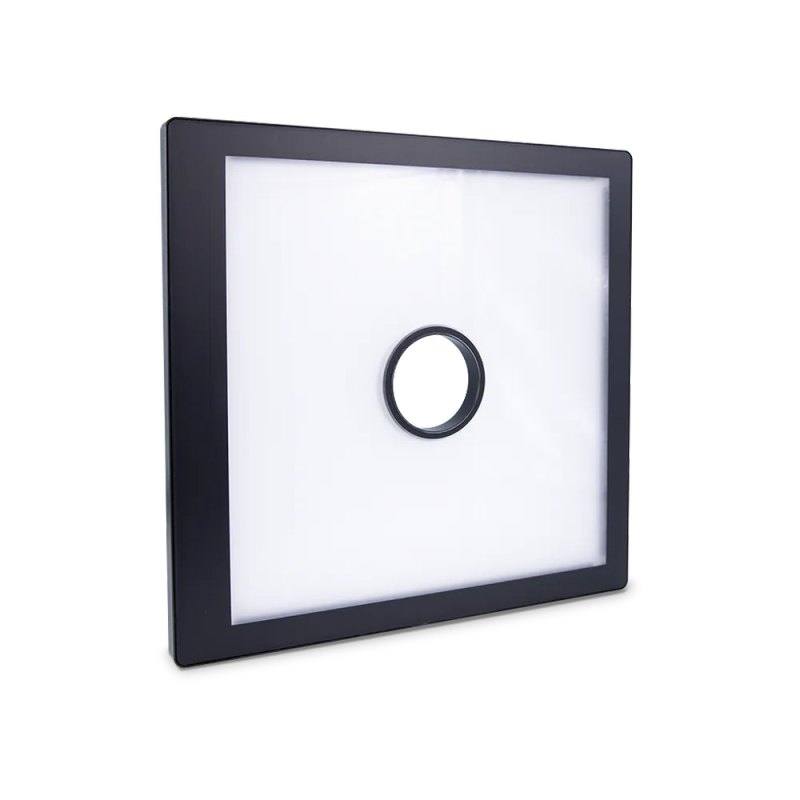
Basler Standard Light Flatdome-200x300-x (W / R / B / IR)
Standard Light Flatdome-200x300
The Basler Standard Light Flatdome-200x300 is a flat coaxial (diffuse axial) illuminator with a 200 x 300 mm emitting surface in a slim 240 x 330 x 12 mm housing, available as White (5000 K), Red (625 nm), Blue (465 nm) and IR (850 nm) variants (order numbers 2200001101/102/103/104). It runs on 24 VDC (+/-5%) with 28 W / 1500 mA power consumption, is voltage-/current-controlled, and supports continuous or triggered/strobed operation (pulse width 100 us to infinity) via an M8 male 4-pin connector. The light is rated IP54 with a 10-30 C operating temperature and can run standalone or with a Basler Lighting Controller such as the SLP Controller.
Brand
Basler
Lighting type
flatdome (flat dome / diffuse on-axis bright-field light)
Color / wavelength
White (5000 K), Red (625 nm), Blue (465 nm), IR (850 nm)
Available wavelengths
W = White 5000 K; R = Red 625 nm; B = Blue 465 nm; IR = 850 nm (all peak/typical)
Color temperature
5000 K (white variant, typical)
Mode
Continuous or triggered/strobed (pulse width 100 us to infinity)
Diffuser
Yes - diffuse light emission
Emission angle
Diffuse
Illuminated area
200 mm x 300 mm light-emitting surface
Controller required
Optional - works standalone or with a Basler Lighting Controller (e.g. SLP Controller)
The Basler Standard Light Flatdome-200x300 is a flat coaxial illuminator - a diffuse on-axis bright-field geometry packed into a slim 240 x 330 x 12 mm body that emits over a 200 x 300 mm surface. Unlike a tall hemispherical dome, the flat-dome construction injects diffuse light along the optical axis via an internal beam-splitter arrangement, so the camera effectively looks through the illuminated field. That on-axis diffuse delivery is what makes this geometry the right tool for flat, glossy or specular surfaces: where a directional light would throw the specular highlight off-axis into a hot glare or away from the lens entirely, the flatdome floods the part with even, multi-directional light that suppresses shadows and reflections. The practical payoff for an installer is a uniform field across the large 200 x 300 mm area, which suits inspection of wide flat parts such as panels, labels, foils and PCBs in a single field of view rather than tiling several smaller lights.
Wavelength is the key selection lever here because the unit ships as four distinct LED variants under separate order numbers: White 5000 K (2200001101), Red 625 nm (102), Blue 465 nm (103) and IR 850 nm (104). White at 5000 K is the general-purpose choice and the only option that preserves color information for color cameras or color-coded features. The monochromatic variants pair with a monochrome camera and a matching band-pass filter to boost contrast and reject ambient light - red 625 nm penetrates and reads warm/neutral surfaces with strong signal, blue 465 nm raises contrast on fine surface texture and red/orange-printed features, and IR 850 nm reads through certain inks, films and translucent materials while being invisible to operators. Because the variant is fixed at order time, the wavelength decision must be made up front against the target surface and contrast mechanism; this is not a field-tunable, multi-color head.
Electrically and mechanically the head is straightforward to design in. It runs on 24 VDC (+/-5%) drawing 28 W / 1500 mA through a 4-pin M8 male connector, and it is voltage-/current-controlled, supporting both continuous operation and triggered/strobed firing with a pulse width from 100 us up to infinity. That means the same light can run free-running for steady-state inspection or be strobed in sync with the camera exposure to freeze parts on a moving line and to overdrive intensity during short pulses. It can run standalone off a 24 VDC supply or, for precise current regulation, repeatable strobe timing and overdrive, be paired with a Basler Lighting Controller such as the SLP Controller. The housing is IP54 - protected against dust and splashing water but not washdown - and is specified for a fairly narrow 10 to 30 C operating range, so it is aimed at conditioned factory environments rather than hot or fully wet cells. At 1600 g and only 12 mm thick it mounts close over the part in tight, low-clearance stations.
Best for
Inspecting glossy, specular or low-reflectivity flat surfaces - painted panels, brushed or coated metal, glass and plastic covers - where directional light would cause glare
Reading and verifying printed labels, foils and codes (OCR/OCV and 2D codes) across a wide 200 x 300 mm field in a single capture
PCB and electronics assembly inspection of large boards needing even, shadow-free diffuse illumination
Surface and defect inspection of wide flat parts in automotive, metal and packaging lines, using the monochrome 465/625/850 nm variants with a matched filter for contrast
Strobed inspection on moving conveyors, firing the light in sync with camera exposure (100 us pulse minimum) to freeze parts and overdrive intensity
Selection notes
Choose the wavelength variant at order time - White 5000 K for color/general use, Red 625 nm or Blue 465 nm for monochrome contrast enhancement, IR 850 nm for reading through films/inks; the head is single-color and not field-switchable, so confirm the order number (2200001101/102/103/104) matches the surface
This is a flat coaxial (on-axis diffuse) geometry, optimized for flat specular surfaces viewed near-perpendicular; it is not a substitute for a deep hemispherical dome on highly curved or three-dimensional parts, nor for a low-angle/dark-field light when you need to emphasize raised or engraved relief
Size the field around the 200 x 300 mm emitting area and the 240 x 330 x 12 mm footprint; the slim 12 mm profile and 1600 g weight allow close, low-clearance mounting, but the camera must image through/along the light, so plan working distance and the beam-splitter path accordingly
Plan the power and control path: 24 VDC (+/-5%), 28 W / 1500 mA over a 4-pin M8 male connector. For repeatable strobing, current regulation and overdrive, design in a Basler Lighting Controller (e.g. SLP) rather than running standalone
Verify the environment fits the limits - IP54 (dust and splash, not washdown) and a 10 to 30 C operating range mean it belongs in a conditioned enclosure, away from washdown zones, heat sources or sub-10 C areas
Specifications: General
Brand
Basler
Lighting type
flatdome (flat dome / diffuse on-axis bright-field light)
Specifications: Interface
Connection
M8 male connector, 4-pin
Specifications: Optical
Color / wavelength
White (5000 K), Red (625 nm), Blue (465 nm), IR (850 nm)
Available wavelengths
W = White 5000 K; R = Red 625 nm; B = Blue 465 nm; IR = 850 nm (all peak/typical)
Color temperature
5000 K (white variant, typical)
Diffuser
Yes - diffuse light emission
Emission angle
Diffuse
Specifications: Electrical
Mode
Continuous or triggered/strobed (pulse width 100 us to infinity)
Controller required
Optional - works standalone or with a Basler Lighting Controller (e.g. SLP Controller)
Driver technology
Voltage-/current-controlled drive
Power consumption
28 W / 1500 mA
Supply voltage
24 VDC (+/-5%)
Specifications: Environment
IP rating
IP54
Operating temperature
10 C to 30 C
Specifications: Geometry
Illuminated area
200 mm x 300 mm light-emitting surface
Specifications: Mechanical
Dimensions
240 mm x 330 mm x 12 mm
Weight
1600 g
Applications this camera is commonly selected for. Open one to see the full recommended hardware and approach.
Get a first image quickly with the pylon Viewer, then move into the pylon SDK for your application. These cameras are GenICam/GenTL-compliant, so any compliant vision software can drive them as well.
Download and install the pylon Camera Software Suite for your OS from Basler. This provides the pylon Viewer, the GenTL transport-layer producers and the pylon SDK (C/C++/.NET/Python). On Windows the installer adds the needed drivers; on Linux follow the included setup notes for USB and network permissions.
2. Connect the camera and check the link
Cable the camera to its matching interface: GigE Vision to a GigE port (use a quality cable and, ideally, a dedicated NIC with jumbo frames enabled), USB3 Vision to a USB 3.x port with the supplied cable, or CoaXPress to the frame grabber. Provide power where required (PoE, USB bus power, or PoCXP). Open the pylon Viewer and confirm the camera appears in the device list; for GigE, make sure the camera and NIC are on the same subnet.
3. Grab a first image and set exposure, gain and pixel format
Select the camera in the pylon Viewer and start a continuous grab. Adjust exposure time and gain until the image is well exposed (avoid clipped highlights), set the pixel format (e.g. Mono8 or a Bayer/RGB format), and focus the lens. Use a test pattern if the lens or scene is not ready yet.
4. Configure triggering and acquisition
Decide between free-run and triggered acquisition. For synchronized capture, set the trigger source (software or a hardware line on the I/O connector), trigger mode and any debounce or exposure mode, then verify timing. Note the parameter names you change in the Viewer feature tree, as you will reuse them in code.
5. Move to the SDK or a GenICam-compliant library
Recreate your settings in code with the pylon SDK (C, C++, .NET or Python) to open the device, apply the same features and pull frames into your pipeline; pylon vTools and pylon AI can add processing blocks. Because the cameras are GenICam/GenTL standard, third-party vision libraries work too. Once the image stream is stable, you can route frames to a deep-learning inspection such as Rosepetal for automated defect detection.
Frequently asked questions
It is a flat coaxial (diffuse on-axis bright-field) light, so it excels on flat, glossy or specular and low-reflectivity surfaces. The on-axis diffuse delivery floods the part evenly and suppresses the glare and shadows that directional lights create on shiny flat parts, across its 200 x 300 mm illuminated area.
Four variants, each a separate order number: White 5000 K (2200001101), Red 625 nm (2200001102), Blue 465 nm (2200001103) and IR 850 nm (2200001104). White suits color cameras and general use; the monochromatic variants pair with a mono camera and matched filter for higher contrast and ambient-light rejection.
Yes. It supports continuous or triggered/strobed operation with a pulse width from 100 us up to infinity, so it can be fired in sync with the camera exposure to freeze parts on a moving line. It is voltage-/current-controlled over its 4-pin M8 connector.
No - it can run standalone from a 24 VDC (+/-5%) supply. A controller is optional: pairing it with a Basler Lighting Controller such as the SLP Controller gives precise current regulation, repeatable strobe timing and overdrive.
It runs on 24 VDC (+/-5%), drawing 28 W / 1500 mA via a 4-pin M8 male connector. It is rated IP54 (dust and splash protected, not washdown) and specified for a 10 to 30 C operating temperature, so it suits conditioned factory environments. The housing measures 240 x 330 x 12 mm and weighs 1600 g.