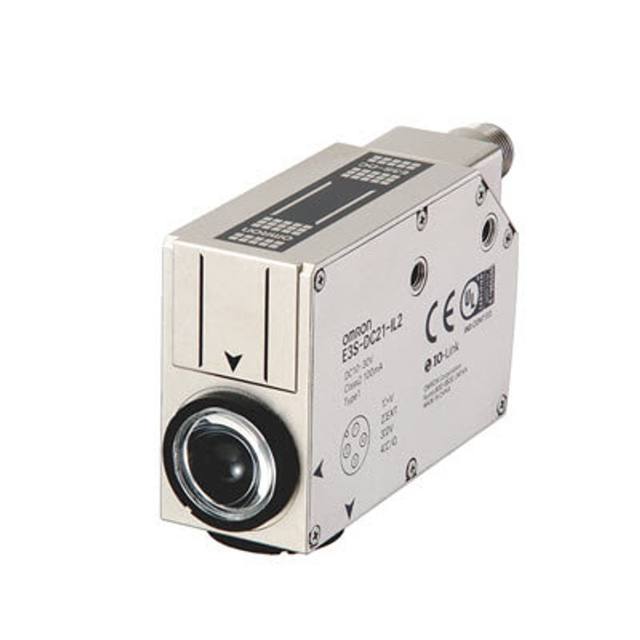
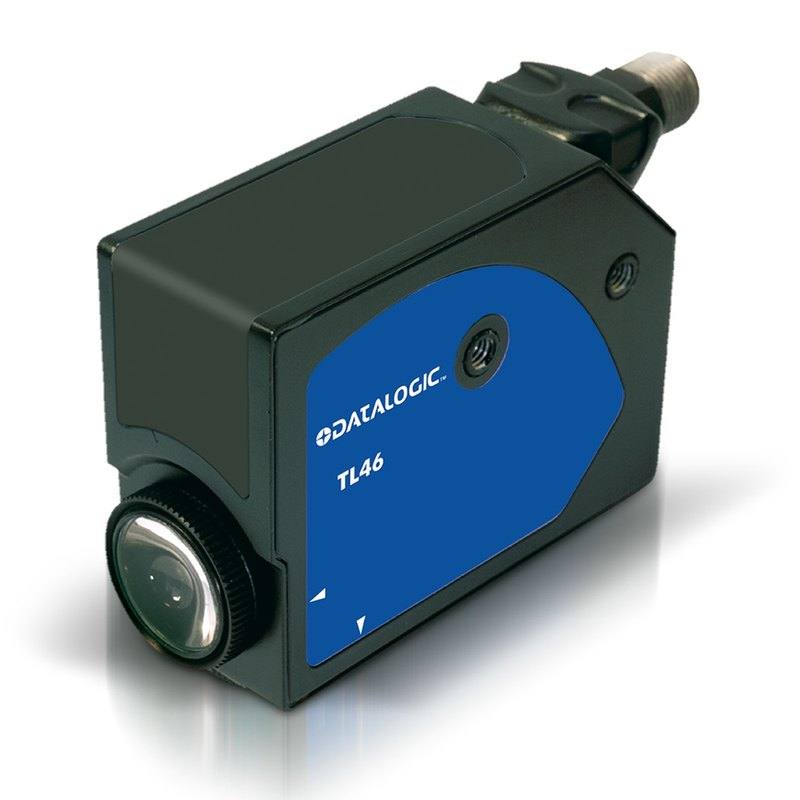
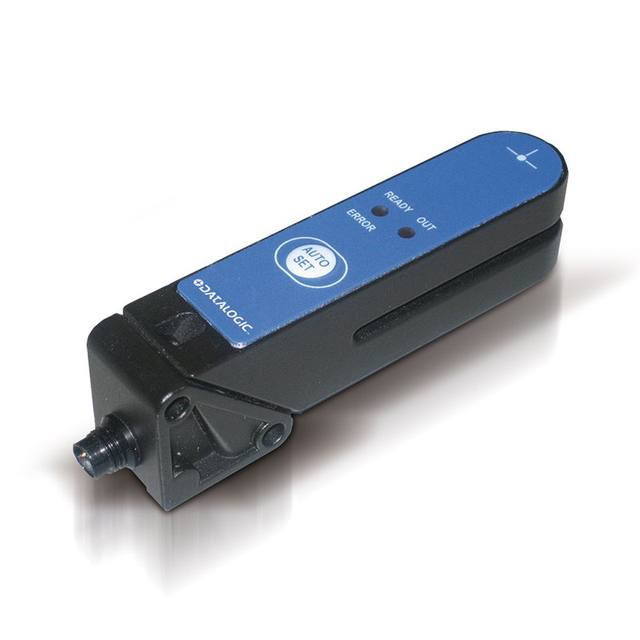
The TL46-W-815 (part number 954601000) is a contrast/print-mark sensor using wide-spectrum RGB or white LED emission with a vertical spot, sensing distance of 6-12 mm and a 15 kHz switching frequency (response time approximately 0.033 ms). It provides NPN/PNP outputs with selectable dark/light operation, a 10-30 VDC supply and an M12 5-pole rotatable connector. The aluminium housing with PMMA lens carries an IP67 rating and operates from -10 to +55 degrees C.
Brand
Datalogic / Datasensing
Sensor type
Contrast / colour mark sensor
Range / distance
6-12 mm sensing distance (9 mm nominal)
Response time
0.033 ms response time (at 15 kHz)
Communication
IO (digital NPN/PNP switching output; IO-Link available on select TL46 variants)
The TL46-W-815 is a contrast (print-mark) sensor that works by measuring the difference in reflected light between a printed registration mark and its surrounding background. Rather than recognising a colour outright, it reads relative grey-level contrast, which is why Datalogic pairs a wide-spectrum white/RGB LED emission with the sensor: a broad, mixed-wavelength source produces a usable contrast difference across the widest range of mark-and-substrate colour combinations, including marks that would disappear under a single-colour emitter. The emitter projects a vertical light spot, which is oriented so that it spans across a registration mark as web material runs past, giving a clean, repeatable transition edge as the mark enters and leaves the spot. It is tuned for a short sensing distance of 6-12 mm (9 mm nominal), so it is mounted very close to the moving web and is not a general-purpose distance or presence sensor.
Speed is the defining characteristic of this part. With a 15 kHz switching frequency and a response time of roughly 0.033 ms, it is built to catch register marks on fast-moving printing, converting, labelling and packaging lines where marks pass the optical window in a fraction of a millisecond. Electrically it is a simple switching device rather than a networked smart sensor: it provides a digital output that can be configured as either NPN or PNP, with selectable dark/light (dark-on/light-on) operation so the same unit can be set to switch on the mark or on the gap. An analog output is also listed, allowing the raw contrast signal to be used where a threshold edge alone is not enough. Power is a wide 10-30 VDC, and all connections are made through an M12 5-pole rotatable connector, which simplifies cable routing on tight machine frames. The specs note that IO-Link is offered on select TL46 variants; this specific part is documented as a discrete NPN/PNP/analog switching unit.
Mechanically the sensor is built for the converting environment. The housing is aluminium with a PMMA lens, it carries an IP67 rating for protection against dust and temporary water immersion, weighs 170 g, and operates from -10 to +55 degC. In a machine-vision context this device is rarely the inspector itself; instead its fast switching edge is most often used as a position/registration trigger. The mark-detected pulse can hand a precise web-position reference to a print-registration controller, a cut-to-mark or labelling actuator, or a vision camera that needs to grab a frame at a fixed point in the print cycle, making it a low-latency front-end timing element alongside an area-scan or line-scan inspection camera.
Best for
Print-to-cut and cut-to-mark registration on packaging and converting lines, where the sensor reads a printed eye-mark to time a knife or sealing jaw against fast-moving film or board
Label position control on labelling machines, detecting the printed registration mark on a label web so each label is placed and cut at the correct point
Web-print registration on flexo, offset or digital presses, using the high-speed mark pulse to keep multi-colour print layers aligned
Triggering a packaging-inspection vision camera at a repeatable point in the print cycle, so each captured frame lands on the same artwork region for code or print verification
Detecting fiducial or registration marks ahead of a traceability-code printing or reading station in the printing and packaging sectors
Selection notes
Confirm the 6-12 mm sensing distance can be held mechanically. This is a short-range contrast sensor, so the web or product surface must be guided to stay within that window; if your gap is larger or varies, this part is not the right choice.
Orient the vertical light spot so it crosses the registration mark as the web travels. Spot orientation relative to mark geometry and travel direction is what gives a clean, repeatable switching edge at 15 kHz.
Match the output to your receiving device before wiring. The unit offers selectable NPN or PNP and dark/light operation, plus an analog signal, so set the polarity and on-state to suit the PLC input, registration controller or camera trigger it feeds.
Because emission is wide-spectrum white/RGB, it is intended to handle difficult mark-on-background contrast combinations, but very low-contrast or gloss/metallic substrates should still be validated on actual samples; if relative contrast is marginal, a dedicated colour-sensing variant may be needed.
If your application requires IO-Link networking or parameter data rather than a discrete switching edge, note that IO-Link is only on select TL46 variants and confirm the part number; this unit is documented as a discrete NPN/PNP/analog device on an M12 5-pole connector with 10-30 VDC supply and IP67, -10 to +55 degC environmental rating.
Specifications: General
Brand
Datalogic / Datasensing
Sensor type
Contrast / colour mark sensor
Specifications: Performance
Range / distance
6-12 mm sensing distance (9 mm nominal)
Response time
0.033 ms response time (at 15 kHz)
Switching frequency
15 kHz
Specifications: Interface
Communication
IO (digital NPN/PNP switching output; IO-Link available on select TL46 variants)
Connection
M12 connector
Specifications: Electrical
Supply voltage
10-30 VDC
Specifications: Environment
IP rating
IP67
Operating temperature
-10 to +55 degC
Specifications: Mechanical
Housing material
Aluminium with PMMA lens
Weight
170 g
Specifications: Sensing
Light source
White LED
Specifications: Output
Output type
PNP / NPN / Analog
Applications this camera is commonly selected for. Open one to see the full recommended hardware and approach.
1. Install the IMPACT Software Suite and connect the camera
Install the IMPACT Software Suite on your PC, which provides both the configuration/viewer tools and the SDK. For a GigE Vision model (E100, M or U series), connect it to a dedicated NIC and, for USB3 models, use a certified USB3 cable and port. Power the camera and confirm it enumerates.
2. Bring the camera online and verify the link
For GigE Vision, put the camera and the host NIC on the same subnet (a static IP on the camera matching the NIC range is the most reliable starting point); for USB3, confirm the device is recognized. Open the IMPACT viewer/device tool, discover the camera, and verify a stable connection before streaming. Enabling jumbo frames on the NIC helps GigE throughput.
3. Set exposure, gain and trigger, then grab a first image
In the IMPACT tools, start a live stream and adjust exposure and gain until the image is well-lit without saturation; set white balance on color models. Begin in free-run (continuous) mode to confirm imaging, then switch to hardware or software trigger as your application requires. Capture and save a reference image once the scene looks correct.
4. Build a vision tool or move to the SDK/API
Use the IMPACT point-and-click vision tools to assemble an inspection, or use the IMPACT SDK to access the camera and results programmatically and feed them into your HMI/PLC application. As these are GenICam/GenTL-compliant devices, you can alternatively drive them from any GenICam-compliant third-party vision library if your pipeline standardizes on one.
5. Route the stable feed to deep-learning inspection (optional)
Once you have a stable, repeatable image, the feed can be sent to a deep-learning inspection platform such as Rosepetal for defect detection or classification tasks that go beyond rule-based tooling. Keep lighting, optics and trigger timing fixed so the images reaching the model stay consistent.
Frequently asked questions
It is a contrast/print-mark sensor. It measures the difference in reflected light between a printed registration mark and the background material, switching its output when a mark passes through its vertical light spot. It reads relative contrast rather than identifying an absolute colour.
Yes. It has a 15 kHz switching frequency and a response time of about 0.033 ms, which is fast enough to catch registration marks on rapidly moving web, label and converting lines.
It is a short-range device with a sensing distance of 6-12 mm, with 9 mm as the nominal working point. The target surface must be held within that window.
It provides a digital switching output selectable as NPN or PNP with selectable dark/light operation, plus an analog output. It is powered from 10-30 VDC and connects through an M12 5-pole rotatable connector. IO-Link is available only on select TL46 variants.
It is rated IP67 (dust-tight and protected against temporary water immersion) in an aluminium housing with a PMMA lens, weighs 170 g, and operates from -10 to +55 degC, suiting it to typical packaging and printing machine environments.
Yes. Its fast, repeatable mark-detected switching edge is well suited as a registration trigger, handing a precise web-position reference to a camera so each frame is captured at the same point in the print cycle, or to a registration/cut controller.