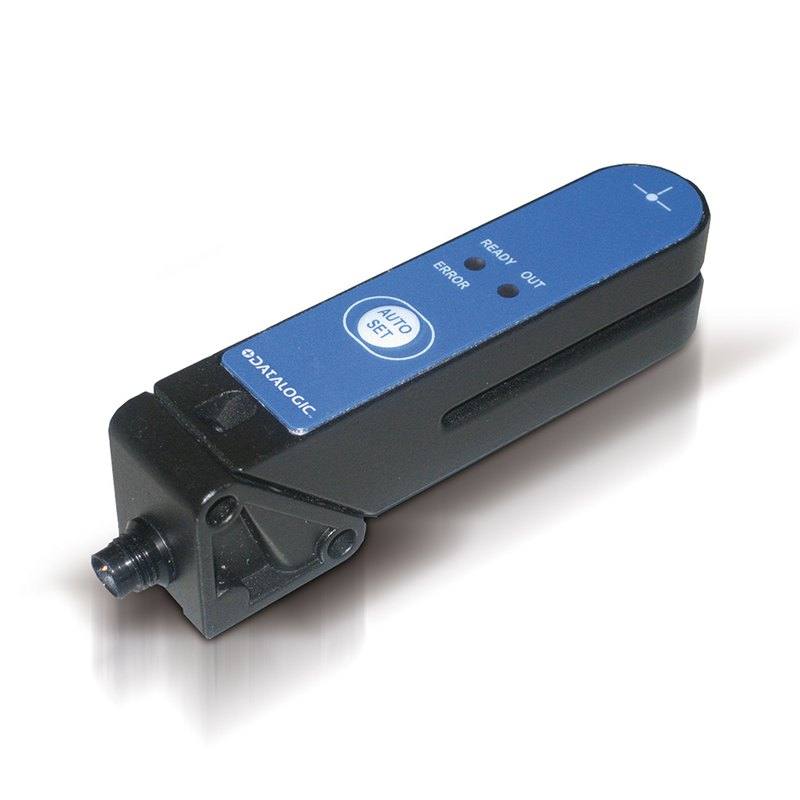
The SR21-IR (part number 953151070) is an infrared-LED fork/label sensor with a 2 mm slot width and 50 mm slot depth, offering 0.5 mm resolution, a 25 kHz switching frequency and roughly 0.02 ms (20 us) response time. It provides selectable light/dark NPN/PNP outputs from a 10-30 VDC supply with teach-in sensitivity adjustment. The Zamak housing carries an IP65 rating, uses a 4-pin M8 connector and operates from -20 to +60 degrees C.
The SR21-IR is a fork (slot) sensor, meaning its emitter and receiver sit on opposing arms of a fixed U-shaped frame with a 2 mm slot width and 50 mm slot depth. Material to be inspected is threaded through that slot, and the sensor reads the difference in infrared transmission as features pass between the arms. Because the optical path is closed and self-aligned across a fixed gap, there is nothing to align in the field and no reflector to mount; positioning reduces to feeding the web cleanly through the slot. With a 0.5 mm resolution it is built to discriminate the small transmission step between a label and the carrier (liner) backing it, which is the defining task in label-detection on backing material. The infrared LED source is chosen precisely because it sees through many label and liner stocks differently than visible light, picking up the density change at a label edge even on stocks that look uniform to the eye.
Electrically the sensor is a switching device, not an analog measurement instrument. It drives a digital output that can be configured as PNP or NPN and as light-operate or dark-operate, from a 10-30 VDC supply through an M8 connector. Sensitivity is set by teach-in rather than a trimmer, so the threshold between liner-only and label-present is captured from the actual material running through the slot. That switching edge is what makes it useful in a vision or motion system: each label gap produces a clean digital transition that can clock a labelling head, index a feed, or serve as a hardware trigger to a camera so an image is captured at a repeatable position relative to the label. With roughly 0.02 ms (20 us) response time and a 25 kHz switching frequency, the output keeps up with high-rate labelling and packaging lines where labels pass in rapid succession.
Mechanically it is built for the machine environment its application implies. The housing is Zamak metal rather than plastic, the body measures 20 x 26 x 90 mm, and it carries an IP65 rating for protection against dust and wash-down jets. It operates from -20 to +60 degrees C, covering chilled packaging areas through warm machine enclosures. As a fork sensor it is a standalone detector that needs no separate controller or amplifier; it is wired directly to the machine PLC or, when used alongside imaging, to a camera trigger input.
Best for
Detecting labels on continuous liner for self-adhesive labelling heads on packaging lines, where each label edge must be found at speed to time application onto the product
Gap and pitch detection on label web feed in packaging machinery, using the 25 kHz output to index the web and avoid double-feeds or missed labels
Generating a hardware trigger for a downstream vision camera so label print, position, or presence is imaged at a repeatable point relative to each label
Label-presence verification on logistics sortation lines, confirming a label is on the carrier before cartons divert to downstream stations
Counting and verifying continuous label runs in wash-down packaging areas where an IP65 metal-bodied sensor is required
Selection notes
Confirm the material to be sensed fits the slot: the fixed 2 mm slot width and 50 mm slot depth set the maximum web thickness and how far the label can reach into the gap, so check that your liner and label stack threads cleanly without contact
The 0.5 mm resolution is matched to the label-vs-liner transmission step; for stocks with very thin or near-transparent labels, validate detection by running real material through the teach-in rather than assuming it will resolve every gap
Wire the output to match the receiving input: choose PNP or NPN and light- or dark-operate to suit the PLC or camera trigger input, and budget for the 10-30 VDC supply on the M8 connector
When using it to trigger a camera, the 20 us response time and 25 kHz switching frequency mean trigger latency is dominated by the sensor's fixed edge, making it suitable for high-rate lines, but verify the camera trigger setup captures at the intended offset from the label edge
This is an infrared fork (slot) device with a digital switching output only; if you need an analog distance or thickness measurement, or contrast/colour discrimination on a reflective surface, a different sensing principle is required
For -20 to +60 degC chilled or warm enclosures the IP65 Zamak housing is appropriate; for full submersion or aggressive chemical wash-down beyond IP65, confirm the environment against the rating before designing it in
Specifications: General
Brand
Datalogic / Datasensing
Sensor type
Fork / label sensor
Specifications: Performance
Response time
0.02 ms (20 us) response time
Resolution
0.5 mm
Switching frequency
25 kHz
Specifications: Interface
Communication
IO (digital NPN/PNP switching output)
Connection
M8 connector
Specifications: Electrical
Supply voltage
10-30 VDC
Specifications: Environment
IP rating
IP65
Operating temperature
-20 to +60 degC
Specifications: Mechanical
Housing material
Zamak (metal)
Dimensions
20 x 26 x 90 mm
Specifications: Sensing
Sensing method
Fork
Light source
Infrared LED
Specifications: Output
Output type
PNP / NPN
Applications this camera is commonly selected for. Open one to see the full recommended hardware and approach.
1. Install the IMPACT Software Suite and connect the camera
Install the IMPACT Software Suite on your PC, which provides both the configuration/viewer tools and the SDK. For a GigE Vision model (E100, M or U series), connect it to a dedicated NIC and, for USB3 models, use a certified USB3 cable and port. Power the camera and confirm it enumerates.
2. Bring the camera online and verify the link
For GigE Vision, put the camera and the host NIC on the same subnet (a static IP on the camera matching the NIC range is the most reliable starting point); for USB3, confirm the device is recognized. Open the IMPACT viewer/device tool, discover the camera, and verify a stable connection before streaming. Enabling jumbo frames on the NIC helps GigE throughput.
3. Set exposure, gain and trigger, then grab a first image
In the IMPACT tools, start a live stream and adjust exposure and gain until the image is well-lit without saturation; set white balance on color models. Begin in free-run (continuous) mode to confirm imaging, then switch to hardware or software trigger as your application requires. Capture and save a reference image once the scene looks correct.
4. Build a vision tool or move to the SDK/API
Use the IMPACT point-and-click vision tools to assemble an inspection, or use the IMPACT SDK to access the camera and results programmatically and feed them into your HMI/PLC application. As these are GenICam/GenTL-compliant devices, you can alternatively drive them from any GenICam-compliant third-party vision library if your pipeline standardizes on one.
5. Route the stable feed to deep-learning inspection (optional)
Once you have a stable, repeatable image, the feed can be sent to a deep-learning inspection platform such as Rosepetal for defect detection or classification tasks that go beyond rule-based tooling. Keep lighting, optics and trigger timing fixed so the images reaching the model stay consistent.
Frequently asked questions
It is an infrared fork (slot) sensor that detects labels on backing material. As the web passes through its 2 mm slot, the infrared LED reads the change in transmission between liner-only and label-present, resolving steps down to 0.5 mm so it can find each label edge or gap.
Yes. It provides a digital switching output (selectable PNP or NPN, light- or dark-operate) with about 0.02 ms (20 us) response time and a 25 kHz switching frequency, so each label edge produces a clean, fast transition you can wire as a hardware trigger to a camera or PLC input.
No. The SR21-IR is a self-contained fork sensor with the emitter, receiver, and output electronics in one housing. It runs from a 10-30 VDC supply on an M8 connector and wires directly to your PLC or trigger input, with sensitivity set by teach-in rather than an external amplifier.
The slot is 2 mm wide and 50 mm deep, so the web plus label stack must fit within the 2 mm gap and the label can reach up to 50 mm into the slot. Check your specific liner and label thickness against the 2 mm slot before specifying it.
It carries an IP65 rating against dust and water jets, uses a metal Zamak housing, and operates from -20 to +60 degrees C, so it suits chilled and washed-down packaging environments within that range. For full immersion or conditions beyond IP65, confirm against the rating first.