Skip to content
DCM Sistemes ALD0707A machine vision lighting
  • Rosepetal compatible
  • Recommended by AIS Vision

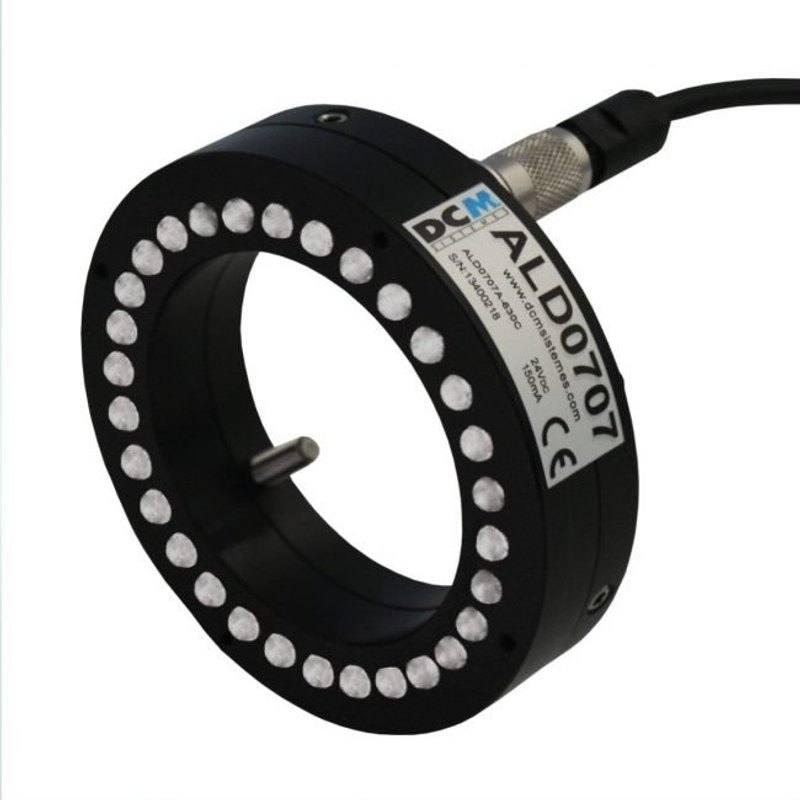
DCM Sistemes ALD0707A Direct Ring Light

ALD0707A

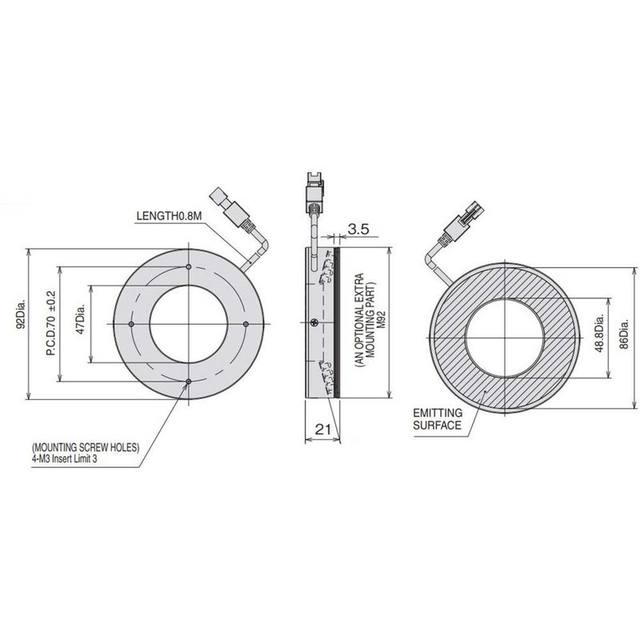
The ALD0707A is a Ø90 x 21 mm direct ringlight with a 60 mm inner diameter and a recommended working distance greater than 120 mm, housed in black anodized aluminium with an IP40 rating. It is available in multiple wavelengths (UV 365/400 nm, blue 470 nm, green 525 nm, red 630 nm, IR 850 nm, RGB and white W00) and in continuous (Type C), pulsed (Type P), strobe (Type S) and iBlueDrive-powered (Type i) operating modes. Standard 24 VDC continuous-mode consumption is around 2.5-3.5 W depending on color, supplied through a 2-pin male chassis connector, while iBlueDrive versions integrate the inline ST00 driver on a 3-pin aerial cable. It weighs 175 g and operates between 0 and 40 ºC.

Brand
DCM Sistemes
Lighting type
Ring (direct ringlight)
Color / wavelength
Red 630 nm (representative; also UV 365/400 nm, blue 470 nm, green 525 nm, IR 850 nm, RGB, white W00)
Mode
Continuous (Type C); also pulsed (P), strobe (S) and iBlueDrive overdrive (Type i)
Working distance
RWD >120 mm
Controller required
No for continuous/pulsed 24 VDC; strobe needs VS series controller, iBlueDrive Type i integrates inline ST00 driver
IP rating
IP40 (IP43 if mounted so light falls vertically)
Inner diameter
Ø60 mm inner diameter
Available wavelengths
UV 365 nm, UV 400 nm, Blue 470 nm, Green 525 nm, Red 630 nm, IR 850 nm, RGB, White (W00)
Driver technology
iBlueDrive (inline ST00 driver on Type i / iBlueDrive versions)
Power consumption
Continuous 24 VDC: 2.5 W (470/525 nm), 3.5 W (630 nm), 2 W (850 nm); strobe up to 16 W
Supply voltage
24 VDC ±3%

Technical overview

The ALD0707A is a direct (bright-field) LED ring light from DCM Sistemes' ALD series, built into a compact aluminium body measuring Ø90 x 21 mm with a Ø60 mm inner clear aperture and weighing 175 g. The ring mounts coaxially around the camera lens so its LEDs project light along, and close to, the optical axis. With a recommended working distance greater than 120 mm, the illuminated cone is broad rather than tightly grazing, which makes this a general-purpose front light: it floods the part with even, near-axial illumination that brings up surface markings, printed text and edges. Because the light enters from the same side as the camera, specular and matte features both return signal, but steep or polished surfaces can throw hot spots back into the lens, so the geometry favours flatter, more diffuse parts at this distance.

The unit is offered across an unusually wide wavelength range — UV at 365 and 400 nm, blue 470 nm, green 525 nm, red 630 nm, IR 850 nm, plus RGB and white (W00) — which lets the same mechanical part be tuned to the contrast problem at hand. Red 630 nm (the representative SKU here) penetrates and reflects well off many substrates and pairs cleanly with monochrome sensors; blue and green sharpen fine surface detail and printed contrast; IR 850 nm cuts through some surface colour to read underlying structure; and UV excites fluorescence for adhesive, coating or security-mark verification. Drive current per colour is modest in continuous mode — around 2.5 W at 470/525 nm, 3.5 W at red 630 nm and 2 W at IR 850 nm on a 24 VDC ±3% supply — so the lamp runs cool enough to sit at 0–40 ºC ambient without active cooling.

Four operating modes share the same housing. Type C is plain continuous DC, wired through a 2-pin male chassis connector (PIN1 = +24 V ±3%, PIN2 = 0 V) and needing no external controller, which suits steady inspection stations and slow-moving or stationary parts. Type P (pulsed) and Type S (strobe) trade duty cycle for brightness — strobe pushes the LEDs up to 16 W to freeze motion or beat ambient light, but Type S requires a DCM VS-series controller to time and current-limit the flash. The Type i / iBlueDrive variant integrates the inline ST00 driver on a 3-pin aerial cable, delivering overdrive intensity from a self-contained module without a separate rack controller. The aluminium housing carries an IP40 rating (IP43 when oriented so light falls vertically and debris cannot settle on the emitter), so this is a light for clean-to-moderate factory environments rather than washdown lines.

Best for

  • Near-axial surface and print inspection of flat, diffuse parts at working distances beyond 120 mm, where even bright-field flood improves edge and texture contrast
  • OCR/OCV and reading of printed or laser-marked text on labels, electronics and packaging, choosing red 630 nm or blue 470 nm to maximise character contrast on monochrome cameras
  • Traceability and code reading (1D/2D marks) on components where consistent on-axis illumination is needed to expose mark edges
  • Fluorescence-based checks — adhesive bead, coating coverage or security marks — using the UV 365/400 nm variants of the same ring
  • High-speed or motion-blur-sensitive stations using the strobe (Type S, up to 16 W) or iBlueDrive (Type i) variants to freeze moving parts on conveyors

Selection notes

  • Choose the wavelength at design-in: the ALD0707A is one mechanical part across UV 365/400, blue 470, green 525, red 630, IR 850, RGB and white W00 — match it to the feature contrast (UV for fluorescence, blue/green for fine surface detail, red/IR for substrate penetration) rather than ordering a default colour.
  • Match the operating mode to your trigger and motion: continuous (Type C) and pulsed (Type P) run directly from 24 VDC with no controller, but strobe (Type S) requires a DCM VS-series controller and the high-intensity iBlueDrive option (Type i) needs the inline ST00 driver and a 3-pin aerial cable instead of the 2-pin chassis connector.
  • Confirm the geometry fits the optics: the Ø60 mm inner aperture must clear your lens and its mount, the Ø90 x 21 mm body must fit the camera-to-part gap, and the recommended working distance >120 mm sets where the flood is most even — closer or polished targets may produce specular hot spots from this direct, on-axis ring.
  • Check the environment against IP40 (IP43 only when mounted so light falls vertically): this rating suits clean to moderate factory cells, not high-pressure washdown or heavy particulate areas, and the 0–40 ºC operating window must cover the enclosure temperature.
  • Budget the power and supply: continuous draw is low (about 2.5 W at 470/525 nm, 3.5 W at 630 nm, 2 W at 850 nm) on a tightly regulated 24 VDC ±3% rail, while strobe can momentarily reach 16 W — size the supply and any controller channel for the peak, not the continuous, figure.

Specifications: General
BrandDCM Sistemes
Lighting typeRing (direct ringlight)

Specifications: Interface
Connection2-pin male chassis connector (PIN1 = +24V ±3%, PIN2 = 0V); iBlueDrive version uses 3-pin aerial inline connector

Specifications: Optical
Color / wavelengthRed 630 nm (representative; also UV 365/400 nm, blue 470 nm, green 525 nm, IR 850 nm, RGB, white W00)
Working distanceRWD >120 mm
Available wavelengthsUV 365 nm, UV 400 nm, Blue 470 nm, Green 525 nm, Red 630 nm, IR 850 nm, RGB, White (W00)

Specifications: Electrical
ModeContinuous (Type C); also pulsed (P), strobe (S) and iBlueDrive overdrive (Type i)
Controller requiredNo for continuous/pulsed 24 VDC; strobe needs VS series controller, iBlueDrive Type i integrates inline ST00 driver
Driver technologyiBlueDrive (inline ST00 driver on Type i / iBlueDrive versions)
Power consumptionContinuous 24 VDC: 2.5 W (470/525 nm), 3.5 W (630 nm), 2 W (850 nm); strobe up to 16 W
Supply voltage24 VDC ±3%

Specifications: Environment
IP ratingIP40 (IP43 if mounted so light falls vertically)
Operating temperature0 to 40 ºC operating; 0 to 60 ºC storage

Specifications: Geometry
Inner diameterØ60 mm inner diameter

Specifications: Mechanical
Housing materialAnodized aluminium
DimensionsØ90 x 21 mm
Weight175 g

Frequently asked questions

Related technical guides

Rosepetal · AI

Test this camera with Rosepetal

Validate your visual inspection with AI: send us sample images and we evaluate the case on your hardware.

AIS Vision · Integration

We validate camera + lens + lighting

AIS Vision defines and tests the optimal combination of camera, optics and lighting for your application before you buy.