Omron / Sentech FLV-DR6030UV Direct Ring Light (UV, 64 mm dia.)
FLV-DR6030UV
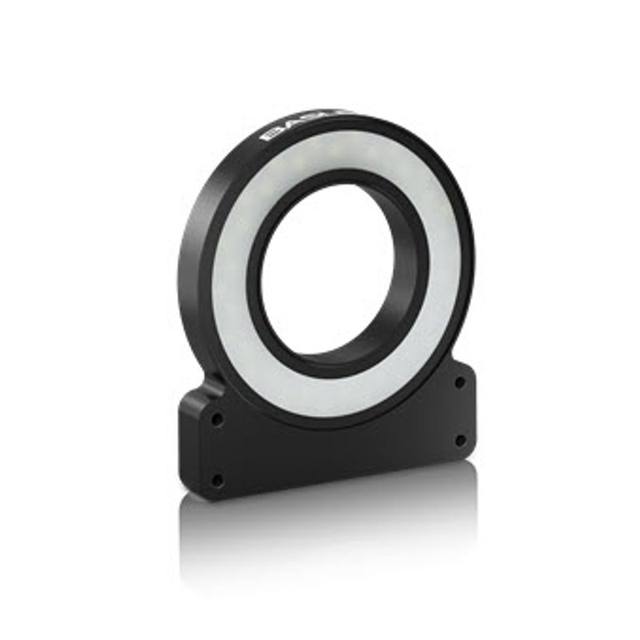
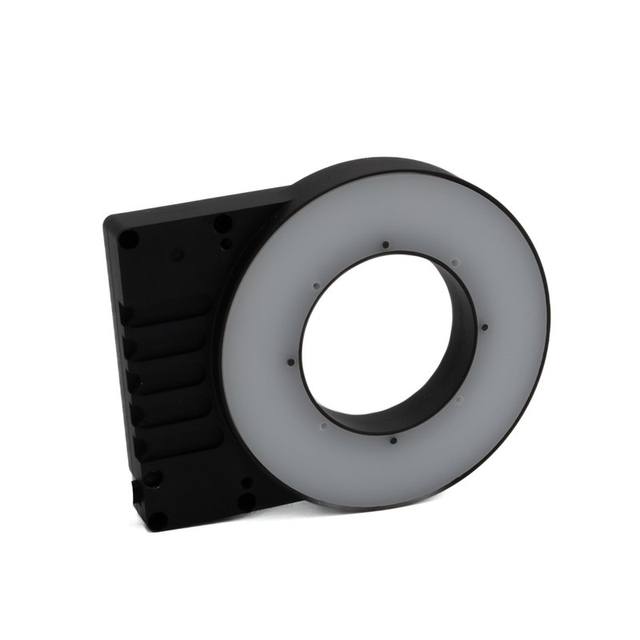
The FLV-DR6030UV is a UV variant of Omron's FLV-DR direct ring light, using high-density UV LED arrays with a typical peak wavelength of 385 nm in an aluminium-alloy case. It has a 64 mm external ring diameter, a 26.5 mm internal ring diameter, a 60 mm emitting surface and a 30-degree lighting angle, consuming 3.2 W and weighing about 90 g. The unit is driven by an Omron FLV-series Lighting Controller (FLV-TCC / FLV-ATC) at 24 VDC and supports both continuous and trigger (strobe) lighting via a 0.8 m cable. An optional FLV-DR diffusion plate is available for more uniform illumination.
Brand
Omron / Sentech
Lighting type
Direct ring light
Color / wavelength
Ultraviolet (UV)
Available wavelengths
UV (typ. 385 nm); FLV-DR series also offered in White, Red (635 nm), Blue (460 nm), Green (525 nm), IR (850 nm)
Mode
Continuous and trigger (strobe) lighting (via FLV lighting controller)
The FLV-DR6030UV is a direct ring light built around a high-density LED array tuned to a typical peak wavelength of 385 nm, placing it firmly in the near-ultraviolet band rather than the visible spectrum. Geometry is the defining trait of any ring light, and here the numbers are compact: a 64 mm outer diameter, a 26.5 mm clear inner aperture, and a roughly 56 mm emitting face (60 mm overall front face) that surrounds the lens and floods light onto the part from a tight, coaxial-leaning position. The specified 30-degree illumination angle is a moderate, semi-directional cone, broad enough to cover a small field without the harsh grazing extremes of a low-angle ring yet directional enough to bring out surface texture. Because it mounts close to the lens through its open center, this fixture is intended for small-to-medium parts imaged at relatively short working distance.
The reason to reach for UV specifically is what 385 nm light does that white light cannot. Many materials, coatings, adhesives, inks and contaminants fluoresce or absorb under near-UV excitation, so the FLV-DR6030UV is a tool for revealing features that are invisible or low-contrast under broadband illumination: UV-reactive security marks, fluorescent dye or adhesive presence/absence, residue and contamination on surfaces, and color-shifted defects in coatings. Paired with the optional FLV-DR diffusion plate the same fixture trades some intensity for far more uniform field illumination, which matters when you are reading subtle fluorescence rather than chasing specular highlights. Whether you run it bare or diffused is one of the core design choices this lamp leaves open to the integrator.
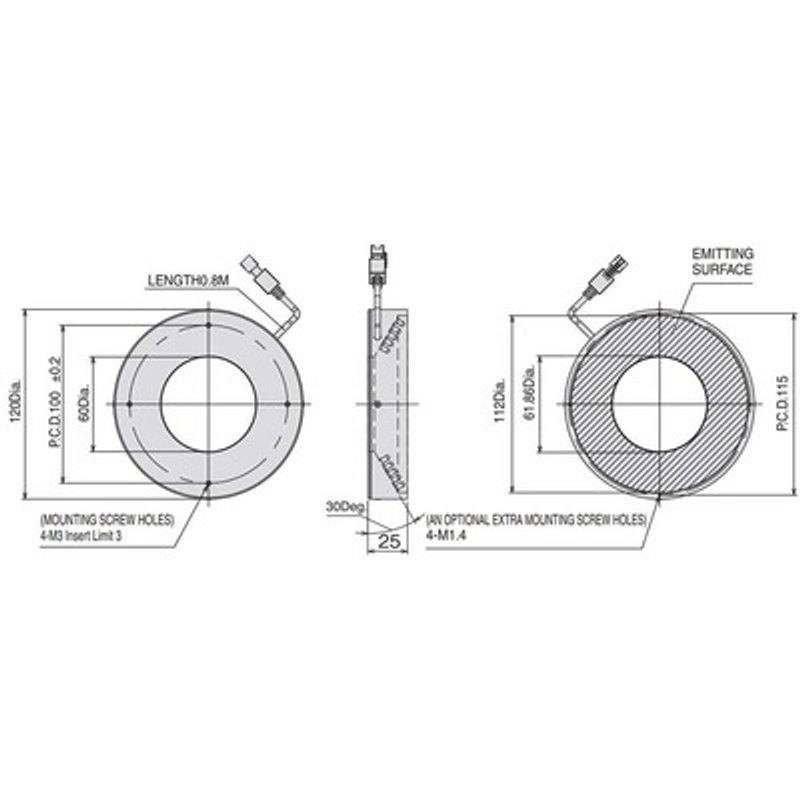
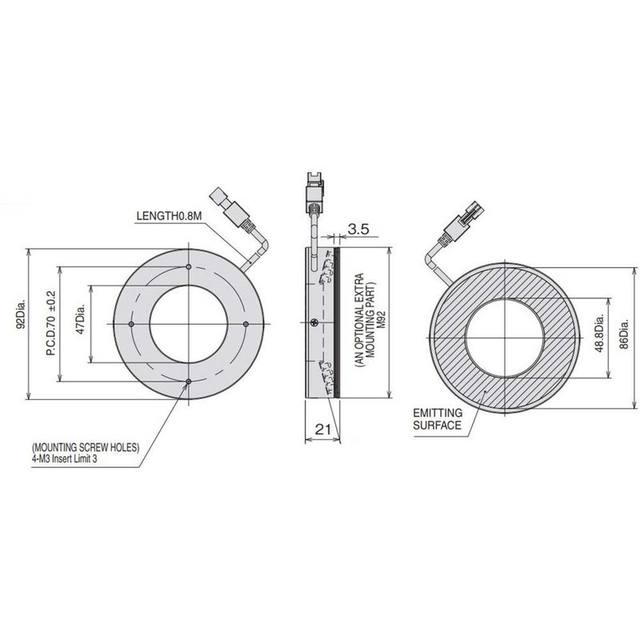
Electrically and mechanically the unit is built to drop into Omron's FLV ecosystem. It is not a standalone lamp: it draws 24 VDC and must be driven by an FLV-series lighting controller (FLV-TCC or FLV-ATC) over its fixed 0.8 m cable, and through that controller it supports both continuous operation and triggered strobe firing. Strobe capability is the key to freezing motion on a moving line and to over-driving the LEDs for brighter pulses synchronized to the camera, while continuous mode suits static or slow-indexing stations. Power draw is a modest 3.2 W and the whole assembly weighs about 90 g in an aluminium-alloy case that doubles as a heatsink. It bolts down through four M3 holes on a 50 mm PCD with a slim 19 mm profile, so it integrates into tight camera stations and existing FLV-driven cells without significant mechanical rework.
Best for
Detecting presence/absence of UV-fluorescent adhesives, glues, or sealants on assembled parts where the bond is invisible under white light
Reading UV-reactive security inks, anti-counterfeit marks, and covert codes on packaging and pharmaceutical labels
Surface contamination and residue inspection on electronics and machined components, where 385 nm excitation lifts contrast on otherwise low-contrast soiling
Coating, lacquer and clear-film inspection where fluorescence or UV absorption reveals coverage gaps, runs, or thin spots
Compact short-working-distance camera stations on small parts where the 64 mm ring mounts coaxially around the lens
Selection notes
This is a controller-dependent fixture: budget for an FLV-TCC or FLV-ATC lighting controller and 24 VDC supply, because the lamp cannot be run directly and the controller is what unlocks both continuous and strobe modes.
The 0.8 m cable length is fixed and integral, so confirm the controller can be located within that reach of the light or plan for the cable run accordingly during cell layout.
Decide up front whether you need the optional FLV-DR diffusion plate: bare gives maximum intensity and a more directional 30-degree cone, while the diffuser delivers more uniform fluorescence imaging at the cost of brightness, and it is a separate purchase.
Size the field to the optics, not the lamp: with a 56-60 mm emitting face, 26.5 mm inner aperture and 30-degree angle, this ring suits small parts at short working distance, so verify the lit area covers your field of view before committing.
Working with 385 nm near-UV requires camera and lens compatibility (UV-capable transmission and a sensor responsive at that wavelength) plus appropriate operator eye-safety and any optical filtering needed to separate excitation from the fluorescence you want to image.
Specifications: General
Brand
Omron / Sentech
Lighting type
Direct ring light
Specifications: Interface
Connection
0.8 m cable to FLV lighting controller
Specifications: Optical
Color / wavelength
Ultraviolet (UV)
Available wavelengths
UV (typ. 385 nm); FLV-DR series also offered in White, Red (635 nm), Blue (460 nm), Green (525 nm), IR (850 nm)
Diffuser
Optional diffusion plate (FLV-DR diffusion plate, sold separately)
Emission angle
30-degree illumination angle
Specifications: Electrical
Mode
Continuous and trigger (strobe) lighting (via FLV lighting controller)
These steps take an Omron Sentech (STC) camera from the box to a stable first image and on to your own application. They apply across the GigE Vision, USB3 Vision and CoaXPress STC families; the interface only changes how you cable and power the camera.
Download and install the Sentech SDK on the host PC. The package provides StViewer, the viewing and configuration software you use to bring the camera up, and StApi, the programming SDK you integrate later. Because the cameras are GenICam/GenTL-compliant, StApi also registers a GenTL producer, so any GenICam-compliant third-party vision software can discover and drive the camera as an alternative front end.
2. Cable, power and connect the camera
Connect according to the interface. GigE Vision: link to a Gigabit NIC (use PoE or the separate power input) and put the camera and host on the same subnet; for USB3 Vision use a USB 3.x port and a certified cable; for CoaXPress (STC) connect to a CoaXPress frame grabber, which also supplies Power-over-Coax. Then open StViewer and let it enumerate the camera. If a GigE camera does not appear, check the IP configuration and firewall, and on USB3 confirm the host bandwidth and driver.
3. Configure exposure, gain and white balance
Open the device in StViewer and start a live stream. Set exposure and gain for a well-exposed, low-noise image: raise exposure first and only add gain when more light or a faster shutter is not an option, keeping exposure short enough to freeze motion on global-shutter models. On colour cameras, run white balance under your actual production lighting. Adjust the lens aperture and focus on a representative target before tuning anything else.
4. Set the trigger and grab a first image
Start in free-run (continuous) acquisition to confirm a clean, stable image. For inline inspection switch to hardware or software triggering: select the trigger source, set the active edge and any delay, and wire the strobe or illumination to the camera's I/O so lighting fires with each exposure. Acquire and save a frame in StViewer; this saved image is your reference for the SDK stage and for downstream inspection.
5. Move to the StApi SDK (or any GenICam software)
Once the image is stable, reproduce the same settings in code. Use StApi to open the device, apply the GenICam features you validated in StViewer (exposure, gain, trigger, pixel format) and grab frames into your application via the bundled C++, C, C#/.NET or Python interfaces; the included samples are the fastest starting point. Prefer a different stack? The same GenICam/GenTL camera works with third-party vision libraries. With a reliable feed, you can route it into a deep-learning inspection such as Rosepetal for AI-based defect detection.
Frequently asked questions
It uses a high-density UV LED array with a typical peak wavelength of 385 nm (near-ultraviolet). The broader FLV-DR series is also offered in White, Red (635 nm), Blue (460 nm), Green (525 nm) and IR (850 nm), but this specific model is the UV variant.
Yes. The FLV-DR6030UV runs on 24 VDC supplied through an Omron FLV-series lighting controller (FLV-TCC or FLV-ATC) via its 0.8 m cable. The controller is also what enables both continuous and trigger (strobe) operation.
Yes. Through the FLV lighting controller it supports trigger (strobe) lighting as well as continuous mode, so it can be pulse-fired in sync with the camera to freeze motion on a line, or run steady for static stations.
The ring is 64 mm outer diameter, 26.5 mm inner diameter, and 19 mm high, with an emitting face of roughly 56 mm (60 mm overall front face). It mounts via four M3 holes on a 50 mm pitch-circle diameter, weighs about 90 g, and is built in an aluminium-alloy case.
Yes. An optional FLV-DR diffusion plate is sold separately. Adding it spreads the light for more uniform illumination, which is useful for even fluorescence imaging, at the cost of some intensity compared with the bare 30-degree cone.