Skip to content
DCM Sistemes ALD1108A machine vision lighting
  • Rosepetal compatible
  • Recommended by AIS Vision

DCM Sistemes ALD1108A Direct Ringlight

ALD1108A

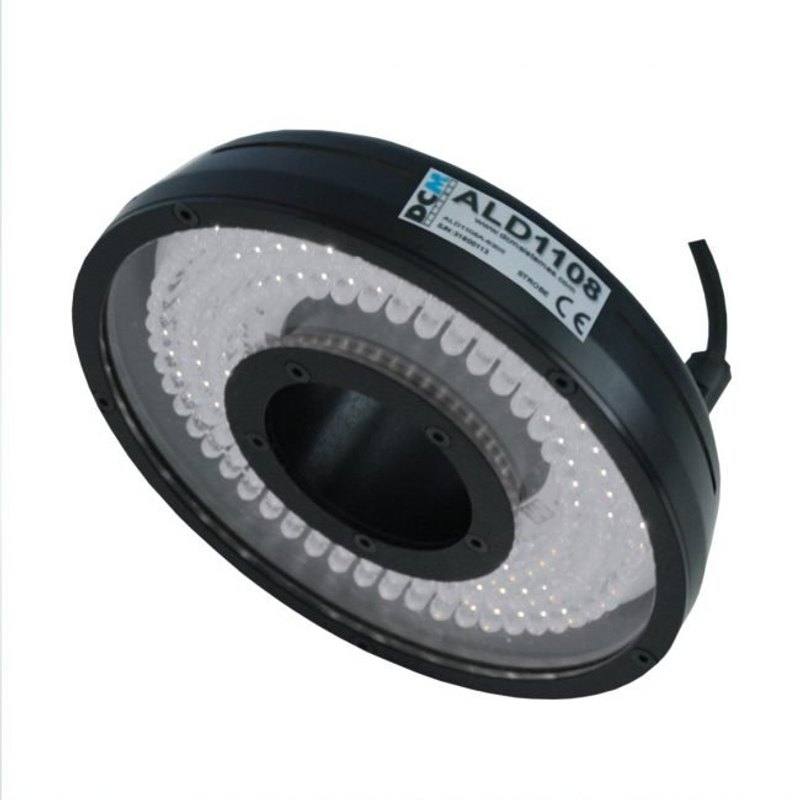
The ALD1108A is the top size of DCM Sistemes' ALD "Direct ringlights" family, a ring of high-power LEDs with a Ø145 x 41 mm anodized-aluminium housing, a 49 mm inner aperture and a recommended working distance greater than 160 mm. It runs on 24 VDC and is offered in continuous (Type C), powered/overdrive (Type P), strobe (Type S) and iBlueDrive (Type i) versions, the latter integrating a built-in iBlueDrive5 driver for continuous or strobe control via a 3P male chassis connector; standard Type C/P/S models use a 2P male chassis connector. It is available in UV (365/400 nm), blue (470 nm), green (525 nm), red (630 nm), IR (850/880 nm), white (W00) and RGB, with selectable narrow, medium (default) or wide emission angles. White continuous consumption is about 10 W and rated IP30, operating from 0 to 40 ºC.

Brand
DCM Sistemes
Lighting type
Ring light (direct / on-axis)
Color / wavelength
White (also UV 365/400, blue 470, green 525, red 630, IR 850/880, RGB)
Mode
Continuous (Type C), powered/overdrive (Type P), strobe (Type S), iBlueDrive (Type i)
Working distance
Recommended working distance >160 mm
Controller required
No external controller for continuous; strobe needs VS/VST/VSC series strobe controller, iBlueDrive integrates a built-in driver
IP rating
IP30 (IP43 if mounted so light falls vertically)
Inner diameter
Inner Ø 49 mm
Illuminated area
On-axis ring, Ø145 mm outer / Ø49 mm inner aperture
Emission angle
Selectable narrow (/AN), medium (/AM, default) or wide (/AW)
Available wavelengths
UV 365 nm, UV 400 nm, blue 470 nm, green 525 nm, red 630 nm, IR 850/880 nm, white W00, RGB
Driver technology
iBlueDrive5 built-in driver (continuous/strobe control)

Technical overview

The ALD1108A is the largest model in DCM Sistemes' ALD "Direct ringlights" family: a Ø145 x 41 mm anodized-aluminium ring of high-power LEDs that projects light directionally from close to the camera axis. Because the illumination arrives at a grazing/directional angle rather than diffusely, it deliberately emphasises shadows, surface texture and edges instead of washing them out. The Ø49 mm inner aperture lets the lens look straight through the ring at the part, so the camera mounts coaxially above the light, and the recommended working distance of greater than 160 mm sets how far that lens-plus-ring assembly should sit from the surface under test. With a Ø145 mm outer diameter this is a large emitter, so it suits correspondingly larger fields of view at that standoff rather than tiny close-up targets.

Wavelength and emission angle are the two levers that decide what this ring reveals. The unit is offered across UV (365/400 nm), blue (470 nm), green (525 nm), red (630 nm), IR (850/880 nm), white (W00) and RGB, and DCM lets you pick a narrow (/AN), medium (/AM, the default) or wide (/AW) emission angle. Shorter wavelengths such as UV and blue scatter more off fine surface structure and raise contrast on scratches, fibres and print, while red and IR penetrate or pass through certain materials and can suppress unwanted colour detail; the angle selection further tunes how concentrated the directional cone is at the >160 mm working distance. Choosing white gives broadband, colour-faithful illumination for general inspection, whereas a monochromatic colour paired with a matched optical filter is the route to maximum defect contrast.

Drive and integration are flexible, which matters for how you wire and trigger this light. It runs on 24 VDC (±3% continuous, ±8% powered) and ships in four modes: continuous (Type C), powered/overdrive (Type P), strobe (Type S) and iBlueDrive (Type i). Continuous needs no external controller; strobe requires a DCM VS/VST/VSC-series strobe controller; and the iBlueDrive version integrates a built-in iBlueDrive5 driver that handles continuous or strobe control on its own. Connection follows the mode — a 3P male chassis connector on iBlueDrive units and a 2P male chassis connector on Type C/P/S. White continuous draw is about 10 W, rising to roughly 51-70 W instantaneous in strobe depending on wavelength, so plan the supply for overdrive peaks. The black anodized-aluminium housing weighs 525 g, is rated IP30 (IP43 when mounted so light falls vertically) and operates from 0 to 40 °C, which positions it for controlled indoor inspection cells rather than washdown or harsh environments.

Best for

  • Surface and defect inspection where directional light is needed to throw scratches, dents, embossing and texture into relief through shadowing
  • AI-based defect inspection that benefits from high-contrast, raking illumination on metal, plastic or electronic surfaces
  • Dimensional measurement and edge-finding tasks at working distances beyond 160 mm with a moderately large field of view
  • Reading and verifying OCR/OCV text and printed/marked codes for traceability, using a monochromatic wavelength plus matched filter to boost print contrast
  • High-speed inspection lines using the strobe (Type S) or iBlueDrive (Type i) modes to freeze motion and overdrive intensity for short exposures

Selection notes

  • Confirm geometry fits your optics: the Ø145 mm outer / Ø49 mm inner aperture means the lens must clear the 49 mm bore and the camera sits coaxially above the ring at a recommended working distance greater than 160 mm — this is a large ring suited to larger FOVs, not close-up macro work.
  • Pick the drive mode before specifying the connector: continuous (Type C) needs no controller, strobe (Type S) requires a VS/VST/VSC strobe controller, and iBlueDrive (Type i) bundles an iBlueDrive5 driver. Type C/P/S use a 2P male chassis connector while iBlueDrive uses a 3P, so wiring differs.
  • Size the 24 VDC supply for the mode: about 10 W for white continuous but up to roughly 51-70 W instantaneous in strobe depending on wavelength, and respect the ±3% (continuous) / ±8% (powered) voltage tolerance to protect the LEDs.
  • Choose wavelength and emission angle for the inspection task: white for colour-faithful general use, or UV/blue/green/red/IR (with a matched filter) for contrast on specific defects; select narrow (/AN), medium (/AM default) or wide (/AW) to control the directional cone at your standoff.
  • Check the environment: IP30 (only IP43 if mounted so light falls vertically) and a 0-40 °C operating range mean this is for clean, temperature-controlled indoor cells, not washdown or hot/dusty areas. Allow for the 525 g weight on the mounting fixture.

Specifications: General
BrandDCM Sistemes
Lighting typeRing light (direct / on-axis)

Specifications: Interface
Connection3P male chassis connector (iBlueDrive); 2P male chassis connector (Type C/P/S)

Specifications: Optical
Color / wavelengthWhite (also UV 365/400, blue 470, green 525, red 630, IR 850/880, RGB)
Working distanceRecommended working distance >160 mm
Emission angleSelectable narrow (/AN), medium (/AM, default) or wide (/AW)
Available wavelengthsUV 365 nm, UV 400 nm, blue 470 nm, green 525 nm, red 630 nm, IR 850/880 nm, white W00, RGB

Specifications: Electrical
ModeContinuous (Type C), powered/overdrive (Type P), strobe (Type S), iBlueDrive (Type i)
Controller requiredNo external controller for continuous; strobe needs VS/VST/VSC series strobe controller, iBlueDrive integrates a built-in driver
Driver technologyiBlueDrive5 built-in driver (continuous/strobe control)
Power consumption~10 W (white, continuous); up to ~51-70 W instantaneous in strobe depending on wavelength
Supply voltage24 VDC (±3% continuous, ±8% powered)

Specifications: Environment
IP ratingIP30 (IP43 if mounted so light falls vertically)
Operating temperature0 to 40 °C (storage 0 to 60 °C)

Specifications: Geometry
Inner diameterInner Ø 49 mm
Illuminated areaOn-axis ring, Ø145 mm outer / Ø49 mm inner aperture

Specifications: Mechanical
Housing materialAnodized aluminium (black)
DimensionsØ145 x 41 mm
Weight525 g

Frequently asked questions

Related technical guides

Rosepetal · AI

Test this camera with Rosepetal

Validate your visual inspection with AI: send us sample images and we evaluate the case on your hardware.

AIS Vision · Integration

We validate camera + lens + lighting

AIS Vision defines and tests the optimal combination of camera, optics and lighting for your application before you buy.