Skip to content
DCM Sistemes ALU0704A machine vision lighting
  • Rosepetal compatible
  • Recommended by AIS Vision

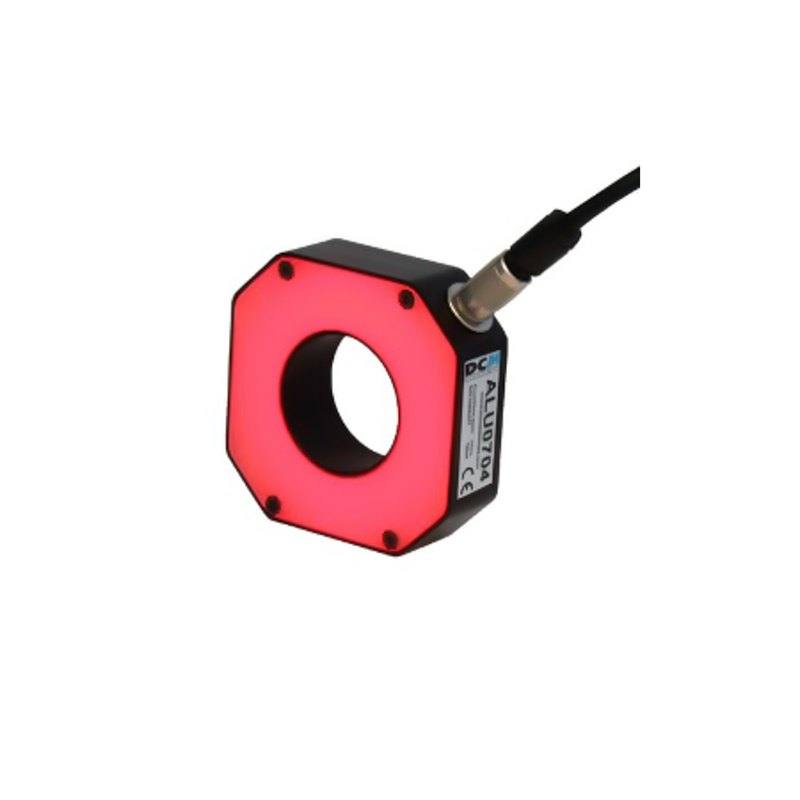
DCM Sistemes ALU0704A Ultra-Diffuse Ringlight

ALU0704A

The ALU0704A is part of DCM Sistemes' ALU series of ultra-diffuse ringlights, measuring 75x75x22 mm with a 37 mm inner diameter, weighing 130 g and rated IP40 (IP43 when light falls vertically). It is powered by 24 VDC ±3% through a 2-pin male chassis connector and is available in White (W00), Blue (470 nm), Green (525 nm), Red (630 nm), IR (850 nm) and RGB versions, with a recommended working distance below 120 mm. Continuous (Type C) consumption is 3.4 W for white/blue/green and 3.8 W for red/IR; strobe (Type S) mode draws 530 mA / 13 W (1255 mA / 30 W for IR) and requires a VST/VSC-series strobe controller. An optional iBlueDrive (Type i) overdrive variant integrates an inline driver for strobe/continuous powered operation via a 3-pin aerial connector.

Brand
DCM Sistemes
Lighting type
Ring light (ultra-diffuse ringlight)
Color / wavelength
White (W00); also Blue 470 nm, Green 525 nm, Red 630 nm, IR 850 nm, RGB
Available wavelengths
White (W00), Blue 470 nm, Green 525 nm, Red 630 nm, IR 850 nm, RGB
Mode
Continuous (Type C); Strobe (Type S) and iBlueDrive overdrive (Type i) variants available
Working distance
< 120 mm (recommended working distance)
Inner diameter
Inner Ø 37 mm
Diffuser
Yes (ultra-diffuse emission)
Emission angle
Diffuse emission
Controller required
No for continuous (24 VDC direct); strobe mode requires VST/VSC-series controller
IP rating
IP40 (IP43 if light falls vertically)
Power consumption
3.4 W (continuous, white/blue/green); 3.8 W red/IR; 13 W strobe (530 mA)

Technical overview

The ALU0704A is an ultra-diffuse LED ring light built to mount around the lens on the camera axis and flood a small part with even, shadow-free frontal light. Its geometry is the defining feature for an installer: a compact 75 x 75 x 22 mm black-anodized aluminium body with a 37 mm inner diameter that the lens looks through, and a recommended working distance under 120 mm. Because the emission is ultra-diffuse rather than a tight cone, the ring does not paint bright hotspots onto glossy parts the way a clear-LED ring would. That makes it specifically suited to bright or specular shining objects, where directional light produces glare that swamps the feature you are trying to read. Diffuse frontal light of this kind reveals printed marks, surface texture and shape on reflective material while suppressing the mirror reflections that defeat ordinary ring lights.

Electrically the part is straightforward to wire in continuous mode: it runs on 24 VDC plus or minus 3 percent through a 2-pin male chassis connector (PIN1 +24 V, PIN2 0 V), drawing 3.4 W in white, blue or green and 3.8 W in red or IR, with no controller required. Note the VCB-series power cable is not included and must be ordered separately. The light is offered in White (W00), Blue 470 nm, Green 525 nm, Red 630 nm, IR 850 nm and an RGB version, which lets you tune contrast to the target: a wavelength that the defect absorbs or reflects differently from the background sharpens edges in monochrome imaging, while the RGB variant supports multi-channel color setups. For applications that need to freeze motion or boost output, a Strobe (Type S) variant draws 530 mA / 13 W (1255 mA / 30 W for IR) but then requires a VST/VSC-series strobe controller, and an iBlueDrive (Type i) overdrive version integrates an inline driver and uses a 3-pin aerial connector with a wider plus/minus 8 percent supply tolerance.

Mechanically and environmentally the ALU0704A targets benchtop and lightly-protected cell installations rather than washdown lines. At 130 g it is light enough to hang off a small camera bracket, and the aluminium housing helps dissipate heat across the 0 to 40 C operating range (0 to 60 C storage). The IP40 rating (rising to IP43 only when light falls vertically) means it resists solid objects but offers minimal liquid protection, so an installer should keep it away from direct spray and coolant. Combined with the sub-120 mm working distance and 37 mm aperture, this is a near-field illuminator dimensioned for small components, code fields and local surface zones rather than large-area or long-standoff inspection.

Best for

  • Reading printed text and 2D/DPM codes on bright or specular metal and foil packaging, where a diffuse frontal ring suppresses the glare that defeats clear-LED rings
  • Surface and defect inspection of small reflective components such as machined metal, electronic parts and glossy plastics within a sub-120 mm working distance
  • Shadow-free frontal illumination of small parts viewed through the 37 mm aperture in benchtop or compact inspection cells
  • Wavelength-tuned contrast tasks (Blue 470 nm, Green 525 nm, Red 630 nm or IR 850 nm) to separate a feature from its background in monochrome imaging
  • Strobed high-speed or motion-freezing inspection on moving lines when ordered as the Type S variant with a VST/VSC controller

Selection notes

  • Confirm the geometry fits your part: the recommended working distance is under 120 mm and the camera images through a 37 mm inner diameter, so this is a near-field light sized for small targets, not large-area or long-standoff scenes.
  • Choose the wavelength deliberately. White (W00) is general-purpose, but Blue/Green/Red monochromatic versions maximize contrast for specific defects and the IR 850 nm or RGB variants serve specialized or multi-channel needs; the wavelength is fixed at order time per unit.
  • Decide continuous versus strobe up front. Continuous (Type C) runs directly from 24 VDC with no controller, but if you need strobe output you must order the Type S variant and budget for a VST/VSC-series strobe controller; the iBlueDrive (Type i) overdrive version uses a different 3-pin connector and a wider plus/minus 8 percent supply tolerance.
  • Plan the cabling: the continuous unit uses a 2-pin male chassis connector at 24 VDC plus or minus 3 percent, and the VCB-series power cable is not included, so it must be specified separately.
  • Respect the environmental limits. The IP40 rating (only IP43 with light falling vertically) and 0 to 40 C operating range make this suitable for clean or lightly-protected cells, not high-pressure washdown or coolant-exposed stations.

Specifications: General
BrandDCM Sistemes
Lighting typeRing light (ultra-diffuse ringlight)

Specifications: Interface
Connection2-pin male chassis connector (PIN1 +24V, PIN2 0V); VCB-series power cable not included

Specifications: Optical
Color / wavelengthWhite (W00); also Blue 470 nm, Green 525 nm, Red 630 nm, IR 850 nm, RGB
Available wavelengthsWhite (W00), Blue 470 nm, Green 525 nm, Red 630 nm, IR 850 nm, RGB
Working distance< 120 mm (recommended working distance)
DiffuserYes (ultra-diffuse emission)
Emission angleDiffuse emission

Specifications: Electrical
ModeContinuous (Type C); Strobe (Type S) and iBlueDrive overdrive (Type i) variants available
Controller requiredNo for continuous (24 VDC direct); strobe mode requires VST/VSC-series controller
Power consumption3.4 W (continuous, white/blue/green); 3.8 W red/IR; 13 W strobe (530 mA)
Supply voltage24 VDC ±3% (continuous, 2P chassis); ±8% via iBlueDrive

Specifications: Environment
IP ratingIP40 (IP43 if light falls vertically)
Operating temperature0 to 40 C (operating); storage 0 to 60 C

Specifications: Geometry
Inner diameterInner Ø 37 mm

Specifications: Mechanical
Housing materialBlack anodized aluminium
Dimensions75 x 75 x 22 mm
Weight130 g

Frequently asked questions

Related technical guides

Rosepetal · AI

Test this camera with Rosepetal

Validate your visual inspection with AI: send us sample images and we evaluate the case on your hardware.

AIS Vision · Integration

We validate camera + lens + lighting

AIS Vision defines and tests the optimal combination of camera, optics and lighting for your application before you buy.