Skip to content
DCM Sistemes ALU1006A machine vision lighting
  • Rosepetal compatible
  • Recommended by AIS Vision

DCM Sistemes ALU1006A Ultra-Diffuse Ringlight

ALU1006A

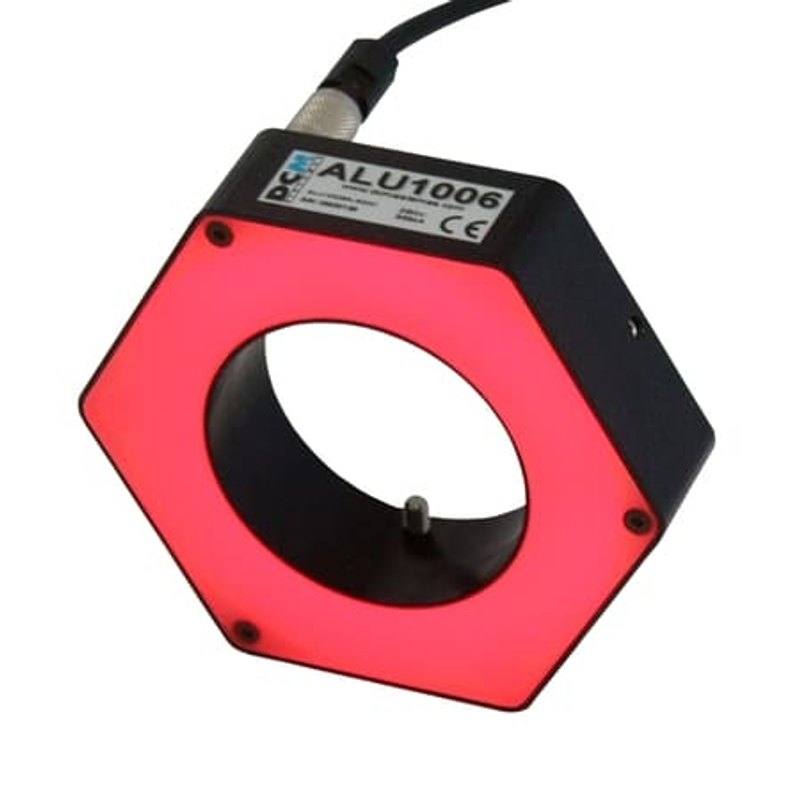
The ALU1006A belongs to DCM Sistemes' ALU series of "ultra-diffuse" ringlights, with external dimensions of 100x100x27.5 mm and a 61 mm internal diameter for through-the-ring camera viewing. It is offered in blue (470 nm), green (525 nm), red (630 nm), IR (850 nm), RGB and white (W00), and in continuous, strobe and iBlueDrive (overdrive) versions powered from 24 VDC. The aluminium-housed unit carries an IP40 rating and uses a 2-pole chassis connector for continuous/strobe types (3-pole aerial for iBlueDrive, 4-pole for RGB strobe), with external strobe/iBlueDrive controllers required for those modes. The diffuse emission makes it suited to inspecting shiny, specular or textured parts such as labels, packaging and substrates.

Brand
DCM Sistemes
Lighting type
Ring light (ultra-diffuse)
Diffuser
Yes - ultra-diffuse emission
Emission angle
Diffuse (ultra-diffuse, 0deg directional)
Color / wavelength
White (W00); also blue 470nm, green 525nm, red 630nm, IR 850nm, RGB
Available wavelengths
Blue 470nm, Green 525nm, Red 630nm, IR 850nm, RGB, White (W00)
Mode
Continuous, Strobe, iBlueDrive (overdrive)
Inner diameter
61 mm
Dimensions
100 x 100 x 27.5 mm
Supply voltage
24 VDC +/-3% (continuous); 24 VDC +/-8% (iBlueDrive)
Power consumption
5.5 W (green 525nm, continuous)
Connection
2-pole chassis connector (continuous/strobe); 3-pole aerial (iBlueDrive); 4-pole chassis (RGB strobe)

Technical overview

The DCM Sistemes ALU1006A is a ring-geometry illuminator built around an ultra-diffuse emission rather than a directional beam. Where a conventional bright-field ring throws light at a defined angle and produces hotspots on shiny parts, this unit's diffuser spreads the LED output across a wide, soft field (specified as ultra-diffuse, 0deg directional), so the camera sees an even wash of light instead of mirror-like reflections. In practice that is what makes it the right tool for specular, curved or glossy surfaces: labels, foil and plastic packaging, coated substrates and rounded parts that would otherwise saturate sensor pixels under hard light. The 61 mm internal diameter is the working feature here, because the camera looks through the ring at the part below, keeping the optical axis coaxial with the illumination for a symmetric, shadow-minimised view.

Geometrically the housing is a compact 100 x 100 x 27.5 mm aluminium square, so it bolts down as a panel-style ring over a part rather than as a large dome, and the metal body helps dissipate heat from the LEDs in continuous duty. The light is offered across a full wavelength menu - white W00 plus blue 470 nm, green 525 nm, red 630 nm, IR 850 nm and an RGB variant - which lets the integrator tune contrast to the target: monochromatic light sharpens edge and print contrast and works cleanly with a matched bandpass filter, IR can improve contrast on some inks and dyes, and white/RGB suit color verification. The catalogued power figure of 5.5 W applies to the green 525 nm continuous build, a useful anchor for sizing the 24 VDC supply, though draw will vary by color and drive mode.

The unit runs from 24 VDC and is sold in three drive modes that determine the wiring and whether external electronics are needed. Continuous mode (24 VDC +/-3%) is the simplest: a 2-pole chassis connector straight to a regulated supply, no controller, ideal when the camera runs free or at moderate frame rates and ambient stability is acceptable. Strobe also uses the 2-pole chassis connector but requires an external strobe controller (DCM cites VST/VSC families), and the RGB strobe variant uses a 4-pole chassis connector to switch channels. The iBlueDrive overdrive option (24 VDC +/-8%, 3-pole aerial connector) drives the LEDs above continuous current in short pulses for higher peak intensity, which is how you freeze fast-moving parts or shorten exposure on a fast line - but it must be paired with its overdrive controller and tied to the camera trigger. One caveat to design around: the IP40 rating means this light is protected against solid objects but not water or washdown, so it belongs in dry, enclosed inspection stations rather than open food-wash or wet automotive cells.

Best for

  • Inspecting shiny, specular or foil packaging and labels where directional light would create glare hotspots, using the ultra-diffuse wash for even brightness
  • Print and OCR/OCV verification on glossy substrates, with a monochromatic color (e.g. red 630 nm or green 525 nm) chosen to maximize text-to-background contrast
  • Reading 1D/2D codes and traceability marks on reflective or laminated surfaces through the 61 mm camera-viewing aperture
  • Surface and defect inspection of curved or coated parts in electronics, automotive and printing, where the diffuse emission suppresses reflection-driven false defects
  • High-speed line inspection when ordered in the iBlueDrive overdrive version, freezing motion with short high-intensity pulses synchronized to the camera trigger

Selection notes

  • Confirm the geometry fits your station: the camera must look through the 61 mm inner ring, and the 100 x 100 x 27.5 mm aluminium body needs clearance to mount coaxially above the part - this is a flat ring, not a dome, so very deep concavities may still self-shadow.
  • Choose the drive mode up front because it dictates wiring and bill of materials: continuous needs only 24 VDC on a 2-pole chassis connector, strobe also uses the 2-pole chassis connector but adds an external strobe controller, RGB strobe uses a 4-pole chassis connector, and iBlueDrive uses a 3-pole aerial connector - strobe and iBlueDrive both require their matching external controller (VST/VSC for strobe, the overdrive controller for iBlueDrive).
  • Select the wavelength to suit the contrast problem rather than defaulting to white: monochromatic blue/green/red plus a matched bandpass filter rejects ambient light and sharpens features, IR 850 nm can lift contrast on some inks, and RGB/white serve color inspection - the W00 white is the baseline variant here.
  • Size the 24 VDC supply against the actual color and mode; the published 5.5 W figure is specifically for green 525 nm continuous, so budget headroom for other colors and especially for overdrive peak current.
  • Respect the IP40 rating - this light is rated against solid ingress only, not liquids, so it is intended for dry, enclosed inspection cells and is not suitable for washdown or wet environments without additional protection.

Specifications: General
BrandDCM Sistemes
Lighting typeRing light (ultra-diffuse)

Specifications: Interface
Connection2-pole chassis connector (continuous/strobe); 3-pole aerial (iBlueDrive); 4-pole chassis (RGB strobe)

Specifications: Optical
DiffuserYes - ultra-diffuse emission
Emission angleDiffuse (ultra-diffuse, 0deg directional)
Color / wavelengthWhite (W00); also blue 470nm, green 525nm, red 630nm, IR 850nm, RGB
Available wavelengthsBlue 470nm, Green 525nm, Red 630nm, IR 850nm, RGB, White (W00)

Specifications: Electrical
ModeContinuous, Strobe, iBlueDrive (overdrive)
Supply voltage24 VDC +/-3% (continuous); 24 VDC +/-8% (iBlueDrive)
Power consumption5.5 W (green 525nm, continuous)
Controller requiredYes for strobe/RGB (strobe controller) and iBlueDrive; not for continuous
Driver technologyiBlueDrive overdrive driver option; external strobe controllers (VST/VSC)

Specifications: Environment
IP ratingIP40

Specifications: Geometry
Inner diameter61 mm

Specifications: Mechanical
Dimensions100 x 100 x 27.5 mm
Housing materialAluminium

Frequently asked questions

Related technical guides

Rosepetal · AI

Test this camera with Rosepetal

Validate your visual inspection with AI: send us sample images and we evaluate the case on your hardware.

AIS Vision · Integration

We validate camera + lens + lighting

AIS Vision defines and tests the optimal combination of camera, optics and lighting for your application before you buy.