Skip to content
DCM Sistemes DOM3218A machine vision lighting
  • Rosepetal compatible
  • Recommended by AIS Vision

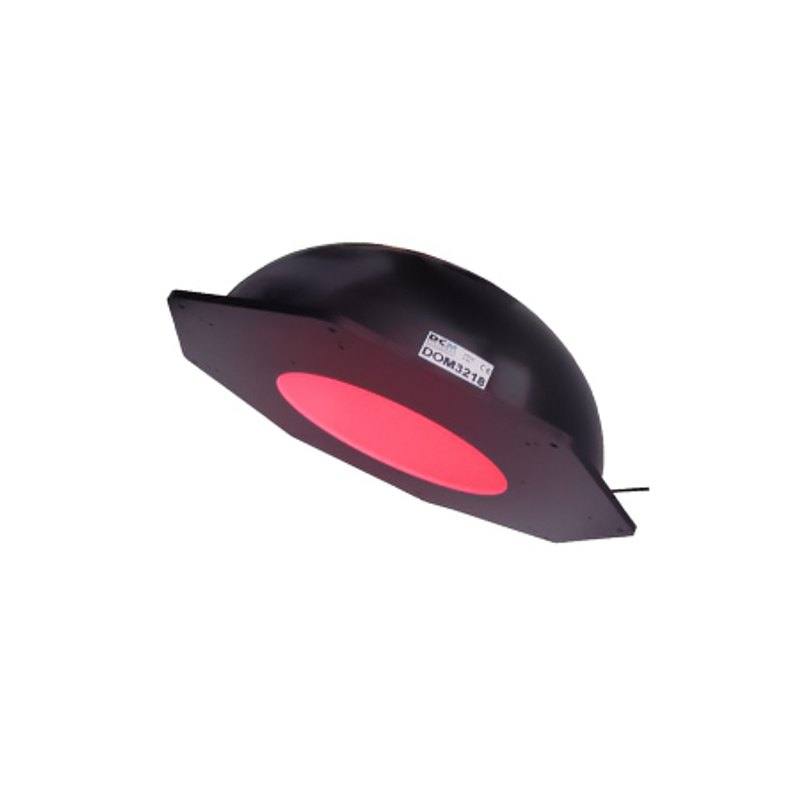
DCM Sistemes DOM3218A Dome Light

DOM3218A

The DOM3218A is a dome (hemispherical diffuse) illuminator in DCM Sistemes' DOM series, with a 337 x 337 x 116 mm anodized-aluminium housing and a 180 mm bottom aperture, weighing 1240 g. It runs on 24 VDC via a 2P flying-leads connection (BN +24V +/-3%, BU 0V), with a recommended working distance under 20 mm, and draws about 29 W in continuous white/blue/green, 33 W in red and 40 W in IR. It is available in monochromatic 470 nm blue, 525 nm green, 630 nm red, 850 nm IR, white and RGB versions, in continuous (Type C), strobe (Type S) or iBlueDrive intelligent (Type i, integrated strobe controller) modes. It ships at IP00 (optional IP65 modifier) and operates from 0 to 40 C; typical uses include detecting cracks, chips, stains and marks on circular objects plus solder, substrate and can inspection.

Brand
DCM Sistemes
Lighting type
Dome (diffuse 'cloudy-day' dome)
Color / wavelength
White (also 470nm blue, 525nm green, 630nm red, 850nm IR, RGB)
Available wavelengths
White, Blue 470nm, Green 525nm, Red 630nm, IR 850nm, RGB
Mode
Continuous (Type C), Strobe (Type S), iBlueDrive intelligent (Type i)
Working distance
< 20 mm (recommended working distance, RWD)
Controller required
No (Type C continuous / Type i iBlueDrive integrated controller; Type S needs external strobe controller)
Diffuser
Yes (diffuse dome illumination)
IP rating
IP00 (IP65 available as modifier)
Inner diameter
180 mm (bottom aperture diameter)
Emission angle
Diffuse (multiple angles of incidence)
Driver technology
iBlueDrive integrated strobe controller (Type i variant)

Technical overview

The DOM3218A is a dome (hemispherical diffuse) illuminator from DCM Sistemes' DOM series. Light enters the hemisphere off-axis and bounces repeatedly off the painted interior before reaching the part, so the object is bathed in soft, multi-directional 'cloudy-day' illumination through the 180 mm bottom aperture. The camera looks down through a hole at the top of the dome, on-axis with the part. The practical consequence of this geometry is that there is no single dominant angle of incidence: specular highlights, hot-spots and cast shadows that would normally appear on shiny, curved or textured surfaces are averaged out. That makes the DOM3218A suited to the surfaces engineers struggle with under directional ring or bar lights, namely glossy metal, curved cans, solder joints and plated substrates, where the spec sheet calls out crack, chip, stain, mark, solder, substrate and can inspection.

Electrically the head runs on 24 VDC (+24 V +/-3%) delivered through a 2P flying-leads tail (BN = +24 V, BU = 0 V, L = 180 mm), so it wires directly to a standard machine-vision power rail without a connectorised pigtail. Current draw depends on the emitter: about 29 W continuous in white, 470 nm blue and 525 nm green, rising to 33 W in 630 nm red and 40 W in 850 nm IR, which is the power budget you must allocate per fixture and the heat the 0 to 40 C rating has to dissipate. It is offered in three drive modes: Type C continuous, Type S strobe (which needs an external strobe controller), and Type i with the integrated iBlueDrive intelligent strobe controller. Because Type C and Type i carry their own drive, the controller-required flag is effectively 'no' for those variants; only the Type S strobe version depends on an external controller, a distinction worth nailing down at the order stage.

Mechanically this is a substantial fixture: a 337 x 337 x 116 mm anodized-aluminium housing weighing 1240 g, so the mounting bracket and any robot or gantry that carries it must be sized for that mass and footprint. The defining constraint, however, is the recommended working distance of under 20 mm. The part has to sit very close to the 180 mm aperture for the diffuse field to wrap around it properly, which dictates camera focal length, depth of field and the mechanical clearance of your conveyor or fixture. The light ships at IP00 (bare, no ingress protection) with an optional IP65 modifier, so the standard unit belongs in a clean, dry, enclosed station, while wet, dusty or washdown lines should specify the sealed variant up front.

Best for

  • Imaging shiny or curved metal parts (cans, lids, machined components) where directional light would throw glare and shadows, using the dome's off-axis diffuse field to flatten specular highlights
  • Detecting cracks, chips, stains and surface marks on circular and reflective objects, the exact defect set the DOM series is specified for
  • Electronics inspection of solder joints and plated substrates, where mixed-reflectivity surfaces need even, shadow-free illumination
  • Packaging and surface inspection on lines that can tolerate a sub-20 mm working distance between part and aperture
  • Wavelength-selective surface or contrast tasks using the monochromatic options (470 nm blue, 525 nm green, 630 nm red, 850 nm IR) or white, with RGB available for multi-channel imaging

Selection notes

  • Working distance is the hard constraint: the recommended distance is under 20 mm, so the part must sit very close to the 180 mm aperture. Confirm your fixture, conveyor clearance and camera optics can hold the part that tight, since this drives focal length and depth of field.
  • Pick the drive mode at order time. Type C (continuous) and Type i (integrated iBlueDrive strobe controller) need no external controller; Type S (strobe) requires a separate strobe controller you must budget and wire in.
  • The standard unit is IP00 (no ingress protection) rated for 0 to 40 C and intended for clean, dry, enclosed stations. Specify the optional IP65 modifier for dusty, humid or washdown environments.
  • Size the power rail and mounting for the chosen emitter and mass: roughly 29 W for white/blue/green, 33 W for red and 40 W for IR at 24 VDC, in a 1240 g, 337 x 337 x 116 mm anodized-aluminium housing.
  • Confirm the supply tolerance and wiring: 24 VDC at +/-3% via 2P flying leads (BN = +24 V, BU = 0 V), so provide a regulated rail and terminate the bare leads correctly.
  • Choose the wavelength to suit the task and material contrast (470 nm blue, 525 nm green, 630 nm red, 850 nm IR, white or RGB) rather than defaulting to white, as the monochromatic options can sharpen defect contrast on specific surfaces.

Specifications: General
BrandDCM Sistemes
Lighting typeDome (diffuse 'cloudy-day' dome)

Specifications: Interface
Connection2P flying leads, L=180mm (BN=+24V, BU=0V)

Specifications: Optical
Color / wavelengthWhite (also 470nm blue, 525nm green, 630nm red, 850nm IR, RGB)
Available wavelengthsWhite, Blue 470nm, Green 525nm, Red 630nm, IR 850nm, RGB
Working distance< 20 mm (recommended working distance, RWD)
DiffuserYes (diffuse dome illumination)
Emission angleDiffuse (multiple angles of incidence)

Specifications: Electrical
ModeContinuous (Type C), Strobe (Type S), iBlueDrive intelligent (Type i)
Controller requiredNo (Type C continuous / Type i iBlueDrive integrated controller; Type S needs external strobe controller)
Driver technologyiBlueDrive integrated strobe controller (Type i variant)
Power consumption29 W (continuous white/blue/green; 33 W red, 40 W IR)
Supply voltage24 VDC (+24V +/-3%)

Specifications: Environment
IP ratingIP00 (IP65 available as modifier)
Operating temperature0 to 40 C

Specifications: Geometry
Inner diameter180 mm (bottom aperture diameter)

Specifications: Mechanical
Housing materialAnodized aluminium
Dimensions337 x 337 x 116 mm
Weight1240 g

Frequently asked questions

Related technical guides

Rosepetal · AI

Test this camera with Rosepetal

Validate your visual inspection with AI: send us sample images and we evaluate the case on your hardware.

AIS Vision · Integration

We validate camera + lens + lighting

AIS Vision defines and tests the optimal combination of camera, optics and lighting for your application before you buy.