
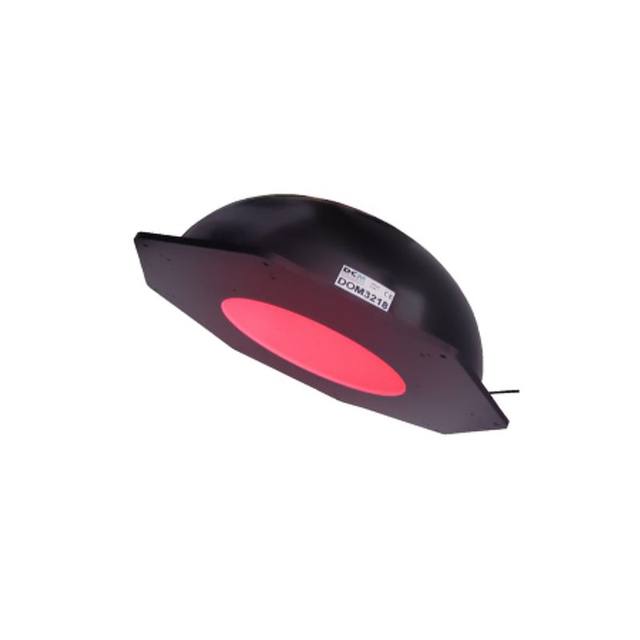
- Rosepetal compatible
- Recommended by AIS Vision
On request
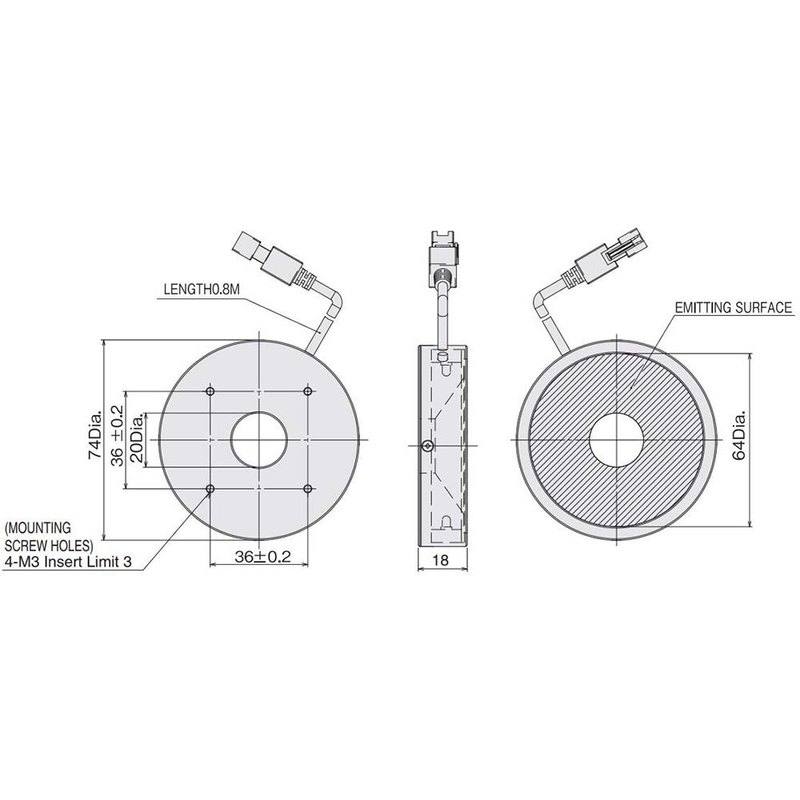
FLV-FS74
The FLV-FS74 is part of Omron's FLV-FS series shadowless dome ring lights, using a uniquely designed diffusion plate to produce highly uniform illumination through reflection and diffusion that eliminates the influence of small surface irregularities while highlighting features created by changes in inclination. It has a 74 mm external ring diameter, a 20 mm internal ring diameter and a 64 mm lighting-area diameter in an aluminum-alloy case, and weighs 140 g. The unit is offered in three color variants: FLV-FS74W (white, 5.2 W), FLV-FS74R (red, 3.5 W) and FLV-FS74B (blue, 5.2 W). It is a controller-driven light that connects to Omron FLV-TCC or FLV-ATC lighting controllers, which supply 24 VDC, and is typically used for edge positioning, size measurement and bump detection on metal parts.
The Omron FLV-FS74 is a shadowless dome ring light, and the word "dome" describes both its optical behaviour and its purpose. Rather than throwing light directly at the part, the FLV-FS series uses a uniquely designed diffusion plate so the LED output is reflected and re-diffused before it reaches the surface. The result is highly uniform illumination that eliminates the influence of small surface irregularities that would otherwise produce distracting specular glints, while still highlighting features created by changes in inclination. In practical terms, this geometry is the standard answer for irregular or glossy surfaces such as machined metal, where direct or ring lighting would create hotspots and shadows that confuse an inspection algorithm. The emission is diffuse by design, so it is not a tool for raking out fine scratches the way a low-angle bar light is, but rather for producing an evenly lit, low-contrast field where edges, geometry and gross topography stand out cleanly.
| Brand | Omron / Sentech |
|---|---|
| Lighting type | Dome (shadowless dome ring light) |
| Connection | 2-pin lighting connecting connector (via FLV-XC cable to controller) |
|---|
| Color / wavelength | White (variants: white / red / blue) |
|---|---|
| Available wavelengths | White (FLV-FS74W), Red ~635 nm (FLV-FS74R), Blue ~465 nm (FLV-FS74B) |
| Diffuser | Yes - diffusion plate for uniform reflected/diffused illumination |
| Emission angle | Diffuse (shadowless dome illumination) |
| Mode | Continuous (controller-driven; strobe/overdrive via FLV controller) |
|---|---|
| Controller required | Yes - requires Omron FLV-TCC or FLV-ATC lighting controller |
| Power consumption | 5.2 W (white/blue); 3.5 W (red) |
| Supply voltage | 24 VDC (supplied by FLV-TCC / FLV-ATC controller) |
| Inner diameter | 20 mm (internal ring diameter) |
|---|---|
| Illuminated area | Lighting area diameter 64 mm |
| Housing material | Aluminum alloy case |
|---|---|
| Dimensions | External ring 74 mm dia., internal ring 20 mm dia., lighting area 64 mm dia. |
| Weight | 140 g |
A practical guide to choosing machine vision lighting: geometry, wavelength, strobe vs continuous, ambient control and how to maximise feature contrast for reliable inspection.
A practical guide to machine vision lighting geometries — ring, bar, backlight, coaxial, dome and dark field — explaining what each reveals, the surfaces it suits, and how to choose the right one directly from your inspection problem.
A practical guide to continuous, strobed, and overdrive LED lighting in machine vision: why a short pulse freezes motion, why overdrive (not strobing alone) adds brightness, how to synchronize the pulse to camera exposure, the duty-cycle limits that protect LED life, and how to size and select a lighting controller.
Rosepetal · AI
Validate your visual inspection with AI: send us sample images and we evaluate the case on your hardware.
AIS Vision · Integration
AIS Vision defines and tests the optimal combination of camera, optics and lighting for your application before you buy.