Skip to content
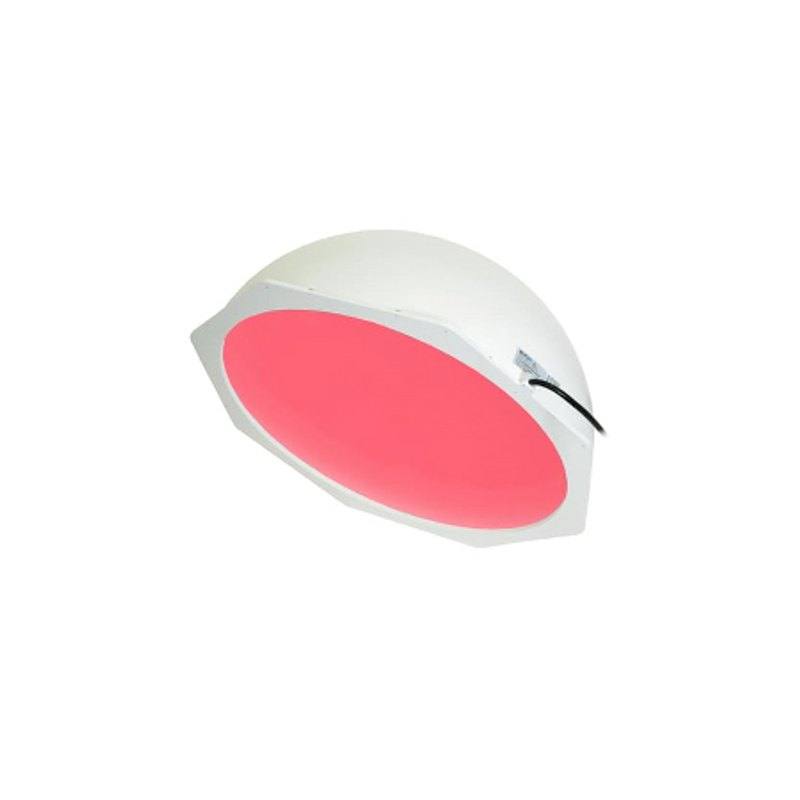
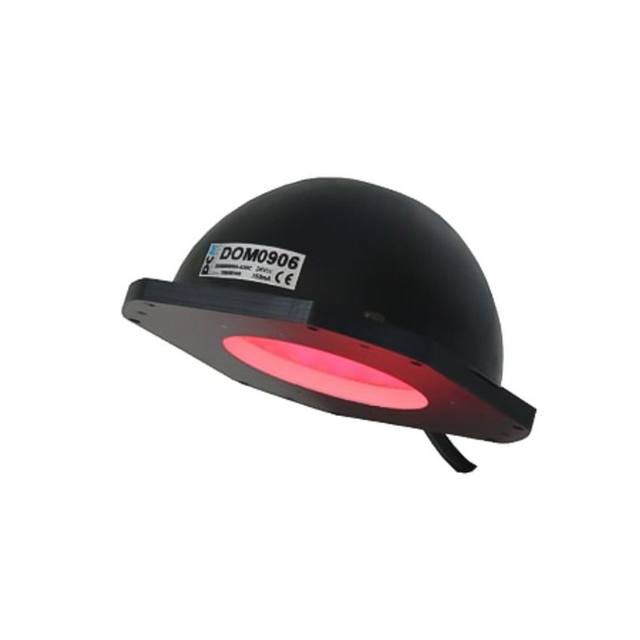
DCM Sistemes DOM5652B machine vision lighting
  • Rosepetal compatible
  • Recommended by AIS Vision

DCM Sistemes DOM5652B Dome Light

DOM5652B

The DOM5652B is a large dome illumination system in DCM Sistemes' DOM series, measuring 570x570x264mm with a Ø516mm bottom aperture. It operates at 24VDC and consumes 126W in continuous mode (Type C), supporting wavelengths from 400nm UV through 850nm IR and white LEDs. The dome structure provides indirect, omnidirectional illumination with a recommended working distance under 50mm, ideal for eliminating highlights and shadows on shiny, curved, or reflective surfaces. Available in both continuous (Type C) and strobe (Type S, up to 333W peak) configurations with 2P flying lead connection.

Brand
DCM Sistemes
Lighting type
Dome
Color / wavelength
white, red (630nm), blue (470nm), green (525nm), IR (850nm), UV (400nm)
Mode
Continuous and Strobe
Working distance
<50 mm
Controller required
No (driver integrated; external controller optional for strobe)
Diffuser
Yes (dome structure provides diffuse illumination)
IP rating
IP00
Inner diameter
Ø516 mm
Illuminated area
Ø516 mm bottom aperture
Emission angle
Diffuse (omnidirectional)
Available wavelengths
400nm (UV), 470nm (Blue), 525nm (Green), 630nm (Red), 850nm (IR), White

Technical overview

The DOM5652B is a large-format dome illumination unit built around a Ø516 mm bottom aperture within a 570 x 570 x 264 mm anodized aluminium housing. The defining characteristic of the dome geometry is that LEDs fire into the concave inner surface, which re-radiates light back down onto the target from virtually every angle simultaneously. This omnidirectional, fully diffuse emission pattern eliminates the directional highlights and hard shadows that would otherwise be produced by ring lights, bars, or spot sources when imaging shiny sheet metal stampings, curved injection-moulded closures, polished circuit-board pads, or reflective packaging films. The consequence is a visually 'flat', high-contrast rendering of surface texture and micro-topography rather than specular glare — exactly what algorithms need to reliably detect scratches, pits, burrs, stains, or delamination on difficult substrates. The recommended working distance of under 50 mm keeps the part close to the aperture plane, maximising the solid angle of incident light and preserving illumination uniformity across the full field.

Electrically, the DOM5652B runs on 24 V DC (±3 %) and draws 126 W in continuous (Type C) operation, with the driver integrated into the unit so no separate controller is required for continuous use. For applications where thermal management or camera synchronisation is critical, a Type S (strobe) variant is available with peak power up to 333 W, enabling very short, bright pulses that freeze motion and extend LED service life; an external controller is needed for strobe triggering in that configuration. Connection is via a 2P flying lead (180 mm, brown = +24 V, blue = 0 V), making wiring straightforward and compatible with standard 24 V machine-vision power rails. Operating temperature is 0–40 °C, consistent with indoor industrial environments. The IP00 rating means the unit is intended for use inside enclosures or machine frames where it will not be exposed to coolant, wash-down, or significant particulate contamination.

The DOM5652B is available across the full spectrum of LED wavelengths relevant to machine vision: white, red (630 nm), green (525 nm), blue (470 nm), IR (850 nm), and UV (400 nm). Wavelength choice directly affects what features become visible. Red or IR illumination penetrates certain surface coatings and reduces sensitivity to ambient lighting variation. Blue and UV wavelengths are shorter and reveal finer surface detail or fluorescence, and UV at 400 nm can excite fluorescent markers or adhesive residue. Green provides good contrast on a wide range of surface tones. White light preserves colour information for colour-camera-based classification or colour-mark inspection. Because the dome geometry already handles the shadow-elimination problem, wavelength selection becomes the primary remaining imaging variable, allowing a single mechanical configuration to be adapted across a broad range of inspection tasks by simply specifying the LED colour at order time.

Best for

  • Inspection of highly reflective or mirror-like surfaces — polished metal stampings, chrome-plated automotive components, and anodised parts — where directional illumination produces blinding specular hotspots that mask surface defects.
  • Surface defect detection on curved or three-dimensional objects such as bottle caps, jar lids, lens barrels, or bearing races, where the dome's omnidirectional coverage eliminates the shadowing that bar or ring lights create on raised or recessed geometry.
  • Electronics PCB and semiconductor inspection where solder joints, bond pads, and component leads have complex reflective geometry; the diffuse dome rendering reveals co-planarity issues, missing solder, and surface contamination that would be invisible under angled illumination.
  • Packaging and label inspection on metallised films, foil pouches, or glossy-coated cartons, where print defects, date-code completeness, and seal integrity must be assessed on a substrate that reflects rather than scatters light.
  • Robot guidance pick-and-place applications handling shiny or irregularly surfaced parts where consistent, shadow-free illumination is needed to stabilise edge and feature detection across varying part orientations.

Selection notes

  • Working distance must stay under 50 mm: the DOM5652B's illumination performance is specified and optimised for parts placed within 50 mm of the bottom aperture. Mounting the camera coaxially through the dome opening is the standard configuration; verify that your lens focal length and camera sensor format can achieve the required field of view at this close working distance before committing to the mechanical layout.
  • Continuous versus strobe variant selection: the standard Type C unit integrates its own driver and runs continuously at 126 W from a 24 V supply with no additional hardware. If you need to synchronise illumination pulses to camera exposure — for higher throughput, to freeze motion on a conveyor, or to reduce average thermal load — specify the Type S strobe variant and budget for an external strobe controller. Peak strobe power reaches 333 W, providing significantly more photon flux per exposure than the continuous mode.
  • Wavelength must be chosen at order time: the DOM5652B is not a multi-spectral or switchable unit; the LED colour is fixed at manufacture. Select wavelength based on the contrast mechanism required for your specific defect and substrate combination. Consider whether a monochrome or colour camera will be used, and whether optical bandpass filters will be employed to suppress ambient light.
  • Enclosure and IP rating: the IP00 rating means there is no protection against particulate ingress or moisture. This unit requires an enclosure or machine frame that shields it from coolant mist, dust, or wash-down. In food, beverage, or outdoor environments an alternative lighting product with higher IP protection would be needed.
  • Physical footprint and weight: at 570 x 570 x 264 mm and 2,400 g the DOM5652B is a substantial fixture. Confirm that your machine frame has adequate clearance above the conveyor or fixture, that mounting brackets can support the weight, and that there is sufficient room for the camera to be positioned coaxially above the dome opening. This unit is suited to dedicated inspection stations rather than space-constrained inline cells.

Specifications: General
BrandDCM Sistemes
Lighting typeDome

Specifications: Interface
Connection2P flying leads, L=180mm (BN=+24V, BU=0V)

Specifications: Optical
Color / wavelengthwhite, red (630nm), blue (470nm), green (525nm), IR (850nm), UV (400nm)
Working distance<50 mm
DiffuserYes (dome structure provides diffuse illumination)
Emission angleDiffuse (omnidirectional)
Available wavelengths400nm (UV), 470nm (Blue), 525nm (Green), 630nm (Red), 850nm (IR), White

Specifications: Electrical
ModeContinuous and Strobe
Controller requiredNo (driver integrated; external controller optional for strobe)
Power consumption126 W (continuous, Type C)
Supply voltage24V DC ±3%

Specifications: Environment
IP ratingIP00
Operating temperature0 to 40°C

Specifications: Geometry
Inner diameterØ516 mm
Illuminated areaØ516 mm bottom aperture

Specifications: Mechanical
Housing materialAnodized aluminium
Dimensions570 x 570 x 264 mm
Weight2400 g

Frequently asked questions

Related technical guides

Rosepetal · AI

Test this camera with Rosepetal

Validate your visual inspection with AI: send us sample images and we evaluate the case on your hardware.

AIS Vision · Integration

We validate camera + lens + lighting

AIS Vision defines and tests the optimal combination of camera, optics and lighting for your application before you buy.