Skip to content
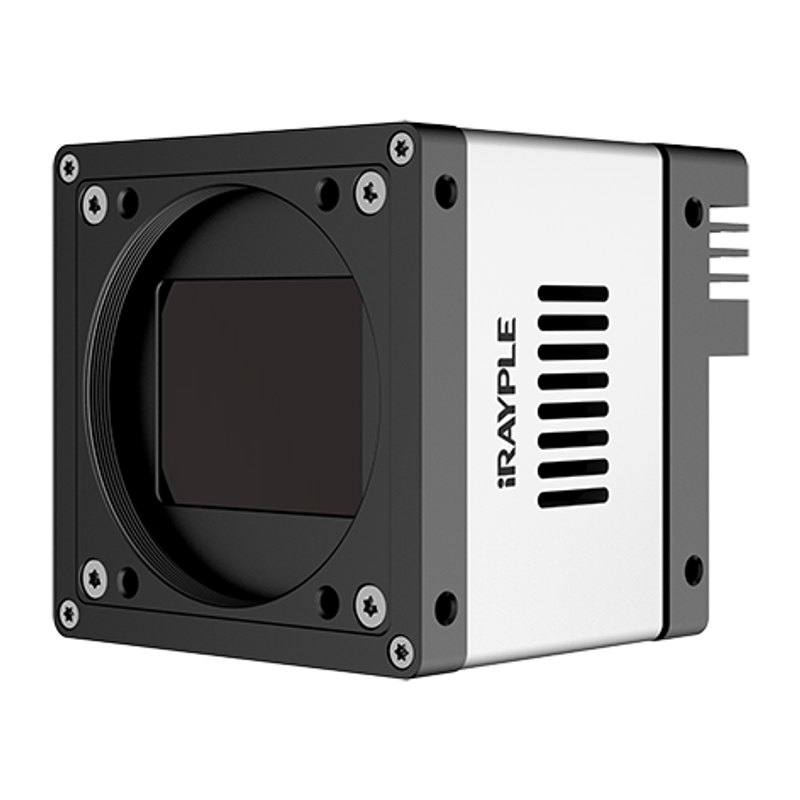
iRAYPLE AX5E07MK250E / AX5E07CK250E (9280x4992, 17.5fps, CameraLink) machine vision camera
  • Rosepetal compatible
  • Recommended by AIS Vision

iRAYPLE AX5E07MK250E / AX5E07CK250E

AX5E07MK250E

The iRAYPLE AX5E07MK250E (mono) / AX5E07CK250E (colour) is a high-resolution area-scan camera from iRAYPLE's Large Area Scan series, built around a customised 46 MP global-shutter CMOS sensor with an APS-C-class 29.69 x 15.97 mm (33.9 mm) optical format and 3.2 x 3.2 um pixels. It delivers 9280 x 4992 pixels at about 17.5 fps over a Camera Link interface supporting Base/Medium/Full/Deca modes per the Camera Link V2.0 protocol and GenICam standard, with 10-bit (Mono8/BayerGB8) output and a 512 MB image buffer. The camera offers 66 dB dynamic range, >40 dB SNR, 1x-32x gain, 16 us to 1 s exposure, ROI and defect-pixel correction, and software/hardware/free-run triggering via a 12-pin Hirose connector with 3 opto-isolated inputs, 3 opto-isolated outputs and an RS232 port. It uses an M58 x 0.75 mount (FBL 12 mm), runs on DC 12-24 V (~6.83 W at 24 V), measures 72 x 72 x 65 mm, weighs 490 g, and operates from -30 C to +50 C.

Brand
iRAYPLE
Camera type
Area scan (Large Area Scan series)
Interface
Camera Link (Base/Medium/Full/Deca, CL V2.0)
Resolution
46 MP
Horizontal resolution
9280 x 4992 px
Mono / color
Mono (MK) / Colour (CK)
Sensor manufacturer
customized (iRAYPLE customised 46 MP CMOS; sensor maker not disclosed — NOT Gpixel)
Sensor model
Customised 46 MP CMOS sensor
Shutter
Global shutter
FPS
17.5 fps (17.57 fps)
Mount
M58 x 0.75 (FBL 12 mm)
Sensor size
29.69 x 15.97 mm (33.9 mm / APS-C)

Technical overview

At the heart of this iRAYPLE camera is a customised 46 MP global-shutter CMOS sensor delivering 9280 x 4992 pixels across a 29.69 x 15.97 mm (33.9 mm diagonal, APS-C-class) optical format with 3.2 x 3.2 um square pixels. The global shutter is the decisive feature for an installer: every pixel is exposed simultaneously, so fast-moving webs, indexed parts and objects on a conveyor are captured without the geometric skew a rolling shutter introduces. Combined with 46 MP of resolution, this lets you either cover a large field of view in a single frame or resolve very fine features within a smaller field, which is why iRAYPLE positions it for surface and defect inspection and dimensional measurement on semiconductor, electronics, battery and printing lines. The 3.2 um pixel is modest in size for a sensor this large, so plan for adequate illumination and a lens that resolves to that pixel pitch.

The interface is Camera Link running the CL V2.0 protocol with Base/Medium/Full/Deca configurations under GenICam, paired with a frame rate of about 17.5 fps at full resolution. Camera Link is a deterministic, low-latency wired interface, which is what makes 46 MP at 17.5 fps practical to move off the camera in real time, but it requires a matching Camera Link frame grabber in the host PC and short, dedicated cabling rather than the plug-and-play networking of GigE or USB3. Output is 10-bit, delivered as Mono8 on the MK monochrome model or BayerGB8 on the CK colour model, and an onboard 512 MB image buffer absorbs bursts when the grabber or host momentarily cannot keep up. Image quality headroom comes from 66 dB dynamic range, greater than 40 dB SNR and programmable gain from 1x to 32x, with exposure adjustable from 16 us up to 1 s to suit anything from strobed high-speed capture to dim, long-integration scenes. ROI readout and defect-pixel correction are available to trim bandwidth to a region of interest and clean up sensor artefacts.

On the integration side the camera uses an M58 x 0.75 lens mount with a 12 mm flange back length, so it needs large-format optics matched to the APS-C-class image circle and the 3.2 um pixel pitch rather than standard C-mount lenses. Triggering and I/O run through a 12-pin Hirose connector providing software, hardware and free-run trigger modes, three opto-isolated inputs and three opto-isolated outputs, plus an RS232 serial port for control or peripheral signalling. The opto-isolated lines let you synchronise the camera to an encoder, proximity sensor or strobe controller while keeping the camera electrically separated from noisy machine wiring. Power is DC 12-24 V drawing roughly 6.83 W at 24 V, the body measures 72 x 72 x 65 mm and weighs 490 g, and the wide -30 to +50 C operating range makes it suitable for cooler or thermally demanding enclosures. Choose the MK variant for the highest sensitivity and contrast on monochrome inspection tasks, and the CK variant where colour discrimination is required.

Best for

  • High-resolution surface and defect inspection of large parts such as panels, PCBs, battery electrodes and printed sheets, where 46 MP in a single global-shutter frame covers a wide field without stitching
  • Dimensional measurement and metrology on moving or indexed parts, using the global shutter to avoid motion distortion and the fine 3.2 um pixel pitch to resolve small geometric features
  • Semiconductor and electronics inspection requiring both a large field of view and fine detail, captured deterministically over Camera Link for tight cycle times
  • High-throughput web and roll-to-roll inspection where the 512 MB buffer and Camera Link bandwidth sustain full-frame capture at 17.5 fps
  • Colour-critical print and material inspection using the CK colour variant when defect classification depends on hue, while the MK mono variant serves contrast-driven defect detection

Selection notes

  • This is a Camera Link camera, so it requires a compatible Camera Link frame grabber and the matching Base/Medium/Full/Deca configuration in the host PC; budget for the grabber and short, dedicated cabling rather than assuming network connectivity
  • Specify large-format optics for the M58 x 0.75 mount and 12 mm flange back length that cover the 29.69 x 15.97 mm (33.9 mm) image circle and resolve the 3.2 um pixel; standard C-mount lenses will not fit or resolve this sensor
  • Plan illumination for the small 3.2 um pixel and use the 16 us to 1 s exposure range and 1x-32x gain to balance light; pairing with a strobe through the opto-isolated outputs and the global shutter enables freezing motion at speed
  • Decide between the MK monochrome model and the CK colour model up front, since they share the body and 46 MP sensor but differ in output (Mono8 vs BayerGB8) and suitability for contrast-based versus colour-based inspection
  • Wire triggering and synchronisation through the 12-pin Hirose connector, which offers 3 opto-isolated inputs, 3 opto-isolated outputs, RS232 and software, hardware and free-run trigger modes; confirm DC 12-24 V supply (about 6.83 W at 24 V) and account for the 72 x 72 x 65 mm, 490 g body in the enclosure

Specifications: General
BrandiRAYPLE
Camera typeArea scan (Large Area Scan series)

Specifications: Sensor
Resolution46 MP
Horizontal resolution9280 x 4992 px
Mono / colorMono (MK) / Colour (CK)
Sensor manufacturercustomized (iRAYPLE customised 46 MP CMOS; sensor maker not disclosed — NOT Gpixel)
Sensor modelCustomised 46 MP CMOS sensor
ShutterGlobal shutter
Sensor size29.69 x 15.97 mm (33.9 mm / APS-C)
Pixel size3.2 x 3.2 um

Specifications: Performance
FPS17.5 fps (17.57 fps)

Specifications: Interface
InterfaceCamera Link (Base/Medium/Full/Deca, CL V2.0)
ProtocolsGenICam, Camera Link V2.0

Specifications: Optics
MountM58 x 0.75 (FBL 12 mm)

Specifications: Electrical
Power12-24vdc

Specifications: Environment
Operating temperature-30 to +50 C

Specifications: Mechanical
Dimensions72 x 72 x 65 mm (excl. lens mount and rear connector)
Weight490 g

Frequently asked questions

Related technical guides

Rosepetal · AI

Test this camera with Rosepetal

Validate your visual inspection with AI: send us sample images and we evaluate the case on your hardware.

AIS Vision · Integration

We validate camera + lens + lighting

AIS Vision defines and tests the optimal combination of camera, optics and lighting for your application before you buy.