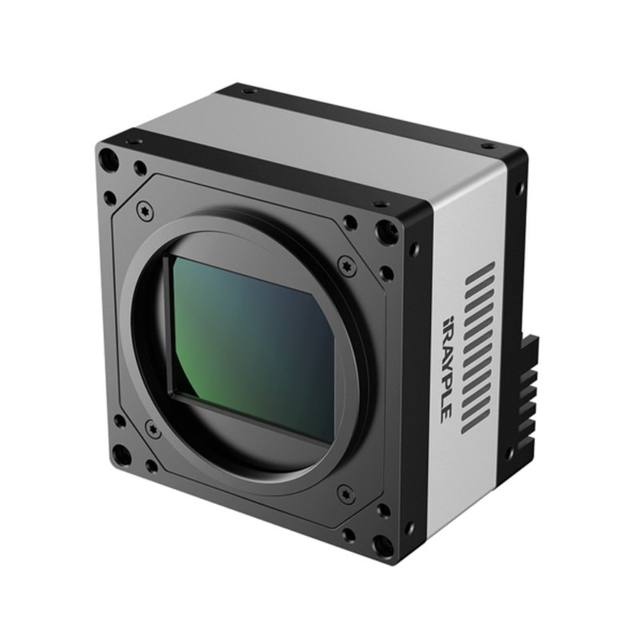
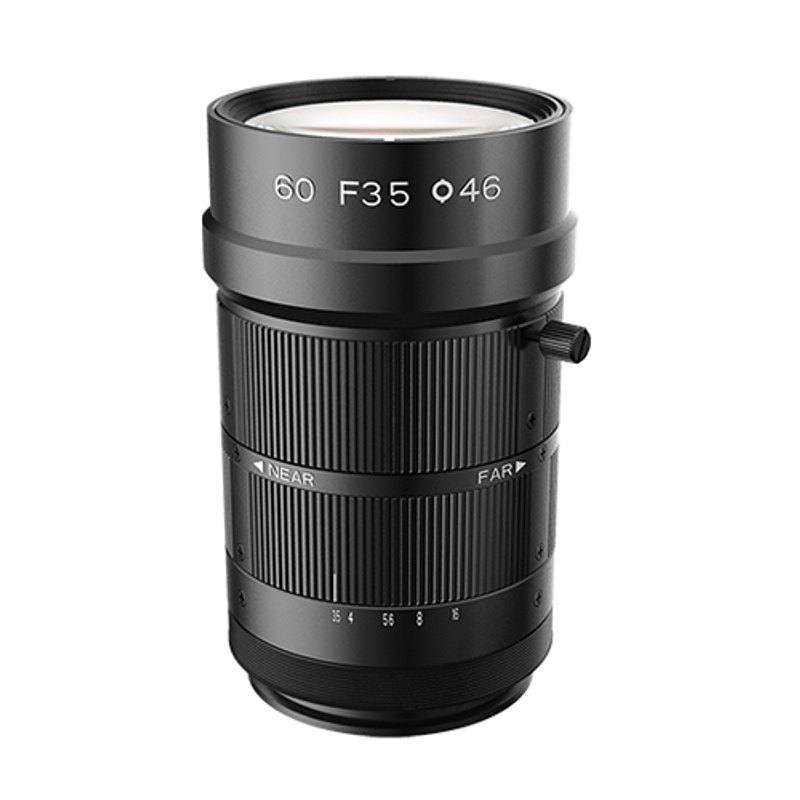
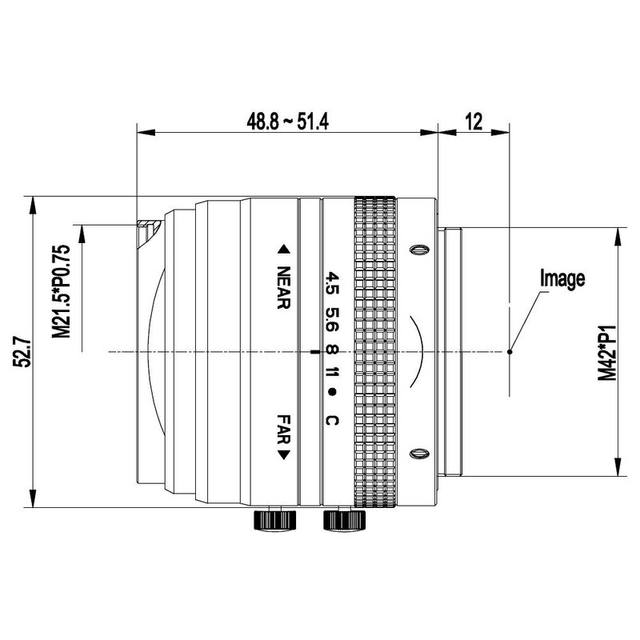
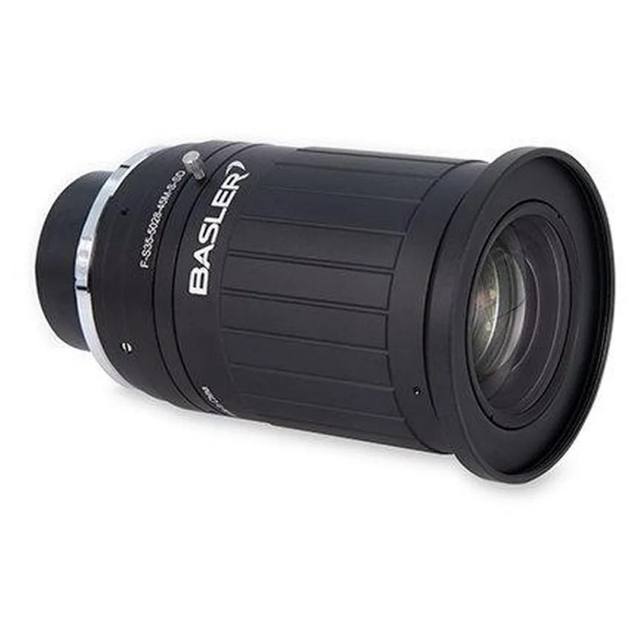
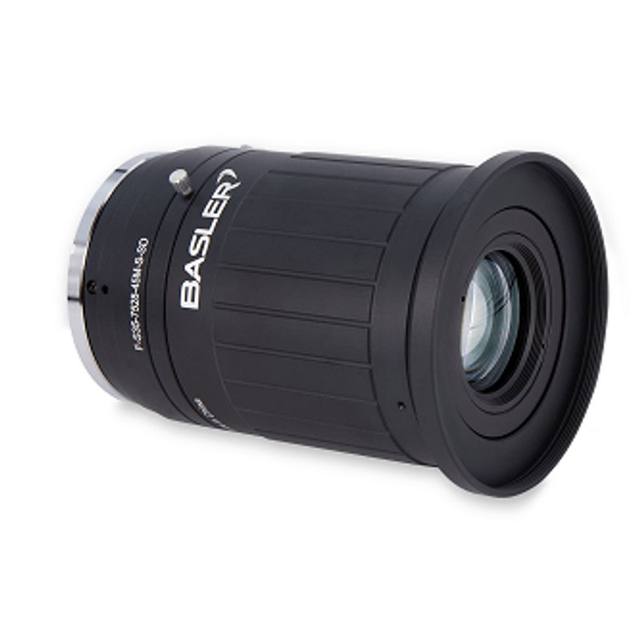
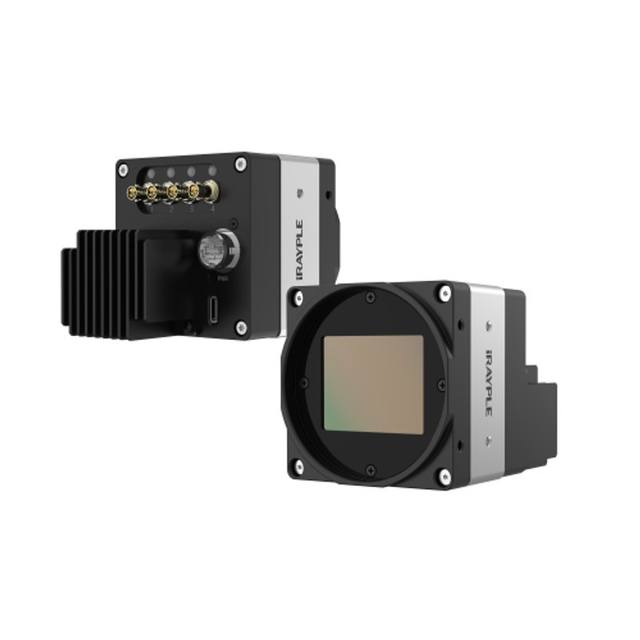
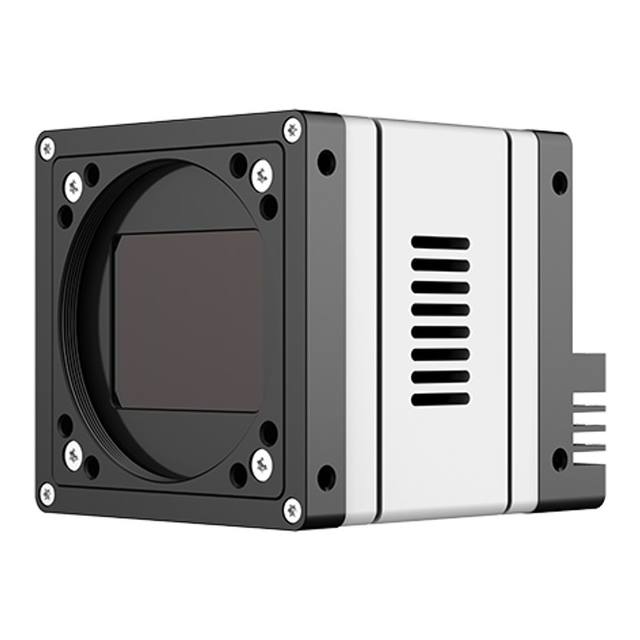
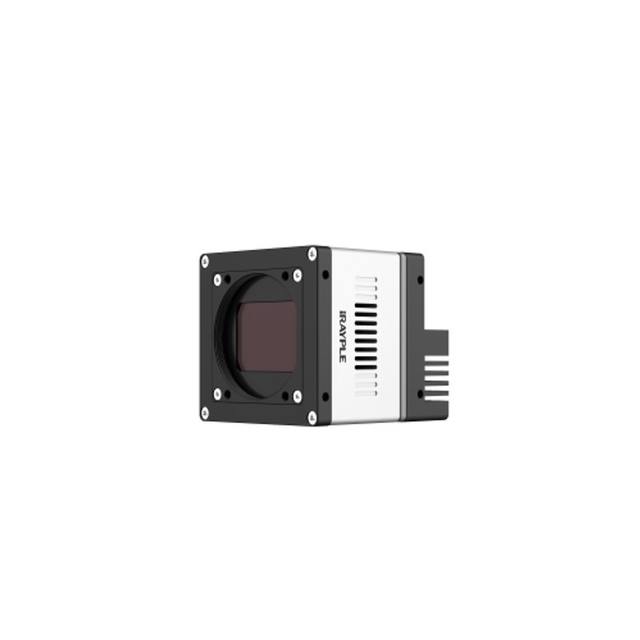
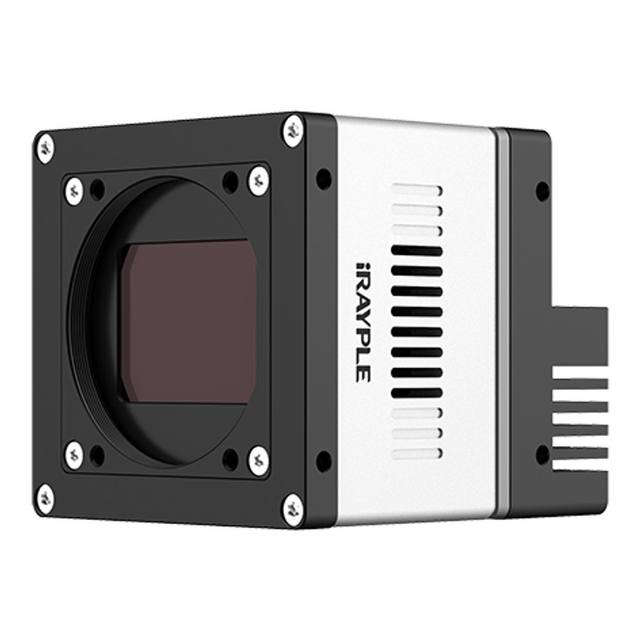
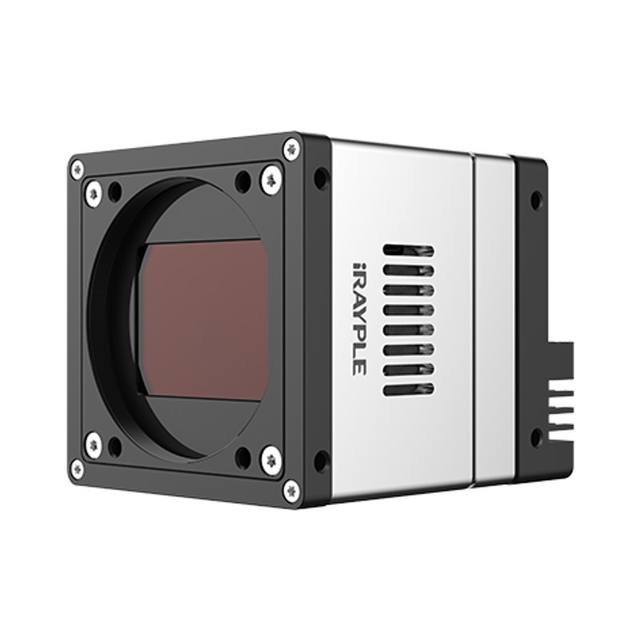
The iRAYPLE F46-6035-M58 is a large-format fixed focal length lens with a 60mm focal length and maximum aperture of F3.5, designed for high-resolution industrial machine vision applications. It covers a 46mm image circle, making it suitable for 65MP sensors with a 3.1µm pixel pitch such as the GMAX3265. The lens features manual focus and iris controls with locking set screws, very low distortion (TV distortion: -0.00008), and operates across a 436–656nm visible wavelength range. Physical dimensions are 101.3mm length × 61mm diameter with a weight of 503g.
The iRAYPLE F46-6035-M58 is a fixed 60 mm focal length lens built around a 46 mm image circle, the key figure that determines sensor compatibility. That 46 mm circle comfortably covers the full active area of 65 MP sensors with a 3.1 µm pixel pitch — such as the GMAX3265 family — meaning every pixel at the sensor corners receives sharp, on-axis-quality image data rather than falling into the vignetted or unresolved fringe that undersized optics produce. For installers, this means you can pair the lens with the latest generation of high-megapixel area-scan cameras without artificially cropping the sensor or accepting resolution loss at the edges of the field. The optical resolution rating of 65 MP is not a marketing margin; it is a matched specification that lets the full sensor contribute to measurement or inspection accuracy.
The maximum aperture of F3.5 — adjustable to F16 via a manual iris with a locking set screw — gives installers meaningful control over depth of field and light throughput. At F3.5 the lens admits enough light for short strobe exposures or moderately lit continuous setups, while stopping down toward F8–F11 tightens the depth of field window and typically improves edge-to-edge sharpness on flat targets, a common trade-off for panel or PCB inspection. The extraordinarily low TV distortion figure of -0.00008 is essentially zero for practical purposes; objects near the edges of the 46 mm circle project at the same magnification as objects at the centre, which is critical for any application where pixel-to-millimetre calibration must hold uniformly across the field. Both focus and iris are manual with locking screws — there is no motorised or auto-iris mechanism — so the lens is intended for fixed-mount, stable-illumination setups where those controls are dialled in at commissioning and left alone.
The M58 thread mount is the standard interface for large-format industrial lenses and mates directly to C-to-M58 adapters, M58-native camera bodies, and lens tubes used in coaxial or darkfield illumination rigs. At 101.3 mm long and 61 mm in diameter, weighing 503 g, this is a substantial optic; mounting hardware must handle the static load without flex, and any tilt in the lens-to-sensor alignment will manifest as focus plane tilt across a 65 MP sensor far more visibly than on smaller formats. The specified operating range of -20 °C to +50 °C covers typical indoor factory floors and many outdoor-shelter inspection stations, though the manual iris locking screws should be checked for torque after any significant thermal cycle. The visible wavelength range of 436–656 nm means the lens is optimised for broadband white or blue-green illumination and is not intended for near-infrared work.
Best for
High-resolution flat-surface inspection on 65 MP cameras — PCB, display panel, or solar-cell inspection where a single shot must resolve fine-pitch features across a wide field without edge distortion.
Dimensional measurement of medium-to-large parts where the near-zero TV distortion (-0.00008) allows a single calibration grid to hold sub-pixel accuracy uniformly across the full 46 mm image circle.
Semiconductor wafer or substrate macro-inspection rigs that demand large image circles and high pixel counts to detect micron-scale defects at production throughput without stitching multiple shots.
Packaging and label OCR/OCV on wide-format print where the 60 mm focal length provides a working distance comfortable for conveyor integration and the 65 MP resolution supports reading fine print or verifying dense barcodes in a single frame.
Automotive surface and paint defect inspection stations using area-scan cameras with large-format CMOS sensors, where consistent illumination response across the full field — enabled by the matched image circle — is essential for reliable grey-level defect detection.
Selection notes
Verify the camera's sensor diagonal before specifying this lens. The 46 mm image circle is designed to cover 65 MP sensors at 3.1 µm pixel pitch, such as the GMAX3265 family. A sensor with a larger diagonal or finer pixel pitch may not be fully resolved to its corners by this optic.
The M58 mount requires either a camera body with a native M58 flange or a well-made adapter. Adapters add to the flange focal distance, which affects the minimum achievable focus distance; confirm the back-focal arithmetic before finalising the mechanical stack.
Both focus and iris are manual with locking set screws — there is no motorised actuation. This lens is not suitable for applications requiring in-process focus or aperture changes. Commission focus and aperture on a representative target, torque the locking screws, and treat those settings as fixed.
The lens is optimised for 436–656 nm visible light. If your illumination strategy includes NIR wavelengths (e.g., 850 nm or 940 nm LED arrays) for contrast enhancement, this lens is not the correct choice; select an optic with a stated NIR-corrected or broadband coating range.
At 503 g and 101.3 mm in length, the lens places a significant cantilever load on the camera mount. Use a lens support bracket or independent lens rail when mounting to lightweight camera bodies or when the assembly will experience vibration, to avoid micro-flex that degrades MTF at high resolution.
Specifications: General
Brand
iRAYPLE
Specifications: Optical
Focal length
60 mm
Lens mount
M58
Aperture (f-number)
F3.5–F16
Image circle / max sensor
46 mm
Optical resolution
65
Telecentric
No
Specifications: Environment
Operating temperature
-20 to +50 °C
Specifications: Mechanical
Dimensions
101.3 × Ø61 mm
Weight
503 g
Applications this camera is commonly selected for. Open one to see the full recommended hardware and approach.
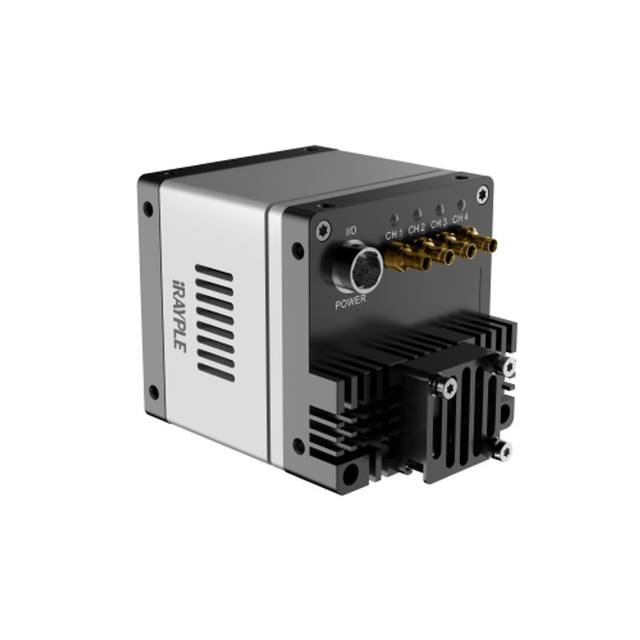
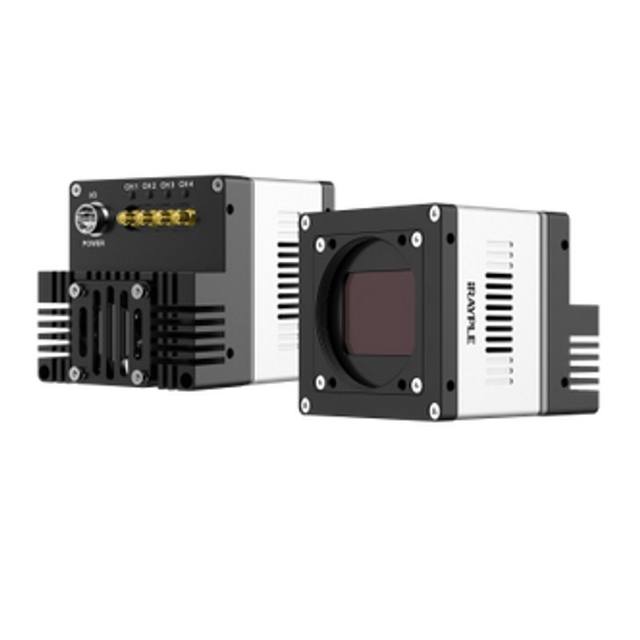
Follow these steps to bring up your iRAYPLE camera, capture a first image, and move from the viewer to your own application. The flow is the same across the A, AE, AX and L series; only the physical interface differs.
Download and install the iRAYPLE machine-vision SDK together with its viewer client for your operating system. The installer provides the camera drivers, the GenTL producer, and the viewer you will use for first light. For GigE Vision models, also install or enable the bundled filter/performance driver on the network adapter to maximize throughput.
2. Connect the camera to the correct interface
Wire the camera to its matching host interface: a dedicated Gigabit (or 10 GigE) NIC for GigE Vision models, a USB3 Vision port with a quality cable for USB3 models, or a frame grabber for CoaXPress models. Power the camera (PoE, USB bus power, or PoCXP / external supply as applicable). For GigE Vision, put the NIC and camera on the same subnet and, where supported, enable jumbo frames.
3. Detect and open the camera in the viewer
Launch the iRAYPLE viewer, run device enumeration, and select your camera from the discovered list. Open it to load the device feature tree (GenICam node map). If a GigE camera is found but cannot be opened, correct the IP configuration so the camera and NIC are in the same address range.
4. Set exposure, gain and trigger, then grab a first image
Start with continuous (free-run) acquisition under stable lighting. Adjust exposure time and gain for a well-exposed, low-noise image, set the pixel format (e.g. Mono8 or a Bayer/RGB format), and tune white balance on color models. Once the live image looks correct, switch trigger mode to hardware or software trigger to synchronize capture with your process, and verify a single triggered frame.
5. Move from the viewer to the SDK or a GenICam library
With imaging confirmed, reproduce the same settings in code using the SDK's C/C++ or Python API: enumerate, open, configure the relevant GenICam features, register a frame callback or grab loop, and convert frames to your pipeline's buffer format. Since the cameras are GenICam/GenTL-compliant, you can alternatively drive them from a third-party GenICam vision library. From here a stable image stream can feed a deep-learning inspection step such as Rosepetal for automated quality control.
Frequently asked questions
The lens is designed for sensors up to 65 MP with a 3.1 µm pixel pitch, specifically called out as covering the GMAX3265 sensor family. Its 46 mm image circle is the governing constraint — any sensor whose diagonal fits within 46 mm will be fully covered.
The specified TV distortion is -0.00008, which is effectively negligible. In practice this means a straight edge positioned anywhere in the field will appear straight in the image without software correction, making the lens well suited to calibrated dimensional measurement applications.
No. Both iris (F3.5–F16) and focus are manual adjustments with mechanical locking set screws. There is no electrical actuation. These controls are intended to be set at installation and locked, not adjusted during operation.
No. The specified operating wavelength range is 436–656 nm, which covers the visible spectrum from blue to red. NIR wavelengths commonly used in machine vision (800 nm and above) are outside the corrected range and will produce chromatic focus shift and reduced resolution.
The lens uses an M58 thread mount, measures 101.3 mm long by 61 mm in diameter, and weighs 503 g. Your camera body or adapter must accept M58 threads, and the mounting arrangement should mechanically support the lens weight to prevent tilt or sag that would degrade corner resolution on a 65 MP sensor.