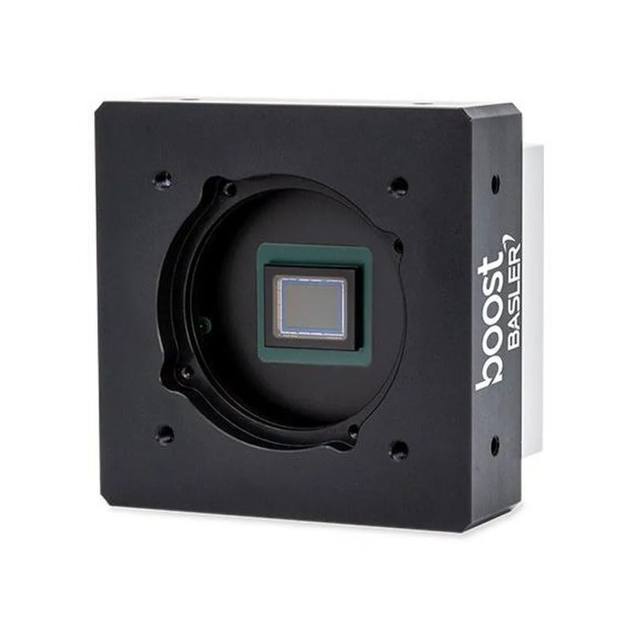
iRAYPLE AX5A22 Series — 12MP 188fps CXP-6 Area Scan Camera (Mono/Color)
AX5A22MX
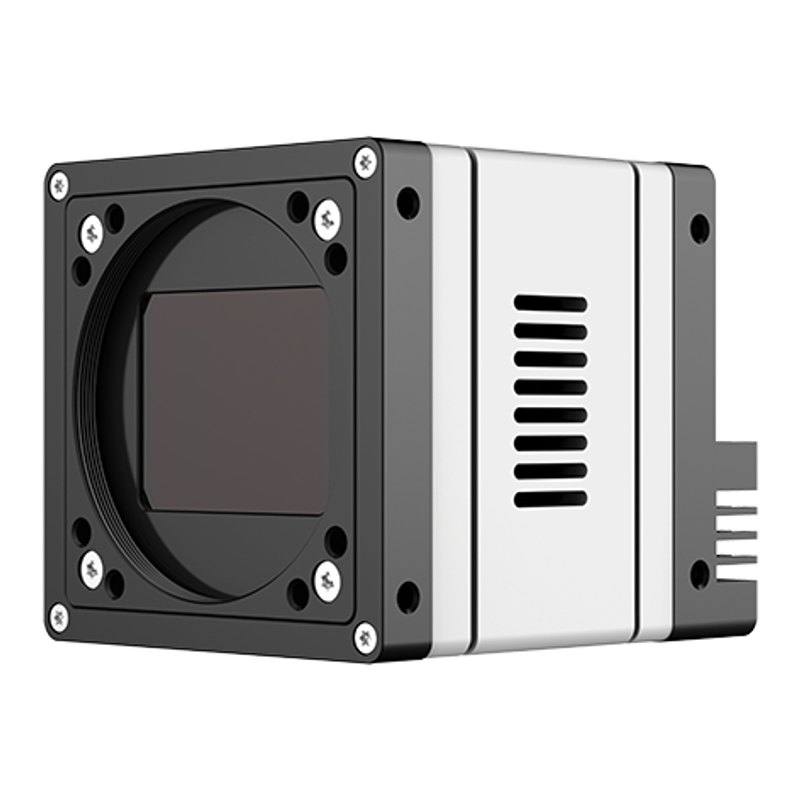
The AX5A22 series comprises six models (MX050E, MX060E, MX340E in mono; CX050E, CX060E, CX340E in color) all built around the ams CMV12000 sensor at 4096×3072 resolution with a 5.5µm pixel pitch on a 22.52×16.89mm optical format. The CXP-6 interface provides 4×6.25Gbps theoretical bandwidth, conforming to CoaXPress and GenICam standards with PoCXP and DC 24V power support. All variants feature a global shutter, 60dB dynamic range, 41.3dB SNR, 2GB onboard image buffer, and support hardware/software trigger and free-run modes with FFC and ROI capabilities. The three sub-variants differ by lens mount: 050E uses M58×0.75 (72×72×72mm body), 060E uses F-mount (72×72×72mm body), and 340E uses M42×1 (80×80×47mm body).
The iRAYPLE AX5A22 series is built around the ams CMV12000 global-shutter CMOS sensor, delivering a 4096 x 3072 pixel (12MP output, 13MP effective) image at a 5.5 µm pixel pitch across a 22.52 x 16.89 mm optical format — a sensor footprint that sits just above APS-C and comfortably covers large-format M58, F-mount, and M42 optics without vignetting. Global shutter is non-negotiable at this frame rate: all pixels integrate simultaneously, so fast-moving components, spinning parts, or strobe-lit conveyor lines produce no rolling-shutter skew or motion blur artifacts. The 60 dB dynamic range and 41.3 dB SNR are sufficient to hold fine surface texture in both specular highlight zones and dark recesses within a single exposure — directly relevant to inspecting stamped metal, PCB substrates, and battery electrode foil where contrast ratios are wide.
The CXP-6 interface runs four lanes at 6.25 Gbps each, providing the raw bandwidth needed to sustain 188 fps at full 12MP resolution without subsampling or windowing — a combination that is genuinely exceptional for this pixel count. Cabling is coaxial, which means substantially longer cable runs than Camera Link or GigE without the EMI sensitivity of those interfaces, a practical advantage on the factory floor. PoCXP eliminates a separate power cable, while the alternative Hirose 6-pin DC 24V connector suits installations where the frame grabber does not supply power over coax. The 2 GB onboard image buffer absorbs burst traffic spikes and decouples camera timing from host processing latency, so sporadic frame grabber stalls do not force re-inspection. GenICam compliance means standard SDK integration across common vision software environments without proprietary driver overhead.
Three lens-mount sub-variants address different optical ecosystems without changing sensor or electronics. The 050E uses M58 x 0.75 in the cubic 72 x 72 x 72 mm body — the natural choice for large-format industrial telecentric or macro lenses designed around the 22 mm image circle. The 060E swaps to Nikon F-mount in the same body, opening access to the broadest selection of legacy and current F-mount glass including high-performance macro and APO designs. The 340E uses M42 x 1 in a shallower 80 x 80 x 47 mm body, useful where axial depth is constrained in a fixture and M42-compatible optics are on hand. All three share identical sensor, interface, and electronics; mount selection is purely about the optical chain already committed to. At 720 g and 15 W, the camera is a deliberate choice rather than a casual drop-in — thermal management and mechanical mounting should be sized accordingly — but the -30 to +50 °C operating range accommodates cold-room or outdoor-housing deployments without heaters.
Best for
High-speed surface defect inspection on fast-moving webs or conveyor lines where 188 fps at 12MP provides the spatial resolution to resolve sub-pixel scratches, pinholes, or coating voids while keeping pace with production throughput.
Dimensional measurement and gauging of large flat components — PCB panels, battery electrode sheets, stamped metal blanks — where the 22.52 x 16.89 mm sensor format captures the full part in a single frame and the global shutter eliminates positional error from part motion.
AI-based defect classification pipelines in electronics and semiconductor back-end processing, where high frame rates feed GPU inference engines faster than any GigE or USB3 camera could sustain, and the 2 GB buffer tolerates inference latency spikes without missed frames.
Multi-camera strobe-triggered inspection rigs for automotive body panels or battery cell surfaces, where CXP-6 long-cable runs simplify cabinet layout and PoCXP reduces junction-box wiring, and the global shutter fires cleanly on a shared hardware trigger.
Industrial OCR/OCV and 2D/DPM code reading at speed on packaging or label lines, where the 4096-pixel horizontal resolution resolves fine print or dense DataMatrix symbols across a wide field of view without sacrificing frame rate.
Selection notes
Frame grabber compatibility is the first gate: CXP-6 in x4 lane configuration requires a frame grabber with four CXP-6 ports allocated to a single camera. Confirm your frame grabber explicitly supports 4-lane CXP-6 and that PCIe bandwidth to host memory matches 188 fps x 12MP throughput before ordering.
Lens image circle must cover 22.52 x 16.89 mm (diagonal ~28.1 mm) at full aperture. Standard C-mount and CS-mount lenses are designed for ≤16 mm diagonals and will vignette severely. Specify M58, F-mount, or M42 lenses rated for ≥1.5" (38 mm diagonal) or larger — confirm the image circle in the lens datasheet, not just the mount compatibility.
At 15 W continuous dissipation inside a 72 x 72 x 72 mm aluminium body, passive conduction cooling through the mounting bracket is the primary thermal path. Ensure the mounting plate and machine structure have sufficient thermal mass, and avoid enclosures that trap heat; verify the ambient never exceeds +50 °C at the camera body with sustained full-frame full-rate operation.
Power supply selection: PoCXP simplifies cabling but requires the frame grabber to supply the full 15 W per camera port — verify the grabber's per-port power budget. If using DC 24V via the Hirose 6-pin connector, the supply must be within the specified voltage tolerance and the cable gauge appropriate for the current draw at the run length used.
ROI and pixel binning can increase the effective frame rate beyond 188 fps for applications that do not require the full 4096 x 3072 frame — useful in trigger-timed inspection where only a central strip of the sensor needs reading. Confirm ROI increment granularity and minimum row count with the GenICam feature set before designing around a higher frame rate assumption.
Specifications: General
Brand
iRAYPLE
Camera type
Area Scan
Specifications: Sensor
Resolution
12MP (13MP effective)
Horizontal resolution
4096 × 3072 px
Mono / color
Mono (MX variants) / Color (CX variants)
Sensor manufacturer
ams CMOSIS
Sensor model
ams CMV12000
Shutter
Global Shutter
Sensor size
22.52 × 16.89 mm
Pixel size
5.5 × 5.5 µm
Specifications: Performance
FPS
188 fps
Specifications: Interface
Interface
CoaXPress CXP-6 (4×6.25Gbps)
Protocols
CoaXPress, GenICam
Specifications: Optics
Mount
M58×0.75 (050E) / F-mount (060E) / M42×1 (340E)
Specifications: Electrical
Power
DC 24V (Hirose 6-pin) / PoCXP
Power consumption
15 W
Specifications: Environment
Operating temperature
-30 to +50 °C
Specifications: Mechanical
Dimensions
72 × 72 × 72 mm
Weight
720 g
Applications this camera is commonly selected for. Open one to see the full recommended hardware and approach.
Matched automatically by: lens mount fits the camera mount · lens image circle covers the camera sensor — this camera: M58×0.75 (050E) / F-mount (060E) / M42×1 (340E) · 22.52 × 16.89 mm sensor.
Follow these steps to bring up your iRAYPLE camera, capture a first image, and move from the viewer to your own application. The flow is the same across the A, AE, AX and L series; only the physical interface differs.
Download and install the iRAYPLE machine-vision SDK together with its viewer client for your operating system. The installer provides the camera drivers, the GenTL producer, and the viewer you will use for first light. For GigE Vision models, also install or enable the bundled filter/performance driver on the network adapter to maximize throughput.
2. Connect the camera to the correct interface
Wire the camera to its matching host interface: a dedicated Gigabit (or 10 GigE) NIC for GigE Vision models, a USB3 Vision port with a quality cable for USB3 models, or a frame grabber for CoaXPress models. Power the camera (PoE, USB bus power, or PoCXP / external supply as applicable). For GigE Vision, put the NIC and camera on the same subnet and, where supported, enable jumbo frames.
3. Detect and open the camera in the viewer
Launch the iRAYPLE viewer, run device enumeration, and select your camera from the discovered list. Open it to load the device feature tree (GenICam node map). If a GigE camera is found but cannot be opened, correct the IP configuration so the camera and NIC are in the same address range.
4. Set exposure, gain and trigger, then grab a first image
Start with continuous (free-run) acquisition under stable lighting. Adjust exposure time and gain for a well-exposed, low-noise image, set the pixel format (e.g. Mono8 or a Bayer/RGB format), and tune white balance on color models. Once the live image looks correct, switch trigger mode to hardware or software trigger to synchronize capture with your process, and verify a single triggered frame.
5. Move from the viewer to the SDK or a GenICam library
With imaging confirmed, reproduce the same settings in code using the SDK's C/C++ or Python API: enumerate, open, configure the relevant GenICam features, register a frame callback or grab loop, and convert frames to your pipeline's buffer format. Since the cameras are GenICam/GenTL-compliant, you can alternatively drive them from a third-party GenICam vision library. From here a stable image stream can feed a deep-learning inspection step such as Rosepetal for automated quality control.
Frequently asked questions
All AX5A22 variants use a global shutter, meaning all pixels integrate light simultaneously. On a conveyor or any scene with lateral motion, a rolling shutter would smear fast-moving features across successive scan lines, causing geometric distortion in measurements and blurring fine defects. The global shutter eliminates this entirely, so parts travelling at high speed under strobe illumination are captured with full geometric fidelity.
The AX5A22 uses CoaXPress CXP-6, which supports substantially longer coaxial cable runs than Camera Link (typically under 10 m) or USB3 Vision (typically under 5 m), making it well suited for installations where the processing rack cannot be positioned close to the camera. Consult your frame grabber and cable manufacturer's specifications for the maximum supported run length at CXP-6 speeds with your chosen cable type.
Yes. The ams CMV12000 sensor, 4096 x 3072 resolution, 188 fps, CXP-6 interface, 2 GB buffer, and all electrical and trigger specifications are identical across all three sub-variants in both mono (MX) and color (CX) versions. The only differences are the lens mount thread (M58 x 0.75, F-mount, or M42 x 1) and the resulting body depth (72 mm for 050E/060E, 47 mm for 340E).
The AX5A22 supports two power methods. PoCXP (Power over CoaXPress) delivers power through the same coaxial cable carrying data, requiring no separate power wiring if your frame grabber supports it and supplies the required wattage per port. Alternatively, a DC 24V supply can be connected via the Hirose 6-pin connector, which is the fallback when the frame grabber does not implement PoCXP.
The CMV12000 sensor provides 60 dB dynamic range and 41.3 dB SNR. A 60 dB dynamic range corresponds to a luminance ratio of 1000:1 within a single exposure, which is sufficient for most industrial surface inspection tasks including specular metal, glass, and printed substrates. Applications with extreme contrast — such as inspecting through transparent packaging over dark backgrounds with direct lighting — may benefit from HDR multi-exposure or careful lighting design to stay within this range.