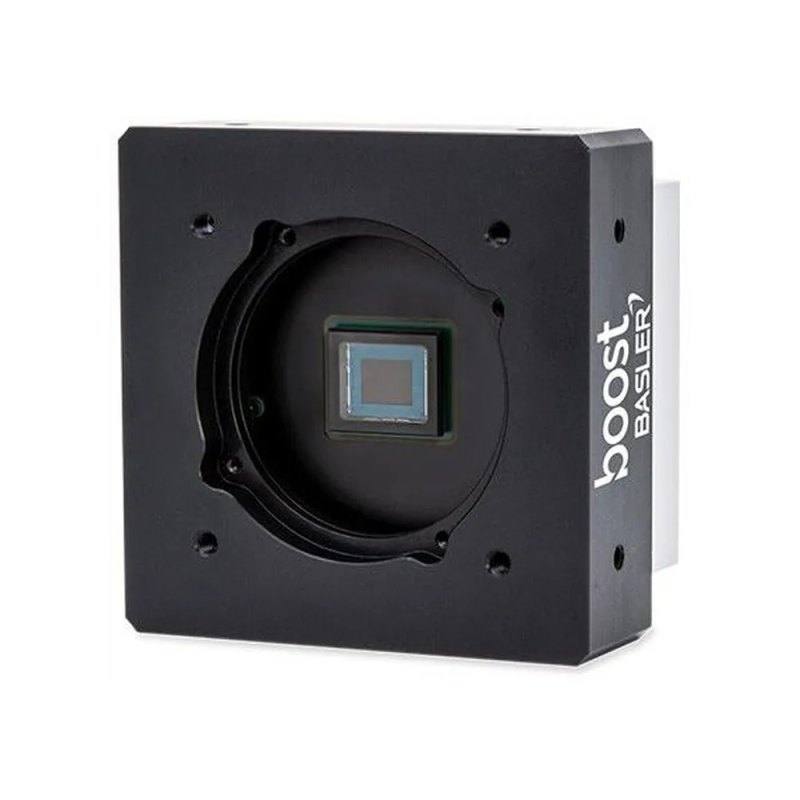
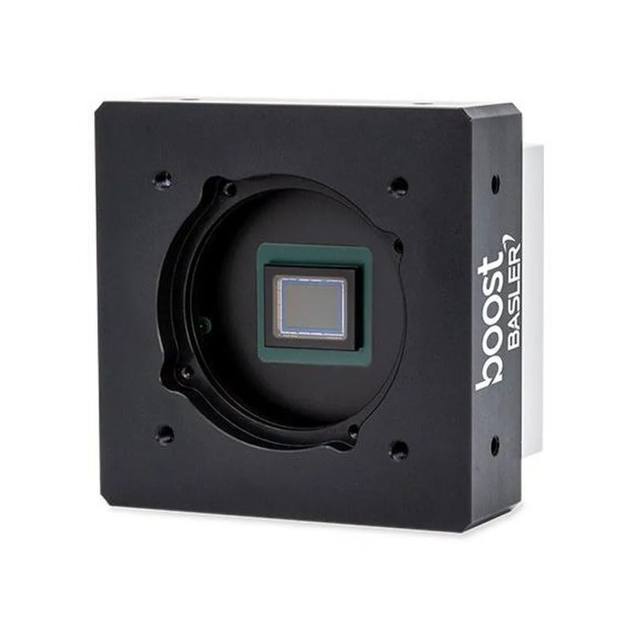
The Basler boost boA1936-400cc is a high-speed color area-scan camera from the boost V series, featuring the Sony IMX421LQJ-C CMOS global shutter sensor at 1936 x 1472 pixel (2.8 MP) resolution and a 4.5 µm pixel pitch on a 2/3" format. It communicates over a single CoaXPress 2.0 CXP-12 link (up to 12.5 Gbps) via a Micro-BNC (HD-BNC) connector, achieving up to 401 fps at 8-bit depth. Power is supplied via Power over CoaXPress (PoCXP) or an external 24 VDC I/O connector, with typical consumption of approximately 8.7 W. The camera is GenICam and CoaXPress 2.0 compliant, housed in a compact 45 x 80 x 80 mm aluminum body and supports C-mount, F-mount, and M42 lens adapters purchased separately.
The Basler boost boA1936-400cc pairs the Sony IMX421LQJ-C global-shutter sensor — a third-generation Sony Pregius device — with a 1936 x 1472 pixel (2.8 MP) array on a 2/3" optical format (8.7 mm x 6.5 mm, 11 mm diagonal). The 4.5 µm pixel pitch is a deliberate balance point: large enough for solid light collection and low read noise, compact enough that a 2/3" C-mount lens delivers a meaningfully wide field of view. Global shutter means every pixel integrates light simultaneously, so moving parts, conveyor-borne products, or robot-mounted viewing angles produce no geometric distortion or rolling-shutter skew — a hard requirement for accurate dimensional measurement and AI-based defect detection on anything that is not perfectly stationary.
The headline specification is 401 fps at 8-bit depth, delivered over a single CXP-12 CoaXPress 2.0 link running at up to 12.5 Gbps on a Micro-BNC (HD-BNC) connector. For an installer, this means a single coax cable handles full-resolution imagery at high speed — no multi-link frame grabber slot needed — while Power over CoaXPress (PoCXP) eliminates the need for a separate power run in most deployments (though an external 18.6–26 VDC supply via the I/O connector is also supported). At 401 fps the camera can freeze motion down to the sub-millisecond exposure range, making it viable for high-cycle-rate packaging lines, semiconductor die inspection, and automotive component verification where parts pass through the field of view at speed. Typical power draw is 8.7 W — modest for a camera of this throughput — which eases thermal management in enclosed enclosures.
The camera body measures 45 x 80 x 80 mm and weighs 436 g, fitting a standard machine-vision mount without requiring oversized brackets. Lens mount options — C-mount natively, with optional F-mount, M42x0.75, and M42x1 adapters purchased separately — cover the full range of industrial lens inventories, from compact C-mount designs optimised for the 2/3" image circle to legacy F-mount glass from metrology stations. Compliance with GenICam and CoaXPress 2.0 standards means the camera integrates with any CXP-12 frame grabber that carries the standard SDK stack. Operating temperature spans 0–50 °C, appropriate for most factory-floor enclosures with basic thermal management. For lighting and trigger pairing, the global shutter enables short strobe pulses synchronised to the trigger input on the I/O connector, allowing high-intensity pulsed illumination that freezes motion and maximises dynamic range without additional motion blur risk.
Best for
High-speed surface and defect inspection on fast-moving conveyors where 401 fps at full 2.8 MP resolution is required to capture every part without missing frames.
Dimensional measurement and gauging of automotive or electronics components where the global shutter eliminates motion-induced distortion and the 2/3" sensor format provides consistent field-of-view geometry across standard C-mount metrology lenses.
Semiconductor and battery cell inspection where the Sony IMX421 global-shutter color sensor supports both texture-based AI defect models and colour-coded visual grading in a single camera.
Packaging line OCR/OCV and traceability code reading at high line speeds, where the combination of 401 fps throughput and global shutter ensures sharply captured label and code images even on fast-moving or irregularly spaced items.
Robot guidance applications where the camera is mounted on a moving arm and global shutter prevents image warping as the robot repositions, while CoaXPress over a single coax cable simplifies cable management through the robot's cable carrier.
Selection notes
A CXP-12 frame grabber is mandatory — CoaXPress 2.0 at 12.5 Gbps is not compatible with GigE or USB3 infrastructure. Verify that your chosen frame grabber supports PoCXP if you intend to power the camera through the coax cable and avoid running a separate 18.6–26 VDC power line.
Lens selection must cover the 2/3" (11 mm diagonal) image circle; undersized lenses intended for 1/2" or smaller sensors will show corner shading and reduced resolution at the edges of the 1936 x 1472 array. The camera ships without a lens mount adapter for F-mount or M42 — order the correct adapter at the same time as the camera.
The 4.5 µm pixel pitch is well-matched to C-mount lenses designed for 2/3" sensors; confirm that the lens resolves at least the Nyquist frequency (111 lp/mm) to avoid the lens becoming the resolution bottleneck in precision inspection tasks.
At 401 fps and 8-bit depth the sustained data rate approaches the full 12.5 Gbps CXP-12 link bandwidth; ensure the host PC's frame grabber and storage or processing pipeline can sustain that throughput. For 10- or 12-bit pixel depth, maximum frame rate will be lower — confirm the actual fps at your required bit depth with Basler's published frame-rate calculator before committing to a line-speed budget.
The 0–50 °C operating range covers standard factory environments but does not include extended cold or hot zones (paint ovens, freezer tunnels). For borderline ambient conditions, plan for enclosure ventilation or active cooling to keep the camera body within its rated range and protect sustained 8.7 W dissipation.
Matched automatically by: lens mount fits the camera mount · lens image circle covers the camera sensor — this camera: C-mount, F-mount, M42×0.75, M42×1 (purchased separately) · 2/3" (8.7 mm × 6.5 mm, 11 mm diagonal) sensor.
By category
All 198C-mount lenses 135Telecentric lenses 60F-mount / large-format lenses 3
By brand
All 198Omron / Sentech 66Basler 59iRAYPLE 48Datalogic / Datasensing 25
Get a first image quickly with the pylon Viewer, then move into the pylon SDK for your application. These cameras are GenICam/GenTL-compliant, so any compliant vision software can drive them as well.
Download and install the pylon Camera Software Suite for your OS from Basler. This provides the pylon Viewer, the GenTL transport-layer producers and the pylon SDK (C/C++/.NET/Python). On Windows the installer adds the needed drivers; on Linux follow the included setup notes for USB and network permissions.
2. Connect the camera and check the link
Cable the camera to its matching interface: GigE Vision to a GigE port (use a quality cable and, ideally, a dedicated NIC with jumbo frames enabled), USB3 Vision to a USB 3.x port with the supplied cable, or CoaXPress to the frame grabber. Provide power where required (PoE, USB bus power, or PoCXP). Open the pylon Viewer and confirm the camera appears in the device list; for GigE, make sure the camera and NIC are on the same subnet.
3. Grab a first image and set exposure, gain and pixel format
Select the camera in the pylon Viewer and start a continuous grab. Adjust exposure time and gain until the image is well exposed (avoid clipped highlights), set the pixel format (e.g. Mono8 or a Bayer/RGB format), and focus the lens. Use a test pattern if the lens or scene is not ready yet.
4. Configure triggering and acquisition
Decide between free-run and triggered acquisition. For synchronized capture, set the trigger source (software or a hardware line on the I/O connector), trigger mode and any debounce or exposure mode, then verify timing. Note the parameter names you change in the Viewer feature tree, as you will reuse them in code.
5. Move to the SDK or a GenICam-compliant library
Recreate your settings in code with the pylon SDK (C, C++, .NET or Python) to open the device, apply the same features and pull frames into your pipeline; pylon vTools and pylon AI can add processing blocks. Because the cameras are GenICam/GenTL standard, third-party vision libraries work too. Once the image stream is stable, you can route frames to a deep-learning inspection such as Rosepetal for automated defect detection.
Frequently asked questions
The camera uses a single CoaXPress 2.0 CXP-12 link via a Micro-BNC (HD-BNC) connector, so you need a frame grabber with at least one CXP-12 port (12.5 Gbps). Any GenICam/CoaXPress 2.0-compliant CXP-12 frame grabber will work. If you want to power the camera through the cable, confirm the frame grabber supports Power over CoaXPress (PoCXP); otherwise you will need to supply 18.6–26 VDC through the I/O connector.
Global shutter eliminates rolling-shutter motion artefacts regardless of lighting mode, but it does not by itself freeze motion — the exposure time must be short enough relative to part speed. At high line speeds you will still need a short exposure, which typically means a strobe or high-intensity continuous light source to maintain adequate signal. The I/O trigger connector enables synchronised pulsed strobing, which is the recommended approach for high-cycle inspection.
The camera body accepts C-mount lenses natively. F-mount, M42x0.75, and M42x1 adapters are available from Basler but are sold separately — they are not included with the camera. Whichever mount you use, the lens must cover the 2/3" image circle (11 mm diagonal) to illuminate the full 1936 x 1472 pixel sensor without vignetting.
The published peak of 401 fps is specified at 8-bit depth over a single CXP-12 link. At 10-bit or 12-bit pixel depth the per-frame data volume increases, reducing the achievable frame rate — the CXP-12 link bandwidth is fixed at 12.5 Gbps. Consult Basler's online frame-rate calculator for the exact fps at your chosen bit depth and any region-of-interest settings.
Yes. Power over CoaXPress (PoCXP) is supported, so if your frame grabber provides PoCXP the camera draws its approximately 8.7 W entirely through the coax cable. If the frame grabber does not support PoCXP, an external supply of 18.6–26 VDC connected to the I/O connector provides power instead.