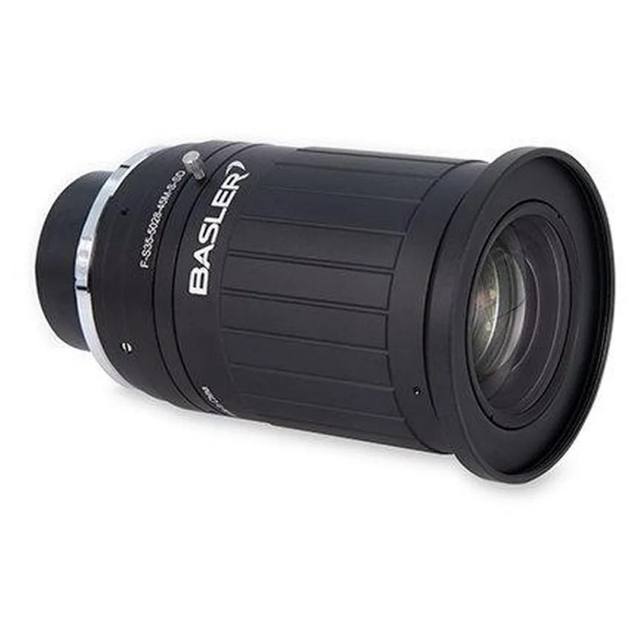
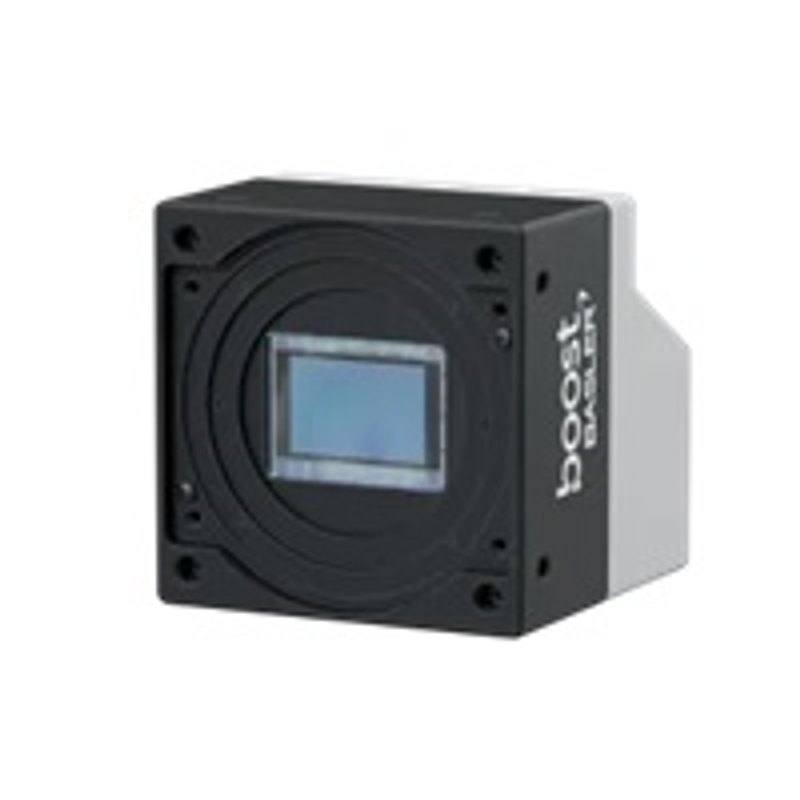
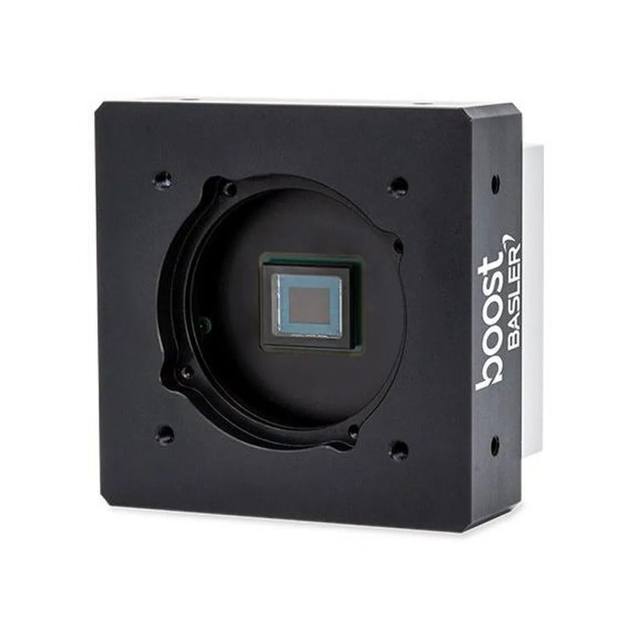
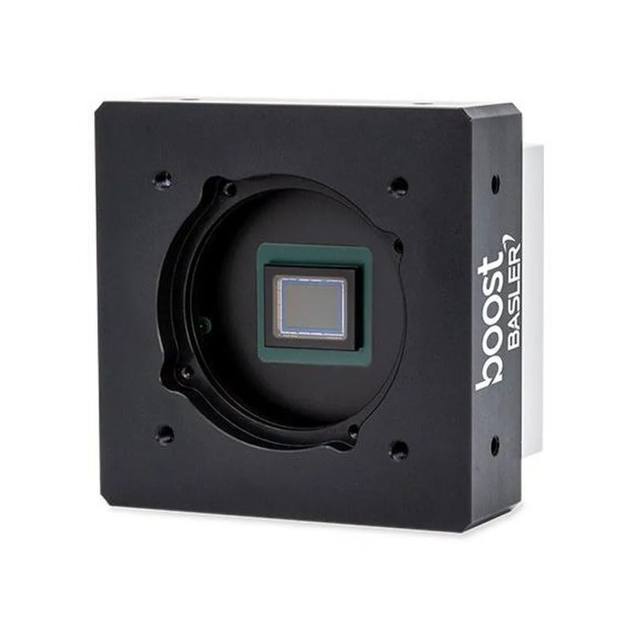
The boA5120-230cc belongs to Basler's boost V product family and uses the Gpixel GSPRINT4521 progressive scan CMOS sensor at 5120 x 4096 pixel resolution (21 MP) with 4.5 µm pixel pitch and APS-C format (1.84"). It achieves 230 fps via 4x CXP-12 (or 115 fps via 2x CXP-12), with global shutter for distortion-free high-speed imaging. Power is provided via Power over CoaXPress (PoCXP) or an external 22.8–25.2 VDC supply, with typical consumption under 18 W. The camera conforms to GenICam, CoaXPress 2.0, CE, FCC, and IP30 standards, and supports C-mount, F-mount, M42x1, and M58x0.75 lens mounts.
The boA5120-230cc pairs a 21 MP Gpixel GSPRINT4521 progressive-scan CMOS sensor (5120 x 4096 pixels, 4.5 µm pitch) with a global shutter — a combination that gives installers both the spatial density needed to resolve fine detail across a wide field of view and the temporal integrity needed when parts are moving at speed. Global shutter exposes every pixel simultaneously, so fast-moving targets arrive at the frame buffer without the rolling-shutter skew that distorts edges and invalidates dimensional measurements. At the APS-C sensor size (23 mm × 18.4 mm, 29.5 mm diagonal) you can deploy C-mount, F-mount, M42×1, or M58×0.75 optics and still cover large inspection zones without mosaicking multiple cameras. The 4.5 µm pixel pitch is small enough to support high-resolution lenses yet large enough to collect adequate photons under the short exposures that high-speed production demands.
Interface bandwidth is the architectural choice that makes 230 fps possible at 21 MP. Running four CXP-12 links in parallel delivers the aggregate throughput required to push full-resolution color frames at that rate. Installations with a single-link frame grabber or tighter cabling budgets can drop to 2× CXP-12 at 115 fps — still extremely fast for a 21 MP color sensor. The camera also supports 4× CXP-6 and 2× CXP-6 configurations at correspondingly reduced frame rates. CoaXPress 2.0 also carries Power over CoaXPress (PoCXP), meaning a single coax cable run carries both data and power; alternatively an external 22.8–25.2 VDC supply (nominally 24 VDC) can be used. Typical consumption is under 18 W, which is manageable for a sensor of this class. GenICam and GenTL compliance means the camera integrates with any standards-compliant SDK or vision runtime without custom drivers.
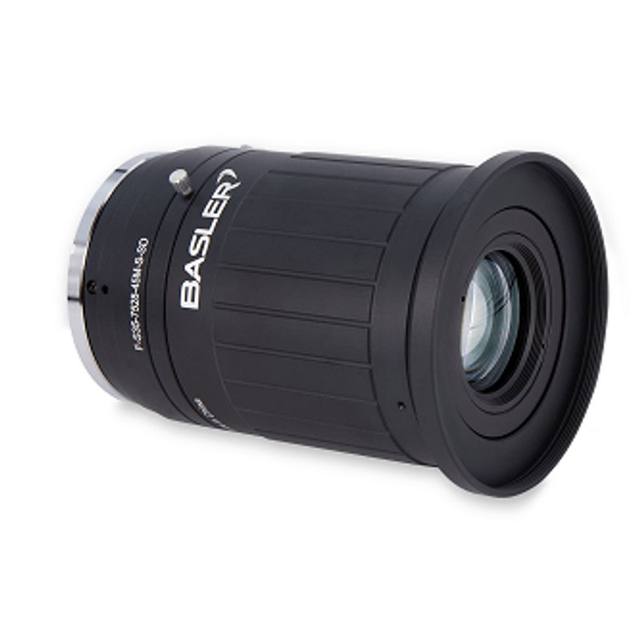
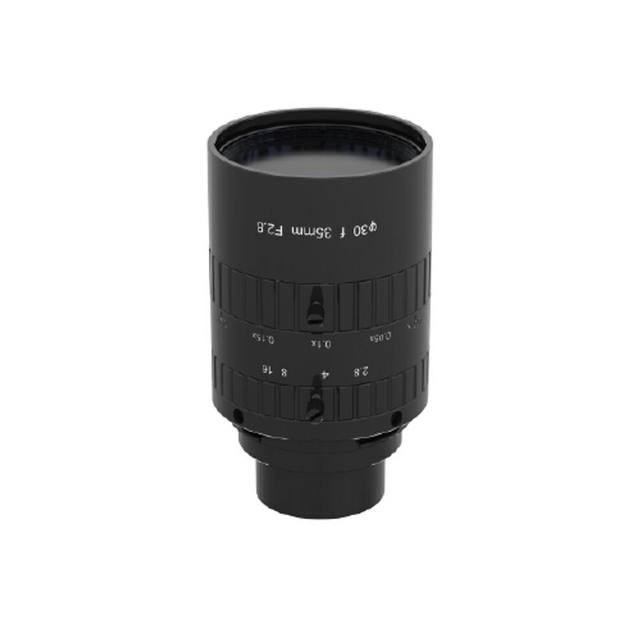
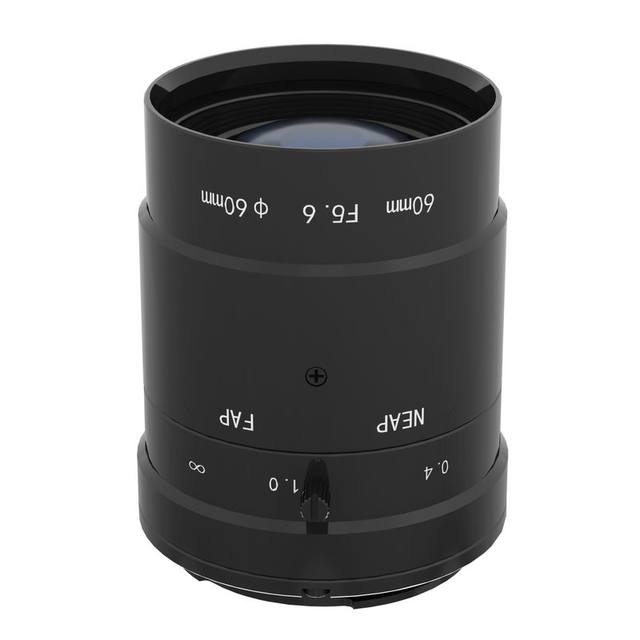
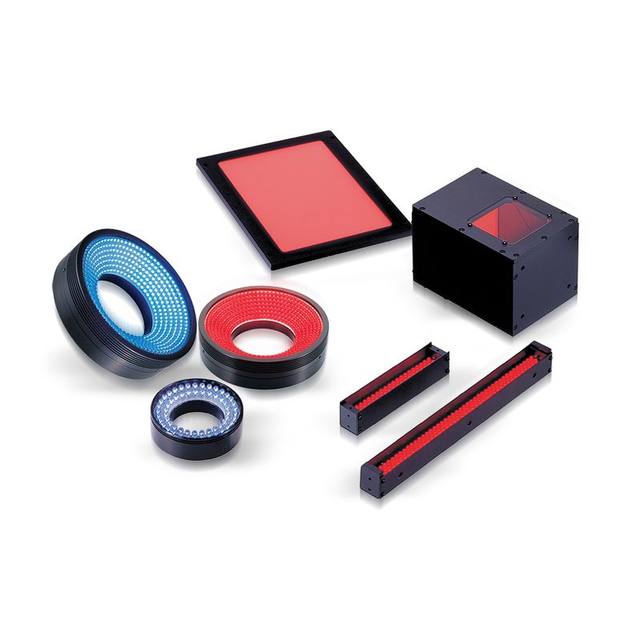
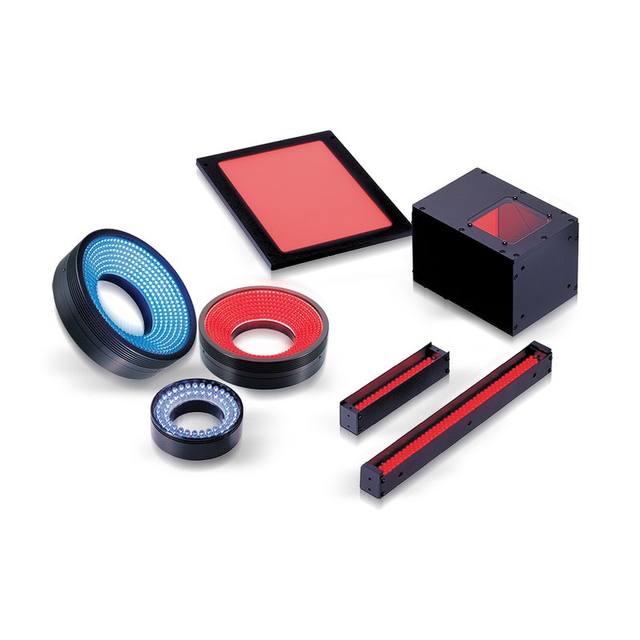
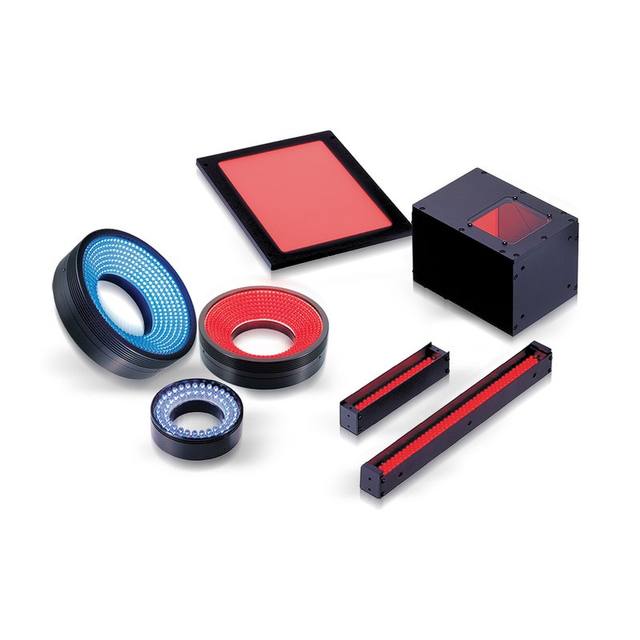
For integrators specifying the optical stack, the 1.84-inch (APS-C) image circle requirement is the key constraint: lenses must cover the full 29.5 mm diagonal to avoid vignetting at the corners. The four supported mount standards (C-mount, F-mount, M42×1, M58×0.75) give access to a broad ecosystem — C-mount for compact machine-vision primes, F-mount for larger Nikon-compatible industrial lenses covering APS-C, and M42/M58 for specialist macro and telecentric optics often used in measurement. With an IR cut filter fitted, the color rendition is tuned for visible-light illumination; strobe triggering (supported via the CoaXPress trigger channel) pairs well with high-intensity LED ring or dome lights to freeze motion at short exposures. The IP30 rating is suitable for controlled factory environments; for wash-down or heavy-dust zones an enclosure or a higher-rated housing should be added. Operating temperature is 0–50 °C, covering most indoor production floors without active cooling.
Best for
High-speed surface and defect inspection on continuous webs, panels, or conveyorised parts where 21 MP resolution must be maintained at line speeds that require 100+ fps — for example flat-glass, solar cell, or rolled-metal inspection.
Automotive and electronics assembly verification requiring simultaneous measurement of many features in a single wide-area shot: 5120 × 4096 pixels across a large field of view enables sub-pixel edge detection across multiple features without tiling multiple cameras.
Semiconductor wafer or PCB inspection where global shutter eliminates distortion artifacts on precision tooling stages that move continuously between frames, and color channels help separate solder, resist, copper, and substrate.
Pharmaceutical and battery electrode inline inspection where color imaging distinguishes coating uniformity, foreign particles, or tab position at throughput rates that would saturate lower-fps cameras.
Robot guidance in pick-and-place cells where high frame rate reduces latency between vision update and arm command, and global shutter prevents pose-estimation errors caused by arm vibration during image capture.
Selection notes
Frame grabber compatibility: 4× CXP-12 requires a frame grabber with four CXP-12 input ports and sufficient PCIe bandwidth (PCIe Gen 3 x8 or x16 is typical). Confirm the grabber vendor's tested camera list before committing to a system design; mismatched CXP channel counts drop the camera to a lower fps tier (2× CXP-12 at 115 fps, or 4× CXP-6 / 2× CXP-6 at reduced rates).
Lens image-circle coverage: the APS-C sensor diagonal is 29.5 mm. Any C-mount lens must be rated to cover at least this circle (many standard C-mount primes cover only 2/3" or 1"). F-mount and M58-mount lenses designed for 35 mm / APS-C formats are safe choices; verify the lens datasheet before ordering.
Storage and processing bandwidth: at 230 fps, 5120 × 4096 pixels, color (with Bayer demosaicing) generates very high processed image data rates. Plan host memory bandwidth, GPU or FPGA preprocessing, and storage IOPS accordingly — the camera can outrun an underpowered host.
Lighting synchronisation: the IR cut filter on this model optimises response for visible-light LED illumination. Strobe triggering is available through the CXP trigger channel. For high-speed strobing at 230 fps, select LED controllers with pulse widths down to 10–20 µs and sufficient overdrive current to maintain adequate exposure at short integration times.
Enclosure planning: the IP30 rating protects only against solid objects larger than 2.5 mm and provides no liquid ingress protection. In environments with coolant mist, metal swarf, or cleaning sprays, a sealed camera enclosure with a protective window is required to avoid sensor or electronics damage.
Matched automatically by: lens mount fits the camera mount · lens image circle covers the camera sensor — this camera: Universal front: C-mount, F-mount, M42x1, M58x0.75 · APS-C / 1.84" (23 mm x 18.4 mm, 29.5 mm diagonal) sensor.
Get a first image quickly with the pylon Viewer, then move into the pylon SDK for your application. These cameras are GenICam/GenTL-compliant, so any compliant vision software can drive them as well.
Download and install the pylon Camera Software Suite for your OS from Basler. This provides the pylon Viewer, the GenTL transport-layer producers and the pylon SDK (C/C++/.NET/Python). On Windows the installer adds the needed drivers; on Linux follow the included setup notes for USB and network permissions.
2. Connect the camera and check the link
Cable the camera to its matching interface: GigE Vision to a GigE port (use a quality cable and, ideally, a dedicated NIC with jumbo frames enabled), USB3 Vision to a USB 3.x port with the supplied cable, or CoaXPress to the frame grabber. Provide power where required (PoE, USB bus power, or PoCXP). Open the pylon Viewer and confirm the camera appears in the device list; for GigE, make sure the camera and NIC are on the same subnet.
3. Grab a first image and set exposure, gain and pixel format
Select the camera in the pylon Viewer and start a continuous grab. Adjust exposure time and gain until the image is well exposed (avoid clipped highlights), set the pixel format (e.g. Mono8 or a Bayer/RGB format), and focus the lens. Use a test pattern if the lens or scene is not ready yet.
4. Configure triggering and acquisition
Decide between free-run and triggered acquisition. For synchronized capture, set the trigger source (software or a hardware line on the I/O connector), trigger mode and any debounce or exposure mode, then verify timing. Note the parameter names you change in the Viewer feature tree, as you will reuse them in code.
5. Move to the SDK or a GenICam-compliant library
Recreate your settings in code with the pylon SDK (C, C++, .NET or Python) to open the device, apply the same features and pull frames into your pipeline; pylon vTools and pylon AI can add processing blocks. Because the cameras are GenICam/GenTL standard, third-party vision libraries work too. Once the image stream is stable, you can route frames to a deep-learning inspection such as Rosepetal for automated defect detection.
Frequently asked questions
230 fps is the full-resolution (5120 × 4096, 21 MP) figure when all four CXP-12 links are active. Reducing to two CXP-12 links halves the available bandwidth and drops the maximum frame rate to 115 fps at full resolution. The camera also supports 4× CXP-6 and 2× CXP-6 configurations, each with proportionally lower throughput.
Both options are supported. Power over CoaXPress (PoCXP) can power the camera directly through the coax link, eliminating a separate power cable run. Alternatively, an external DC supply in the 22.8–25.2 VDC range (nominally 24 VDC) can be used. Typical consumption is under 18 W.
Global shutter exposes all 21 million pixels at exactly the same instant. Rolling shutter exposes rows sequentially, so a part moving at conveyor speed appears geometrically distorted — edges tilt and dimensional measurements are invalid. Global shutter eliminates this distortion, which is critical for accurate gauging and defect localisation at high conveyor speeds.
The camera supports C-mount, F-mount, M42×1, and M58×0.75 lenses via a universal front. For the 29.5 mm diagonal APS-C sensor, C-mount lenses must be explicitly rated for APS-C coverage (most standard C-mount primes do not cover this format). F-mount lenses designed for APS-C or full-frame 35 mm are a reliable choice; M58 is common for large-format telecentric and macro optics.
No — the boA5120-230cc is rated IP30, which means protection against solid objects larger than 2.5 mm but no protection against liquids of any kind. For areas with wash-down cycles, coolant mist, or cleaning fluid contact, the camera must be installed inside a sealed protective enclosure with an optical-quality window.