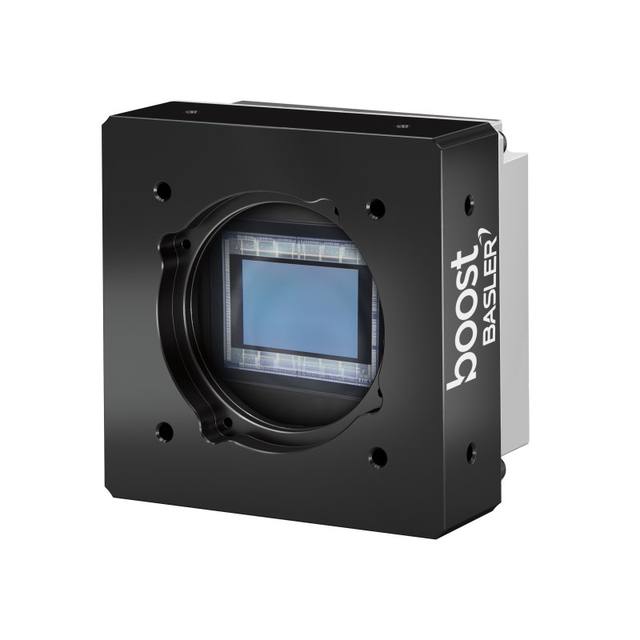
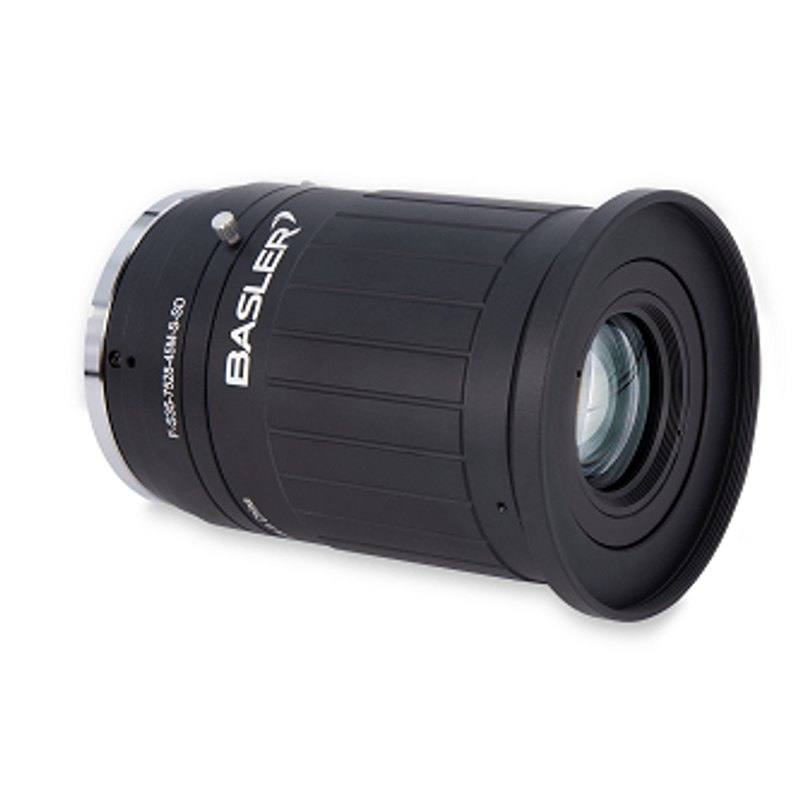
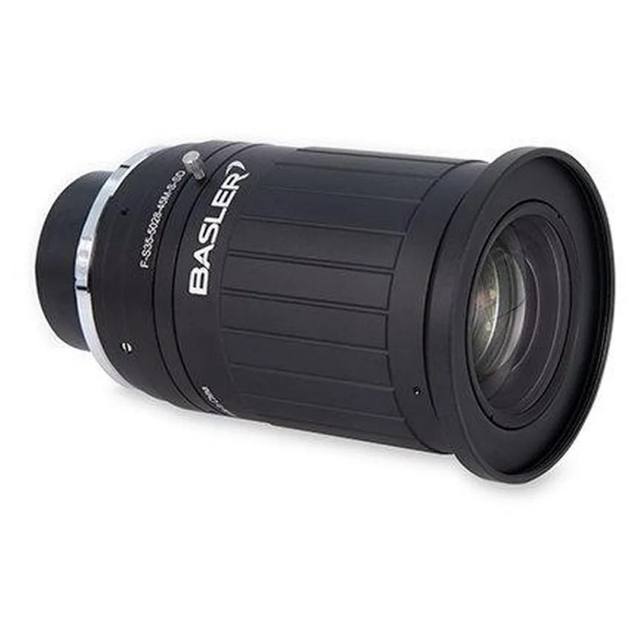
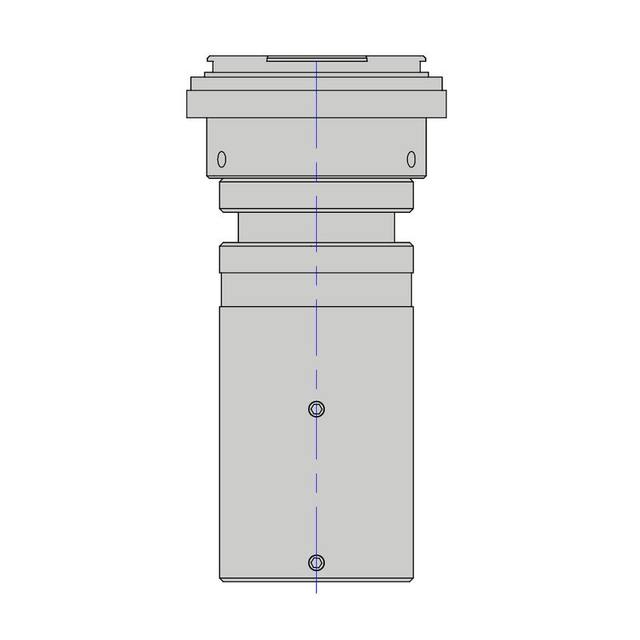
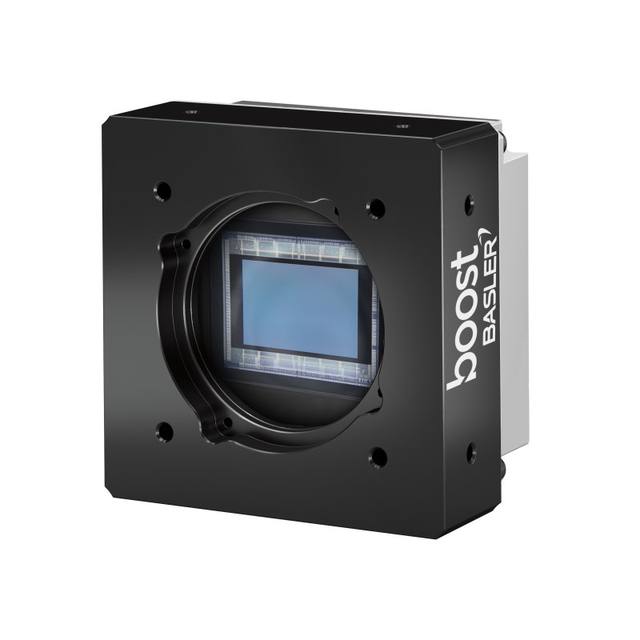
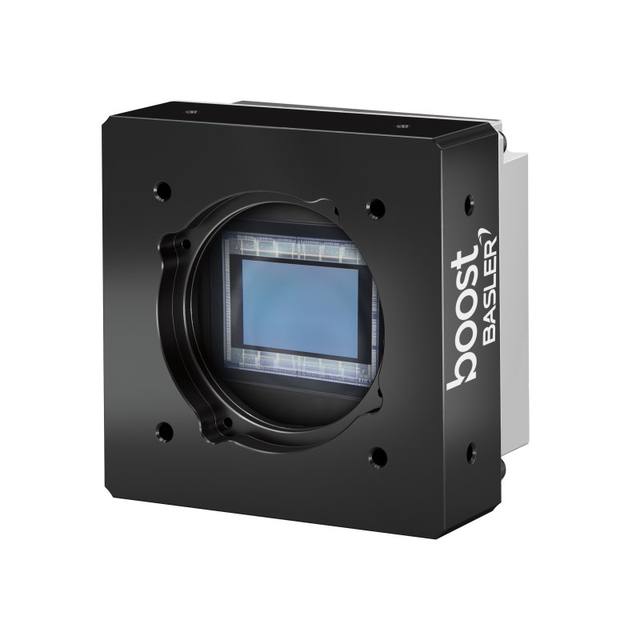
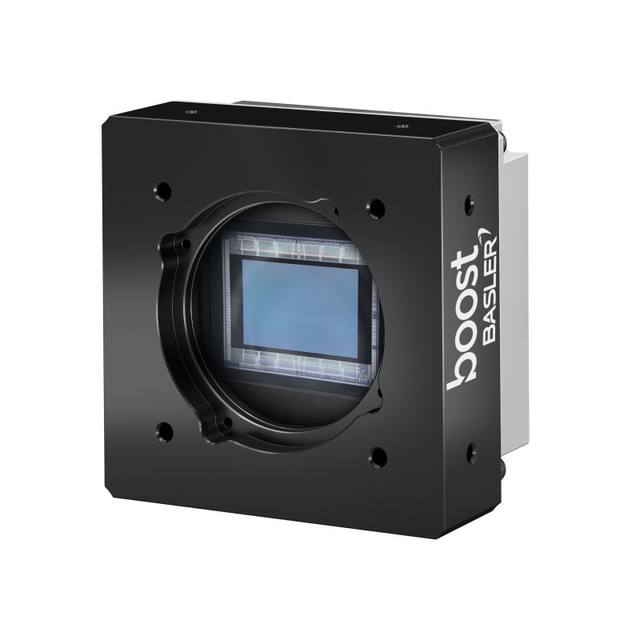
The Basler F-S35-7528-45M-S-SD is a fixed focal length machine vision lens designed for Basler F-mount cameras with Super 35 format sensors and a pixel pitch of 3.2 µm, covering sensor resolutions up to 45 MP. It delivers high optical performance with MTF >43% at center and >25% at corner at 155 LP/mm (F2.8, polychromatic, 0.1x magnification) and typical optical distortion of -0.27%. The lens features a metal housing with manual focus and iris operation, locking screws for both focus and iris, and a blue dot indicator for optimal aperture. It is compatible with Basler boost and racer CXP-12 cameras via the Basler F-mount adapter (part 2000032201) and is discontinued with remaining stock available.
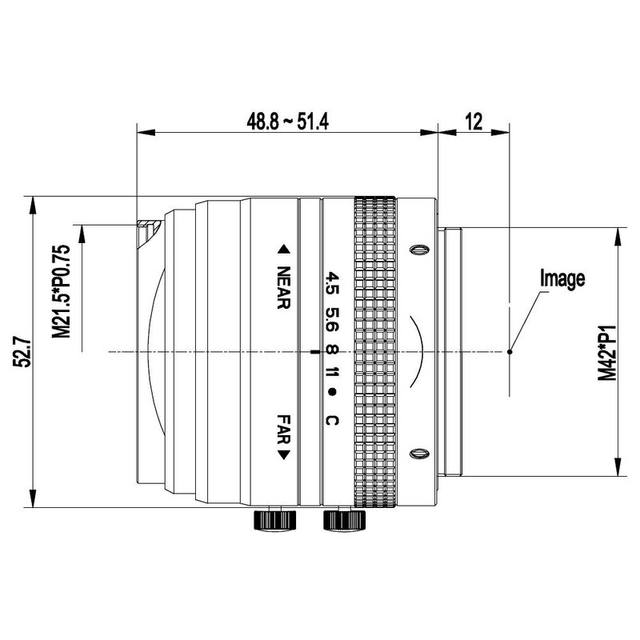
The Basler F-S35-7528-45M-S-SD is a 75 mm fixed focal length lens engineered specifically for Basler F-mount cameras equipped with Super 35 format sensors. Its 32 mm image circle fully covers the Super 35 sensor diagonal without vignetting, making it a correct-format match for high-resolution Basler boost and racer CXP-12 platforms. The lens is rated for sensors up to 45 MP at a pixel pitch of 3.2 µm — a tight pitch that demands high optical performance to avoid pixel-level blur. MTF exceeding 43% at the image center and exceeding 25% at the corner at 155 LP/mm (F2.8, polychromatic, 0.1x magnification) confirms the lens resolves detail well out to the image corners, which matters when the full sensor area is used for inspection rather than a cropped region of interest.
At 75 mm focal length, this lens produces a narrower angle of view than shorter alternatives in the same series, which translates to a longer working distance for a given field of view. The specified focus range of 340–1550 mm means the lens can be positioned comfortably away from the part under inspection — useful in conveyor or in-line installations where mechanical clearance between the camera and the product matters, or where a physical barrier such as a protective window is required. The aperture range of F2.8 to F22 gives the integrator control over depth of field and light throughput: F2.8 maximises light collection for fast exposures or dim environments, while stopping down improves depth of field and edge-to-edge sharpness at the cost of longer exposure. The blue dot indicator on the barrel marks the optimal aperture, guiding setup toward best contrast without iterating through every f-stop. Typical optical distortion of -0.27% (barrel) is low for a non-telecentric design at this focal length; it requires only minimal software correction in dimensional measurement workflows.
The all-metal housing with locking screws for both focus and iris is a deliberate industrial design choice: once focus and aperture are dialled in during commissioning, both are positively locked so vibration and thermal cycling in a production environment do not cause drift. The lens operates across -10 to 50 °C, covering most indoor industrial environments without active heating. At 560 g it is a substantial optic — mounting rigidity and camera bracket stiffness should be verified at specification. The lens connects to Basler boost and racer CXP-12 cameras via the dedicated Basler F-mount adapter (part 2000032201); this adapter is not included and must be ordered separately. Integrators should note that this lens is discontinued with remaining stock available, so procurement lead times and long-term availability should be confirmed with a Basler distributor before committing it to a new design.
Best for
High-resolution surface inspection on Basler boost or racer CXP-12 cameras where the full 45 MP sensor area is used to resolve fine surface defects, scratches, or texture anomalies across a wide field of view.
Dimensional measurement and gauging applications requiring accurate linear measurement, where the -0.27% distortion figure minimises correction overhead and the 75 mm focal length provides a comfortable working standoff from the part.
Packaging and label inspection lines where the long working distance range (340–1550 mm) allows the camera to be mounted above a conveyor with a protective guard between camera and product, and fine print or code details must be resolved across the Super 35 sensor.
Electronics and semiconductor board inspection at medium fields of view, where 45 MP resolution at 3.2 µm pixel pitch provides the spatial detail needed to detect component placement errors, solder bridges, or marking defects.
OCR and OCV applications on industrial lines where character heights are small relative to the field of view, and the high centre MTF (>43% at 155 LP/mm) ensures sufficient contrast for reliable character segmentation.
Selection notes
Confirm sensor format compatibility before ordering: this lens is designed for Super 35 sensors and fills its 32 mm image circle correctly on that format. Using it on a smaller sensor wastes resolution; using it on a larger sensor will result in vignetting at the image corners.
The Basler F-mount adapter (part 2000032201) is required for mounting onto Basler boost and racer CXP-12 cameras and is not bundled with the lens — budget and specify it alongside the lens in your BOM.
Because this lens is discontinued, verify stock availability with your Basler distributor before finalising a design. If the application may require spare or replacement lenses over a multi-year production run, consider qualifying an alternative lens family to avoid a future re-qualification exercise.
The 75 mm focal length is not telecentric, so perspective error will grow when parts are significantly taller than flat. For strict dimensional gauging where part height variation is a concern, evaluate whether the perspective error at your working distance falls within your measurement uncertainty budget.
Lock both the focus and iris screws during commissioning and record the aperture f-stop selected (using the blue dot indicator as a starting reference). Shipping or line maintenance can disturb an unlocked lens; verifying the locked state as part of a periodic maintenance checklist prevents subtle image quality degradation that is hard to diagnose remotely.
Specifications: General
Brand
Basler
Specifications: Optical
Focal length
75 mm
Lens mount
F-mount
Aperture (f-number)
F2.8–F22
Image circle / max sensor
32 mm (Super 35 format)
Optical resolution
45 MP (3.2 µm pixel pitch)
Working distance
340–1550 mm (focus range 0.34–1.55 m)
Telecentric
No
Specifications: Environment
Operating temperature
-10–50 °C
Specifications: Mechanical
Weight
560 g
Housing material
Metal
Applications this camera is commonly selected for. Open one to see the full recommended hardware and approach.
Matched automatically by: camera mount fits the lens mount · camera sensor is covered by the lens image circle — this lens: F-mount · 32 mm (Super 35 format) image circle.
Get a first image quickly with the pylon Viewer, then move into the pylon SDK for your application. These cameras are GenICam/GenTL-compliant, so any compliant vision software can drive them as well.
Download and install the pylon Camera Software Suite for your OS from Basler. This provides the pylon Viewer, the GenTL transport-layer producers and the pylon SDK (C/C++/.NET/Python). On Windows the installer adds the needed drivers; on Linux follow the included setup notes for USB and network permissions.
2. Connect the camera and check the link
Cable the camera to its matching interface: GigE Vision to a GigE port (use a quality cable and, ideally, a dedicated NIC with jumbo frames enabled), USB3 Vision to a USB 3.x port with the supplied cable, or CoaXPress to the frame grabber. Provide power where required (PoE, USB bus power, or PoCXP). Open the pylon Viewer and confirm the camera appears in the device list; for GigE, make sure the camera and NIC are on the same subnet.
3. Grab a first image and set exposure, gain and pixel format
Select the camera in the pylon Viewer and start a continuous grab. Adjust exposure time and gain until the image is well exposed (avoid clipped highlights), set the pixel format (e.g. Mono8 or a Bayer/RGB format), and focus the lens. Use a test pattern if the lens or scene is not ready yet.
4. Configure triggering and acquisition
Decide between free-run and triggered acquisition. For synchronized capture, set the trigger source (software or a hardware line on the I/O connector), trigger mode and any debounce or exposure mode, then verify timing. Note the parameter names you change in the Viewer feature tree, as you will reuse them in code.
5. Move to the SDK or a GenICam-compliant library
Recreate your settings in code with the pylon SDK (C, C++, .NET or Python) to open the device, apply the same features and pull frames into your pipeline; pylon vTools and pylon AI can add processing blocks. Because the cameras are GenICam/GenTL standard, third-party vision libraries work too. Once the image stream is stable, you can route frames to a deep-learning inspection such as Rosepetal for automated defect detection.
Frequently asked questions
The lens is designed for Basler F-mount cameras with Super 35 format sensors, specifically Basler boost and racer CXP-12 models. Connection requires the Basler F-mount adapter, part number 2000032201, which is sold separately.
The lens is rated for sensors up to 45 MP with a pixel pitch of 3.2 µm. Using it with a sensor that has a smaller pixel pitch than 3.2 µm may result in the pixel resolving detail beyond what the optics can deliver, reducing effective system resolution.
The lens delivers MTF greater than 43% at the image centre and greater than 25% at the corner, measured at 155 LP/mm under polychromatic light at F2.8 and a magnification of 0.1x. Performance at other apertures and magnifications will differ; stopping down typically improves corner performance at some cost to diffraction-limited centre sharpness.
Typical optical distortion is -0.27% (barrel). This is a low figure for a non-telecentric fixed focal length lens and will require only minor correction in software for high-accuracy dimensional measurement tasks. The exact correction required depends on the working distance and the precision demanded by the application.
The lens focuses between 340 mm and 1550 mm from the subject. It cannot focus closer than 340 mm, so very close-range macro inspection is outside its design envelope. For fields of view that require working distances below 340 mm, a shorter focal length lens should be considered.