Skip to content
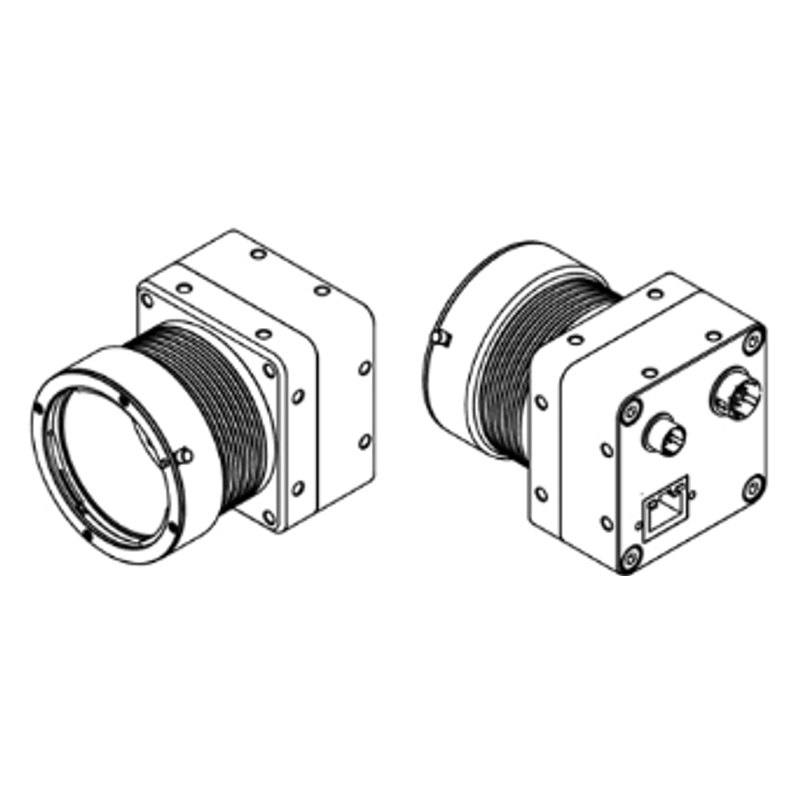
Omron / Sentech FS-C4KU7DGES-F machine vision camera
  • Rosepetal compatible
  • Recommended by AIS Vision

Omron / Sentech Sentech FS-C4KU7DGES-F GigE Vision Color Dual Line Scan Camera

FS-C4KU7DGES-F

The FS-C4KU7DGES-F uses the ams OSRAM DR-2X4K-7-inver-RGB dual-line Bayer CMOS sensor with 7.0 µm square pixels and a global shutter, delivering 4,096 × 2 effective pixels at up to 26 kHz line rate. It communicates over GigE Vision 2.1 / GenICam SFNC 2.4 with IEEE 1588 PTP synchronization, drawing power via PoE (IEEE 802.3af CLASS1) or an external +10.8–26.4 Vdc supply at 6.5 W or less. The camera outputs Bayer and RGB8 pixel formats at 8/10/12-bit depth and includes flat field correction, horizontal/vertical binning, and ROI control. Physical dimensions are 56 × 58 × 73.6 mm with an F-mount, weighing approximately 290 g, and operates from 0 °C to +40 °C.

Brand
Omron / Sentech
Camera type
Line scan
Interface
GigE Vision (1 GbE, PoE IEEE 802.3af)
Resolution
4,096 pixels (4K)
Horizontal resolution
4,096 pixels (H)
Mono / color
Color (dual-line Bayer)
Sensor manufacturer
ams_awaiba (key); display 'ams OSRAM' is correct
Sensor model
ams OSRAM DR-2X4K-7-inver-RGB
Shutter
Global shutter
Line rate
26 kHz (max)
Mount
F-mount
Pixel size
7.0 µm × 7.0 µm

Technical overview

The FS-C4KU7DGES-F is built around the ams OSRAM DR-2X4K-7-inver-RGB dual-line Bayer CMOS sensor, which delivers 4,096 effective pixels across two staggered color-filtered rows at a 7.0 µm square pixel pitch. That 28.672 mm active sensor width combined with a global shutter is the defining characteristic for installers: every pixel integrates and reads out simultaneously, so there is no spatial smear even when the conveyor jerks or the web flutters. The dual-line Bayer architecture reconstructs full-color information from a single scan pass, letting the camera produce both raw Bayer and debayered RGB8 output at 8, 10, or 12-bit depth — giving downstream vision software the choice between maximal dynamic-range data and ready-to-inspect color imagery. At a maximum 26 kHz line rate, the camera can image a web or part moving at several metres per second while maintaining the pixel density needed for sub-millimetre defect detection.

Interface and power flexibility make the FS-C4KU7DGES-F practical to deploy at any point on a production line. The camera is classified IEEE 802.3af CLASS1 for PoE and draws up to 6.5 W; because that consumption can exceed what a switch enforces for CLASS1, a PoE switch port confirmed to supply the full 6.5 W — or the alternative external +10.8 to +26.4 Vdc supply — must be used. Either way, a single GigE Vision 2.1 / GenICam SFNC 2.4 Ethernet cable carries image data and, where the switch is suitably provisioned, power, eliminating a separate power run to the camera head. IEEE 1588 PTP synchronisation allows multiple cameras or peripheral devices to share a common hardware clock over the network, which is essential when stitching adjacent camera fields or correlating trigger events across a wide-web or multi-lane line. On-camera features including flat field correction, horizontal and vertical binning, and ROI control give integrators the means to compensate for non-uniform illumination, reduce data rate when full resolution is not required, and focus bandwidth on the region of interest.

The F-mount lens interface is a deliberate choice for a 28.672 mm active width. F-mount glass is readily available in focal lengths that cover the full sensor at typical web-inspection working distances, and the flange distance is well-defined for repeatable focus. Because this is a line-scan camera, the lens must resolve cleanly along a single line of 4,096 pixels at 7 µm pitch; MTF at the Nyquist frequency of approximately 71 lp/mm must be evaluated specifically for line-scan use, where only the horizontal axis matters for sharpness. The compact 56 × 58 × 73.6 mm aluminium alloy body and 290 g mass mean the camera can be mounted on a linear stage or pivot arm without overloading it, and the 0 °C to +40 °C operating range suits conditioned factory environments such as cleanrooms, climate-controlled electronics lines, and temperature-regulated pharmaceutical packaging halls.

Best for

  • Continuous web and roll-to-roll color surface inspection — printed labels, flexible packaging film, textiles, and coated paper — where the 4K resolution and 26 kHz line rate together maintain pixel density at conveyor speeds of several metres per second.
  • Wide-panel electronics and PCB inspection where the 28.672 mm sensor width and global shutter allow the full panel width to be covered in a single scan pass without motion artefacts from inter-pixel timing skew.
  • Pharmaceutical blister-pack and label verification requiring simultaneous color and defect analysis, where PoE simplifies hygienically routed cabling and flat field correction compensates for uneven LED bar illumination.
  • Automotive paint and trim surface inspection where color-accurate output (RGB8 at up to 12-bit depth) is needed to distinguish hue deviations from structural surface defects, and IEEE 1588 PTP enables synchronisation across a multi-camera line spanning the full vehicle body.
  • Printing press inline quality control where dual-line Bayer color reconstruction and Bayer/RGB8 output format flexibility allow the same camera to feed both a color-match algorithm and a binary defect classifier without a second imaging pass.

Selection notes

  • Lens coverage for 28.672 mm active width: verify that the chosen F-mount lens has an image circle that fully covers this sensor at the intended working distance. Lenses rated for 35 mm full-frame cover the width with margin, but APS-C-class lenses may vignette at the sensor edges and should be checked against the manufacturer's MTF data.
  • GigE bandwidth and line rate: at 4,096 pixels × 12-bit depth and a 26 kHz line rate the raw throughput exceeds 1.2 Gbit/s, which saturates a 1 GbE link. In practice, ROI cropping, binning, or reducing bit depth to 8 bits are the primary tools for staying within link bandwidth; confirm the required resolution and bit depth combination against link capacity before commissioning.
  • PoE switch provisioning: the camera is classified IEEE 802.3af CLASS1 but draws up to 6.5 W in operation. IEEE 802.3af CLASS1 guarantees only up to approximately 4 W to the powered device; switches that enforce the class budget strictly may under-power the camera. Confirm that the PoE switch port can supply the camera's actual 6.5 W consumption, or use the alternative +10.8 to +26.4 Vdc external power input instead.
  • Illumination synchronisation: line-scan color cameras are particularly sensitive to illumination spectral balance across the dual Bayer rows. A strobed line-light synchronised to the camera's line trigger via the external trigger input and IEEE 1588 PTP ensures consistent color reconstruction. Continuous LED bars are simpler but require flat field correction to compensate for falloff at sensor ends.
  • Operating temperature ceiling at +40 °C: in enclosed machine enclosures with recirculated air or near heat-generating drive electronics, ambient temperatures can exceed this limit. Plan for adequate ventilation or a cooled enclosure; the aluminium alloy body aids passive heat dissipation but is not rated for elevated industrial ambients above 40 °C.

Specifications: General
BrandOmron / Sentech
Camera typeLine scan

Specifications: Sensor
Resolution4,096 pixels (4K)
Horizontal resolution4,096 pixels (H)
Mono / colorColor (dual-line Bayer)
Sensor manufacturerams_awaiba (key); display 'ams OSRAM' is correct
Sensor modelams OSRAM DR-2X4K-7-inver-RGB
ShutterGlobal shutter
Pixel size7.0 µm × 7.0 µm
Sensor size28.672 mm (active sensor width)

Specifications: Performance
Line rate26 kHz (max)

Specifications: Interface
InterfaceGigE Vision (1 GbE, PoE IEEE 802.3af)
ProtocolsGigE Vision 2.1, GenICam SFNC 2.4, IEEE 1588 (PTP)

Specifications: Optics
MountF-mount

Specifications: Electrical
PowerPoE (IEEE 802.3af CLASS1) or external +10.8–26.4 Vdc
Power consumption6.5 W

Specifications: Environment
Operating temperature0 to +40 °C

Specifications: Mechanical
Dimensions56 × 58 × 73.6 mm
Weight290 g
Housing materialAluminum alloy (AC)

Frequently asked questions

Related technical guides

Rosepetal · AI

Test this camera with Rosepetal

Validate your visual inspection with AI: send us sample images and we evaluate the case on your hardware.

AIS Vision · Integration

We validate camera + lens + lighting

AIS Vision defines and tests the optimal combination of camera, optics and lighting for your application before you buy.