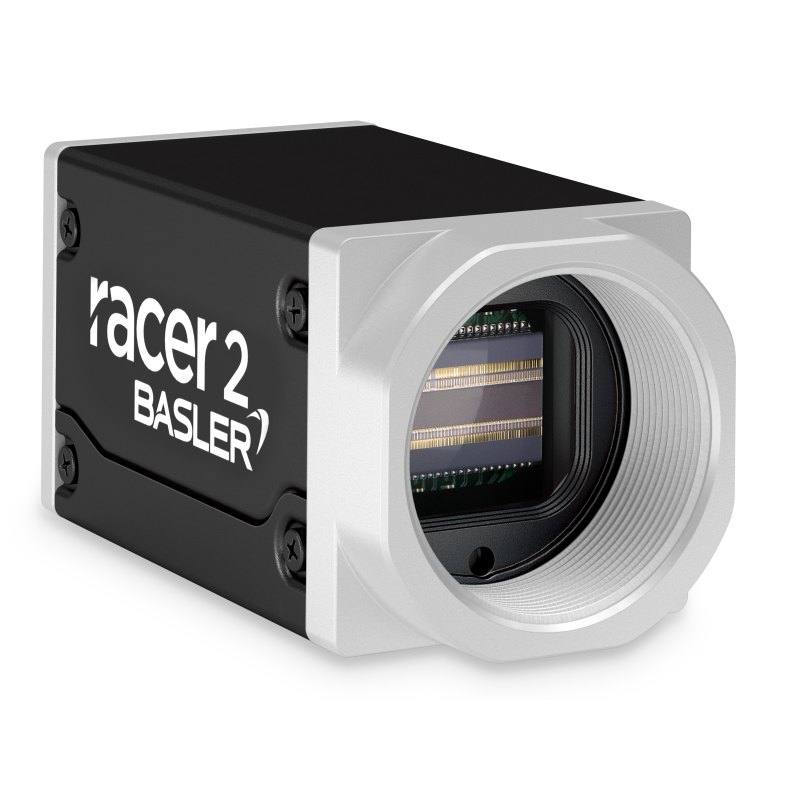
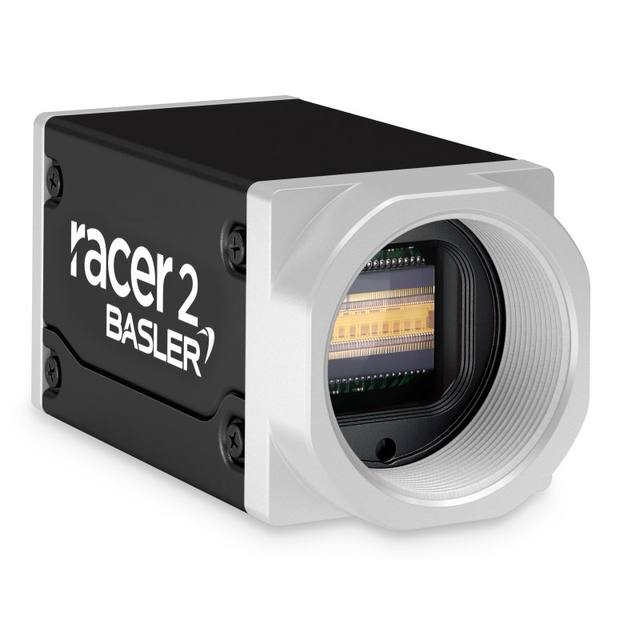
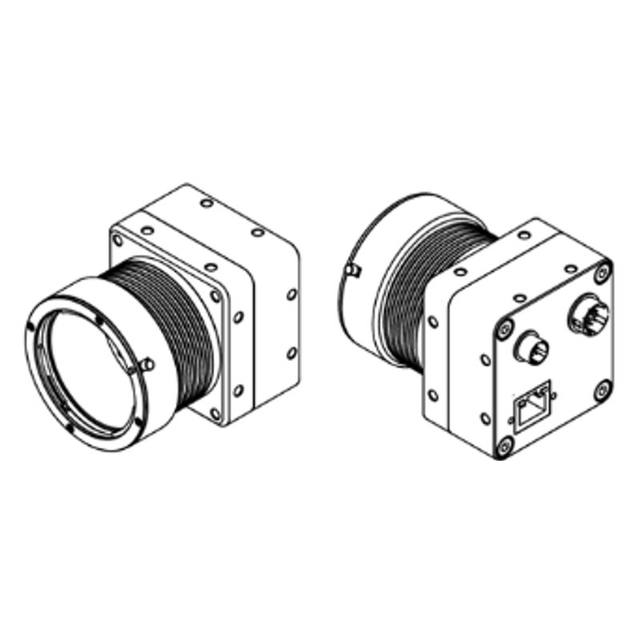
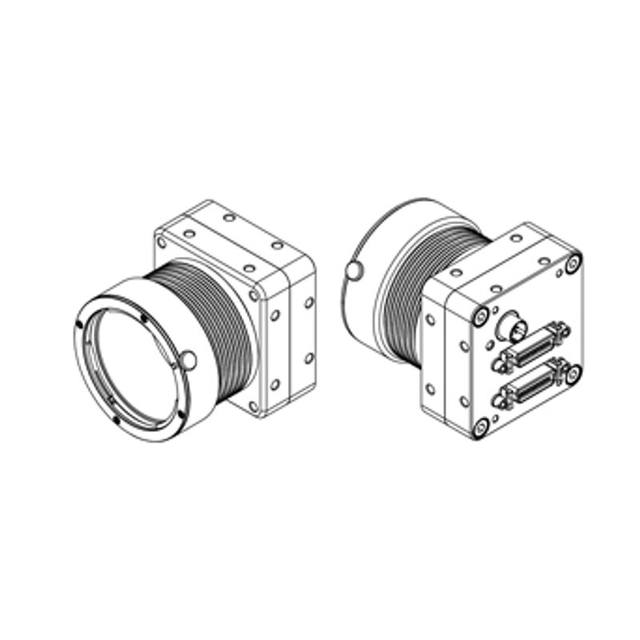
The Basler r2L4096-14gc is a racer 2 S series GigE line scan camera featuring a Gpixel GL3504 dual-line CMOS sensor with 4096 pixels at 3.5 µm pixel pitch and a 14.34 mm sensor format. It achieves a standard line rate of 14 kHz and a maximum of 42.6 kHz under optimal ROI conditions, with 12-bit pixel depth in color. The camera supports Power over Ethernet (IEEE 802.3af) or 12–24 VDC via M8 I/O connector, and complies with GigE Vision 2.0 and GenICam standards. Its compact 29 × 29 mm cross-section and sub-100 g weight suit space-constrained inline inspection systems.
The Basler r2L4096-14gc is a GigE line scan camera built around the Gpixel GL3504 dual-line CMOS sensor, delivering 4096 pixels across a 14.34 mm sensor format at a 3.5 × 3.5 µm pixel pitch. That combination puts this camera firmly in the mid-resolution color line scan class: the 14.34 mm sensor accepts standard C-mount lenses designed for 1-inch image circles, giving integrators a wide choice of off-the-shelf optics. The dual-line architecture — two staggered rows that are summed or time-delayed to reconstruct a single output line — uses a global shutter, so motion artifacts are suppressed even on fast-moving webs or conveyor lines without the smear penalty of a rolling-shutter design. The standard line rate of 14 kHz and the headline 42.6 kHz maximum (achievable under reduced ROI) give substantial headroom to match a wide range of production line speeds and inspection pixel-size requirements.
Connectivity follows a single GigE Vision 2.0 cable that carries both data and power: Power over Ethernet (IEEE 802.3af) eliminates the need for a dedicated power supply and simplifies cable routing in tight enclosures, though 12–24 VDC via the M8 I/O connector is also available when a PoE-capable switch is not practical. At 5.4 W, the camera operates comfortably within the 15.4 W IEEE 802.3af budget. GigE Vision 2.0 and GenICam compliance mean it integrates into any standards-conformant vision runtime — Basler Pylon, MVTec Halcon, and open-source GenICam-compatible SDKs — without vendor lock-in. 12-bit pixel depth in color output preserves subtle tonal gradations that 8-bit capture would clip, which matters for detecting low-contrast surface defects and for colour grading applications.
The physical form factor is an important differentiator in the racer 2 S series. At 62.2 × 29 × 29 mm and 100 g, the camera fits in enclosures and on gantries where conventional line scan housings cannot, and the sub-100 g mass keeps vibration-induced image blur manageable on lightweight frames. The −10 to +60 °C operating temperature range covers most indoor industrial environments and many outdoor packaging or printing lines without active cooling. For illumination pairing, line scan work nearly always requires a dedicated line light or bar light synchronised to the encoder-triggered line acquisition; the M8 I/O connector provides the strobe output needed to drive LED controllers in sync with camera exposure, avoiding motion blur and maximising LED brightness in pulsed mode.
Best for
Continuous web and roll inspection — printed film, foil, paper, or nonwoven fabric — where 4096-pixel cross-web resolution and 14 kHz line rate together deliver the spatial sampling needed to catch fine print defects, pinholes, and colour deviations at industrial throughput speeds.
Flat-panel and flexible electronics surface inspection where colour fidelity at 12-bit depth is required to distinguish substrate contamination, coating non-uniformity, and layer-alignment errors that monochrome imaging would miss.
High-volume packaging line verification — label registration, colour match, date-code legibility, and seal-area inspection — where the compact 29 × 29 mm cross-section allows camera integration inside tight conveyor guards and the PoE single-cable connection simplifies installation.
Textile and carpet inspection on wide-loom systems, where multiple r2L4096-14gc units can be tiled side by side on a C-mount bar to cover full fabric width, with GenICam multi-camera synchronisation keeping line rates consistent across cameras.
Precision printing quality control (commercial, security, or functional printing) where the 3.5 µm pixel pitch and 12-bit colour capture resolve fine halftone dots and ink density gradients with the accuracy required for print-defect grading workflows.
Selection notes
Lens selection must respect the 14.34 mm sensor format: use C-mount lenses with an image circle of at least 14.5 mm (1-inch class or larger). The 3.5 µm pixel pitch is small — select a lens explicitly rated for high-resolution performance (check the manufacturer's MTF specification at the working aperture) to avoid the lens becoming the resolution bottleneck before the sensor.
Line rate vs. conveyor speed must be budgeted explicitly. At the chosen line rate and a desired square pixel projection, maximum web speed equals line_rate × pixel_ground_size. For example, a 10 µm ground pixel at 14 kHz limits web speed to 0.14 m/s; higher speeds require operating closer to the 42.6 kHz maximum ROI mode, which reduces the active pixel window and must be compensated by cropping the inspection zone accordingly.
Power delivery choice affects cabinet design: PoE IEEE 802.3af (max 15.4 W budget, camera draws 5.4 W) requires a PoE-capable managed switch or injector within the cable length limit for the chosen Cat5e/Cat6 run. If cable runs exceed ~80 m or the switch infrastructure does not support PoE, the 12–24 VDC M8 route avoids the PoE path entirely.
The dual-line global-shutter sensor requires line-trigger synchronisation from a shaft encoder or motion controller to maintain geometric accuracy. Without encoder input, web speed variation will stretch or compress the image in the scan direction. Plan for an encoder with adequate resolution (pulse-per-mm matching the desired ground pixel size) wired to the M8 I/O connector.
Illumination must be a line light (bar light or telecentric coaxial line illuminator) positioned to deliver adequate photon flux within the camera's exposure time at the chosen line rate. At 42.6 kHz maximum, the available exposure window per line is under 24 µs — high-intensity pulsed LED line lights driven from the camera's strobe output are essential to avoid motion blur and maintain signal-to-noise at 12-bit depth.
Specifications: General
Brand
Basler
Camera type
Line Scan
Specifications: Sensor
Horizontal resolution
4096 px
Mono / color
Color
Sensor manufacturer
Gpixel
Sensor model
Gpixel GL3504
Shutter
Global Shutter
Sensor size
14.34 mm
Pixel size
3.5 × 3.5 µm
Specifications: Performance
Line rate
14 kHz (max 42.6 kHz)
Specifications: Interface
Interface
GigE (100/1000 Mbit/s)
Protocols
GigE Vision 2.0, GenICam
Specifications: Optics
Mount
C-mount
Specifications: Electrical
Power
PoE (IEEE 802.3af) or 12–24 VDC
Power consumption
5.4 W
Specifications: Environment
Operating temperature
-10 to +60 °C
Specifications: Mechanical
Dimensions
62.2 × 29 × 29 mm
Weight
100 g
Applications this camera is commonly selected for. Open one to see the full recommended hardware and approach.
Get a first image quickly with the pylon Viewer, then move into the pylon SDK for your application. These cameras are GenICam/GenTL-compliant, so any compliant vision software can drive them as well.
Download and install the pylon Camera Software Suite for your OS from Basler. This provides the pylon Viewer, the GenTL transport-layer producers and the pylon SDK (C/C++/.NET/Python). On Windows the installer adds the needed drivers; on Linux follow the included setup notes for USB and network permissions.
2. Connect the camera and check the link
Cable the camera to its matching interface: GigE Vision to a GigE port (use a quality cable and, ideally, a dedicated NIC with jumbo frames enabled), USB3 Vision to a USB 3.x port with the supplied cable, or CoaXPress to the frame grabber. Provide power where required (PoE, USB bus power, or PoCXP). Open the pylon Viewer and confirm the camera appears in the device list; for GigE, make sure the camera and NIC are on the same subnet.
3. Grab a first image and set exposure, gain and pixel format
Select the camera in the pylon Viewer and start a continuous grab. Adjust exposure time and gain until the image is well exposed (avoid clipped highlights), set the pixel format (e.g. Mono8 or a Bayer/RGB format), and focus the lens. Use a test pattern if the lens or scene is not ready yet.
4. Configure triggering and acquisition
Decide between free-run and triggered acquisition. For synchronized capture, set the trigger source (software or a hardware line on the I/O connector), trigger mode and any debounce or exposure mode, then verify timing. Note the parameter names you change in the Viewer feature tree, as you will reuse them in code.
5. Move to the SDK or a GenICam-compliant library
Recreate your settings in code with the pylon SDK (C, C++, .NET or Python) to open the device, apply the same features and pull frames into your pipeline; pylon vTools and pylon AI can add processing blocks. Because the cameras are GenICam/GenTL standard, third-party vision libraries work too. Once the image stream is stable, you can route frames to a deep-learning inspection such as Rosepetal for automated defect detection.
Frequently asked questions
The standard line rate is 14 kHz across the full 4096-pixel line. The maximum of 42.6 kHz is achievable only under a reduced region-of-interest (ROI), meaning fewer than 4096 active pixels are read out per line. The specific ROI width that enables 42.6 kHz is determined by the camera's pixel clock and readout architecture — consult the Basler racer 2 S datasheet for the ROI-to-line-rate table.
It supports both. Power over Ethernet (IEEE 802.3af) allows a single Cat5e/Cat6 cable to carry both GigE data and up to 15.4 W of power; the camera draws 5.4 W, comfortably within budget. Alternatively, 12–24 VDC can be supplied via the M8 I/O connector when a PoE switch is unavailable or cable runs are very long.
The camera uses a C-mount and the sensor is 14.34 mm in the scan direction. You need a C-mount lens with an image circle of at least 14.5 mm — 1-inch class lenses are the natural choice. Given the 3.5 µm pixel pitch, select a lens specified for high-resolution performance to avoid the lens becoming the limiting factor.
Yes. The r2L4096-14gc complies with GigE Vision 2.0 and GenICam standards, which means it is recognised and configurable in any conformant vision runtime including Basler Pylon and other GigE Vision 2.0-compatible SDKs and frameworks without custom drivers.
The camera outputs 12-bit pixel depth in colour. Compared to 8-bit, 12-bit capture provides 16× finer tonal resolution per channel, preserving subtle differences in ink density, surface coating uniformity, and material colour that would be lost or clipped in 8-bit. This is particularly relevant for print-defect grading and pharmaceutical packaging colour verification where pass/fail thresholds are tight.