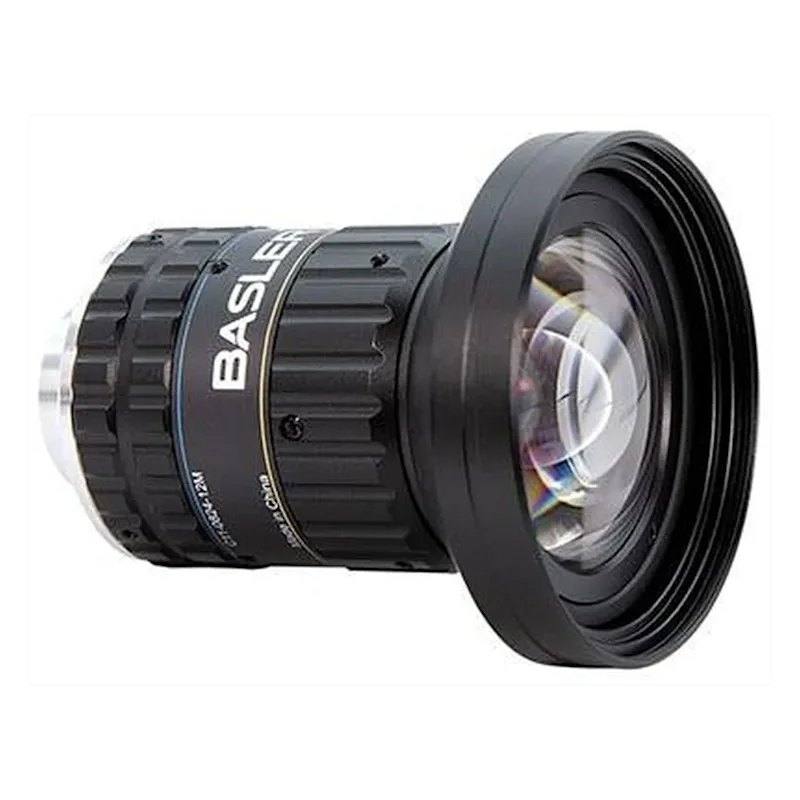
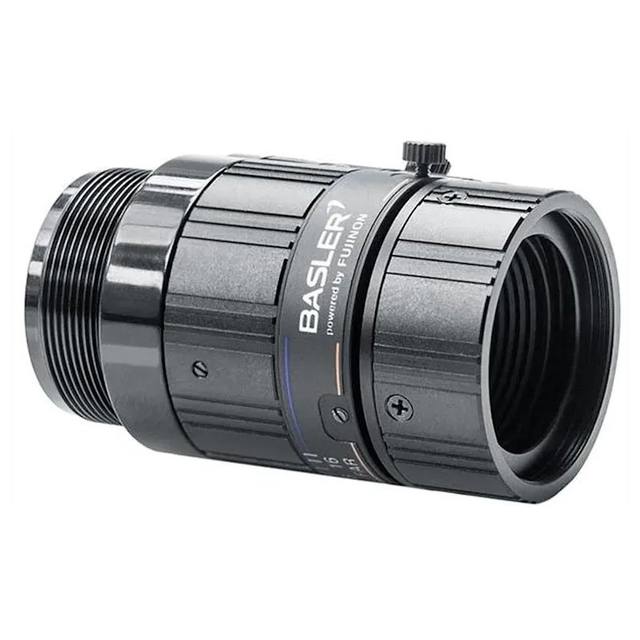
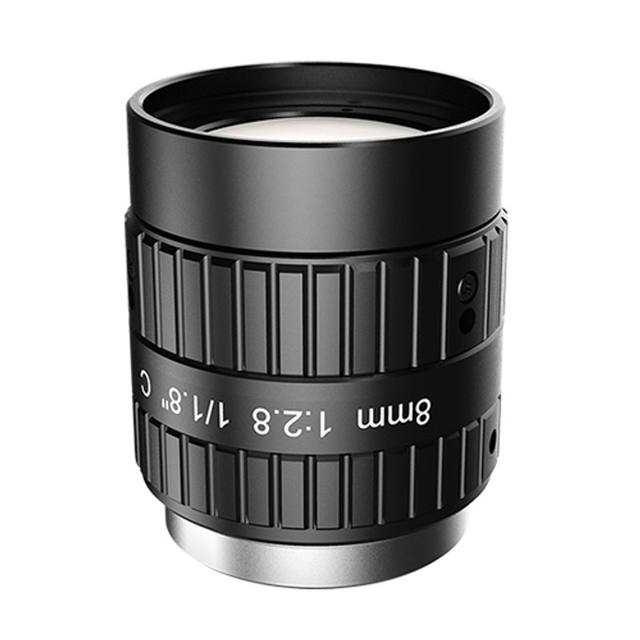
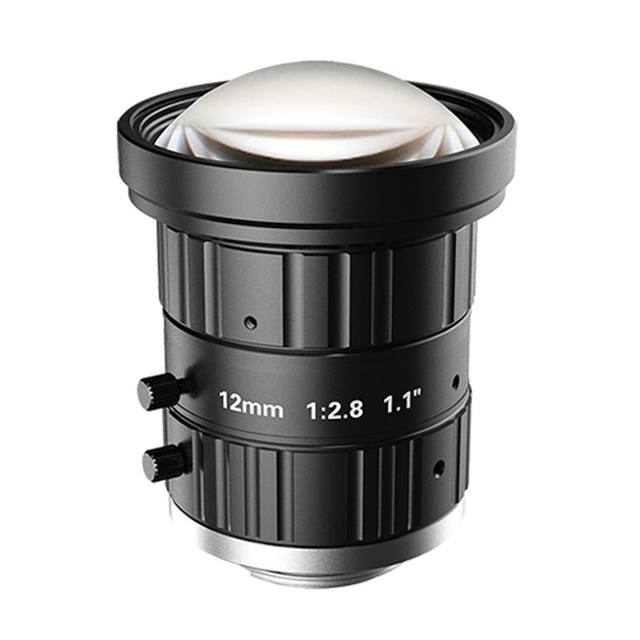
The Basler Lens C11-0824-12M is a Premium-line C-mount fixed focal lens with an 8.46 mm focal length and a 17.6 mm (1.1") image circle, covering the largest sensors in Basler's lineup at 12 MP. The aperture range of F2.4–F16 (optimal at F2.8) delivers a wide 84° horizontal field of view at 1.1". Distortion is -9.5% due to the wide-angle design, and the lens weighs approximately 264 g with a metal housing and C-mount interface.
The Basler C11-0824-12M is an 8.5 mm (8.46 mm measured) fixed focal length C-mount lens engineered to cover the full 1.1" (17.6 mm) image circle at a certified 12 MP resolving power. At that focal length, the lens delivers an 84° horizontal field of view when paired with a 1.1" sensor. Using this lens on a smaller sensor (e.g., 2/3" or 1") narrows the angular coverage proportionally, since the active image area is a subset of the full image circle.
The aperture range of F2.4 to F16 gives the integrator meaningful exposure flexibility. The maximum aperture of F2.4 maximises light throughput — critical in high-speed inspection lines where exposure times must be kept short to freeze motion — while Basler rates the optical sweet spot at F2.8, where the balance between diffraction and aberration correction is optimal for resolving 12 MP detail. Stopping down toward F8–F16 extends depth of field at the cost of light and, eventually, diffraction softening. The 100 mm to infinity working distance range makes the lens practical from close-range part inspection on a conveyor through wider-area robot-guidance cells. Distortion is rated at -9.5%, a barrel-distortion figure characteristic of wide-angle lens designs that must be accounted for — or corrected in software — whenever dimensional measurement accuracy is paramount.
Mechanically, the C11-0824-12M ships with a metal housing and a standard C-mount interface. At 264.4 g it is heavier than compact board-level lenses. Operating temperature of -20 °C to +60 °C covers the majority of factory and outdoor-adjacent environments. This is a non-telecentric, perspective lens, so object-to-lens distance variations will produce measurable magnification changes; applications requiring sub-millimetre dimensional repeatability across varying part heights should factor in this characteristic or consider telecentric alternatives for those specific measurement axes.
Best for
Wide-area surface inspection and defect detection on large panels, PCBs, or packaging where a single camera must cover a broad field — the 8.5 mm focal length on a 1.1" sensor delivers an 84° horizontal field of view, reducing the number of camera stations required per line.
High-speed robot guidance and bin-picking cells where the wide 84° field of view lets a single fixed camera monitor a large robot workspace, and the F2.4 maximum aperture supports short exposure times under existing factory lighting.
Electronics and semiconductor tray or wafer-level inspection where 12 MP resolving power across a 1.1" sensor gives dense spatial sampling over a large field, supporting both coarse layout verification and finer component presence checks in a single image.
Food, beverage, and logistics packaging lines that require wide-angle coverage at moderate working distances above a conveyor, where the lens's broad field reduces the number of camera stations needed per line.
General-purpose area-scan setups pairing with cameras fitted with sensors up to 1.1", where the 17.6 mm image circle ensures full-frame coverage without vignetting on the target sensor format.
Selection notes
Match the image circle to your sensor before ordering: this lens is rated for 1.1" (17.6 mm) sensors. Using it on a smaller sensor is optically fine — you will use a fraction of the image circle — but a shorter-focal-length lens on that smaller sensor may give an equivalent or wider field of view at lower cost and weight.
Budget for software distortion correction in any dimensional measurement application. The -9.5% barrel distortion is characteristic of wide-angle lens designs and is correctable with standard lens calibration routines (e.g., OpenCV calibrateCamera, Halcon calibrate_lens), but it is not negligible for sub-pixel measurement.
Confirm your camera's C-mount register distance. C-mount specifies a 17.526 mm flange distance; cameras with CS-mount bodies (12.5 mm register) require a 5 mm adapter ring. Mixing up mount registers shifts focus range and may prevent infinity focus.
Select aperture based on your depth-of-field and lighting budget together. Basler rates optical performance as optimal at F2.8 — a good starting point for most inspection setups. Stopping down increases depth of field but reduces light throughput; opening up increases light throughput but narrows the in-focus range.
At 264.4 g, verify that your camera's C-mount thread and housing are rated for the combined lens weight, particularly on pan-tilt robot arms or vibrating conveyor mounts where dynamic loads can exceed static ratings.
Specifications: General
Brand
Basler
Specifications: Optical
Lens mount
C-mount
Focal length
8.46 mm (nominal 8.5 mm)
Aperture (f-number)
F2.4–F16
Image circle / max sensor
1.1" / Ø17.6 mm
Optical resolution
12 MP
Telecentric
No
Working distance
100 mm to ∞
Specifications: Environment
Operating temperature
-20 to +60 °C
Specifications: Mechanical
Weight
264.4 g
Applications this camera is commonly selected for. Open one to see the full recommended hardware and approach.
Matched automatically by: camera mount fits the lens mount · camera sensor is covered by the lens image circle — this lens: C-mount · 1.1" / Ø17.6 mm image circle.
Get a first image quickly with the pylon Viewer, then move into the pylon SDK for your application. These cameras are GenICam/GenTL-compliant, so any compliant vision software can drive them as well.
Download and install the pylon Camera Software Suite for your OS from Basler. This provides the pylon Viewer, the GenTL transport-layer producers and the pylon SDK (C/C++/.NET/Python). On Windows the installer adds the needed drivers; on Linux follow the included setup notes for USB and network permissions.
2. Connect the camera and check the link
Cable the camera to its matching interface: GigE Vision to a GigE port (use a quality cable and, ideally, a dedicated NIC with jumbo frames enabled), USB3 Vision to a USB 3.x port with the supplied cable, or CoaXPress to the frame grabber. Provide power where required (PoE, USB bus power, or PoCXP). Open the pylon Viewer and confirm the camera appears in the device list; for GigE, make sure the camera and NIC are on the same subnet.
3. Grab a first image and set exposure, gain and pixel format
Select the camera in the pylon Viewer and start a continuous grab. Adjust exposure time and gain until the image is well exposed (avoid clipped highlights), set the pixel format (e.g. Mono8 or a Bayer/RGB format), and focus the lens. Use a test pattern if the lens or scene is not ready yet.
4. Configure triggering and acquisition
Decide between free-run and triggered acquisition. For synchronized capture, set the trigger source (software or a hardware line on the I/O connector), trigger mode and any debounce or exposure mode, then verify timing. Note the parameter names you change in the Viewer feature tree, as you will reuse them in code.
5. Move to the SDK or a GenICam-compliant library
Recreate your settings in code with the pylon SDK (C, C++, .NET or Python) to open the device, apply the same features and pull frames into your pipeline; pylon vTools and pylon AI can add processing blocks. Because the cameras are GenICam/GenTL standard, third-party vision libraries work too. Once the image stream is stable, you can route frames to a deep-learning inspection such as Rosepetal for automated defect detection.
Frequently asked questions
With an 8.46 mm focal length and a 17.6 mm image circle, the approximate field of view can be estimated using FOV = WD × (sensor dimension / focal length). At 500 mm working distance, the result scales with the actual horizontal sensor dimension of your specific camera model. Use this formula with your camera's published sensor dimensions for an accurate figure for your setup.
The 4/3" format has a diagonal of approximately 21.6 mm, which exceeds the 17.6 mm image circle of this lens. Vignetting — darkening of the image corners — will appear. For 4/3" sensors you need a lens with an image circle of at least 21–22 mm (typically marketed for 4/3" or larger). This lens is well-matched to 1.1" sensors and will also cover smaller formats such as 1", 2/3", and 1/2.3" without vignetting.
At -9.5%, straight lines near the image corners will appear noticeably curved. For presence/absence or defect detection this is generally acceptable. For dimensional measurement, calibration using a checkerboard target and standard lens correction routines (OpenCV calibrateCamera, Halcon calibrate_lens) can reduce residual distortion substantially, making the lens usable for precision tasks after correction.
Basler rates optical performance as optimal at F2.8, which is the best trade-off between light throughput and aberration correction at 12 MP. For high-speed lines where strobed illumination is available, F2.8 to F4 is a good starting range. If continuous lighting and longer exposure are acceptable, stopping down to F4–F8 delivers greater depth of field. The minimum working distance is 100 mm.
This is a fixed focal length, manual iris and manual focus lens — it has no electronic iris actuation. Focus and aperture are set mechanically at integration time and locked with set-screws. If your application requires remote or automatic focus adjustment, you would need a liquid-lens adapter or a motorised focus stage used in combination with this lens.