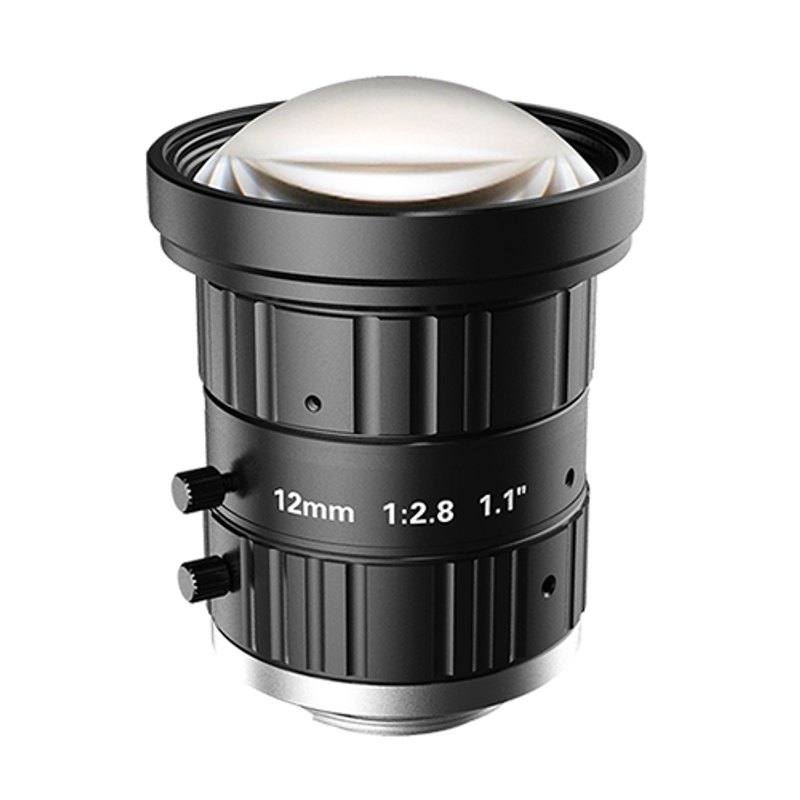
The MH1228X belongs to iRAYPLE's MH-X series (1.1" 12MP), covering five focal lengths from 12mm to 50mm on sensors up to Φ17.6mm. With F2.8–F16 aperture and a wide 70.5°×59.8°×46.3° field of view, it achieves TV distortion of -0.22% and 65% relative illumination at F2.8. The large Φ47mm barrel weighs 186g and supports manual focus and iris control across -10°C to +50°C, making it suited for 12MP area scan cameras in high-resolution inspection tasks.
Brand
iRAYPLE
Focal length
12mm
Lens mount
C-Mount
Aperture (f-number)
F2.8–F16
Image circle / max sensor
1.1" / Φ17.6mm
Optical resolution
Designed for 12MP sensors (per marketing text; not listed as a discrete spec)
The iRAYPLE MH1228X is a 12mm fixed focal-length C-mount lens engineered specifically for 12-megapixel sensors up to 1.1" (17.6mm image circle). At 12mm, this wide-angle optic produces a field of view of 70.5° horizontal, 59.8° vertical, and 46.3° diagonal — geometry that translates to broad scene coverage relative to working distance. The lens focuses from 100mm to infinity, so it can be positioned very close to a target for compact machine cells without sacrificing image quality. Because it is a conventional (non-telecentric) entocentric lens, apparent object size will change with depth; applications requiring absolute dimensional measurement across varying Z-heights should account for perspective error.
The optical design delivers resolving power matched to 12MP sensor densities — fine enough to keep pixel-level detail crisp across the full 1.1" image circle. TV distortion is held to -0.22%, a specification that sits well below the 0.5% threshold typically required for metrology or code-reading tasks where straight lines and dimensional ratios must be preserved. Relative illumination at the widest aperture (F2.8) reaches 65%, meaning corner brightness is maintained at about two-thirds of the center value — a reasonable figure for a wide-field 1.1" design. The aperture range of F2.8–F16 gives the integrator meaningful control: F2.8 maximizes light collection and suits dimmer environments or short strobe pulses, while stopping down toward F8–F11 increases depth of field and brings corner sharpness closer to peak center resolution for flat, high-contrast targets.
Mechanically, the MH1228X uses a standard C-mount (17.526mm flange focal distance), making it compatible with the broad ecosystem of C-mount area-scan cameras from major manufacturers. The 47mm barrel diameter and 56.99mm length are substantial for a 12mm lens — a consequence of the large image circle coverage — so verify that the camera's front-of-body clearance can accommodate the barrel and that any housing or bracket leaves room for the manual iris and focus adjustment rings. At 186g the lens is heavier than compact M12 or smaller-format alternatives, and the weight should be considered when the camera is mounted at an angle or subject to vibration. Operating temperature spans -10°C to +50°C, covering standard factory and warehouse environments without requiring additional thermal management.
Best for
High-resolution flat-field inspection at short-to-medium working distances, where the 12MP-rated optic keeps pixel-level defects resolved across a 1.1" sensor without center-to-corner degradation.
Wide-area surface inspection cells where the 70°+ horizontal FOV allows a single camera to cover broad part zones — printed circuit boards, pharmaceutical blister packs, or flat food packaging — without stitching.
OCR/OCV and 1D/2D code reading applications demanding low distortion: the -0.22% TV distortion figure ensures character geometry and code cell ratios are faithfully preserved at the pixel level.
Dimensional gauging and edge-detection tasks on relatively flat parts at controlled working distances, where the sub-0.25% distortion and sharp resolving power allow reliable sub-pixel edge localization.
Compact machine cells requiring close focus: the 100mm minimum working distance lets the lens work inside tight enclosures or directly above short-clearance conveyors.
Selection notes
Match sensor format carefully: the MH1228X covers a 1.1" (17.6mm) image circle. Pairing it with a larger sensor (e.g., 1.2" or 4/3") will introduce vignetting and resolution fall-off in corners; pairing it with a smaller sensor (e.g., 2/3" or 1/2") is optically safe but wastes the lens's resolving budget — a lower-cost design may then be more economical.
Verify pixel pitch against resolving power: at 12MP on a 1.1" sensor, typical pixel pitches run 2.5–3.5µm. Confirm the lens MTF at your sensor's Nyquist frequency (typically 143–200 lp/mm at these pitches) in the datasheet before finalizing the selection, particularly for edge positions on the image circle.
FOV and working distance are linked by the 12mm focal length. Use the relation FOV_h ≈ 2 × WD × tan(35.25°) ≈ 1.41 × WD to estimate horizontal coverage. If your scene width demands a narrower FOV at the same WD, step up to a longer focal length in the MH-X series (16mm, 25mm, 35mm, or 50mm).
Aperture selection drives both exposure and depth of field. F2.8 gives the most light but the shallowest DOF — suitable for well-lit flat targets. For 3D parts with height variation exceeding a few millimeters at short WD, stop down to F8–F11 and compensate with brighter or strobed lighting to maintain shutter speed.
At 186g and 47mm diameter, confirm mechanical compatibility with your camera body: some compact GigE or USB3 camera housings have M42 or smaller front apertures, and the C-mount thread engagement alone may not support the lens weight reliably in downward or sideways orientations without an additional lens support bracket.
Specifications: General
Brand
iRAYPLE
Specifications: Optical
Focal length
12mm
Lens mount
C-Mount
Aperture (f-number)
F2.8–F16
Image circle / max sensor
1.1" / Φ17.6mm
Optical resolution
Designed for 12MP sensors (per marketing text; not listed as a discrete spec)
Telecentric
No
Working distance
0.1m to infinite (Focus Range per datasheet)
Specifications: Environment
Operating temperature
-10°C to +50°C
Specifications: Mechanical
Dimensions
56.99mm × Φ47mm
Weight
186 g
Applications this camera is commonly selected for. Open one to see the full recommended hardware and approach.
Matched automatically by: camera mount fits the lens mount · camera sensor is covered by the lens image circle — this lens: C-Mount · 1.1" / Φ17.6mm image circle.
Follow these steps to bring up your iRAYPLE camera, capture a first image, and move from the viewer to your own application. The flow is the same across the A, AE, AX and L series; only the physical interface differs.
Download and install the iRAYPLE machine-vision SDK together with its viewer client for your operating system. The installer provides the camera drivers, the GenTL producer, and the viewer you will use for first light. For GigE Vision models, also install or enable the bundled filter/performance driver on the network adapter to maximize throughput.
2. Connect the camera to the correct interface
Wire the camera to its matching host interface: a dedicated Gigabit (or 10 GigE) NIC for GigE Vision models, a USB3 Vision port with a quality cable for USB3 models, or a frame grabber for CoaXPress models. Power the camera (PoE, USB bus power, or PoCXP / external supply as applicable). For GigE Vision, put the NIC and camera on the same subnet and, where supported, enable jumbo frames.
3. Detect and open the camera in the viewer
Launch the iRAYPLE viewer, run device enumeration, and select your camera from the discovered list. Open it to load the device feature tree (GenICam node map). If a GigE camera is found but cannot be opened, correct the IP configuration so the camera and NIC are in the same address range.
4. Set exposure, gain and trigger, then grab a first image
Start with continuous (free-run) acquisition under stable lighting. Adjust exposure time and gain for a well-exposed, low-noise image, set the pixel format (e.g. Mono8 or a Bayer/RGB format), and tune white balance on color models. Once the live image looks correct, switch trigger mode to hardware or software trigger to synchronize capture with your process, and verify a single triggered frame.
5. Move from the viewer to the SDK or a GenICam library
With imaging confirmed, reproduce the same settings in code using the SDK's C/C++ or Python API: enumerate, open, configure the relevant GenICam features, register a frame callback or grab loop, and convert frames to your pipeline's buffer format. Since the cameras are GenICam/GenTL-compliant, you can alternatively drive them from a third-party GenICam vision library. From here a stable image stream can feed a deep-learning inspection step such as Rosepetal for automated quality control.
Frequently asked questions
The lens is designed for sensors up to 1.1" diagonal (17.6mm image circle), covering formats including 1.1", 1", 2/3", 1/2.5", 1/2", and 1/3". It is not suitable for sensors larger than 1.1" — such as 4/3" or 35mm full-frame — where the image circle would be insufficient and heavy vignetting would result.
The horizontal FOV is 70.5° on a 1.1" sensor. The approximate horizontal coverage at a given working distance can be estimated using FOV_h ≈ 1.41 × WD. For narrower fields at the same distance, use a longer focal length from the MH-X series.
Yes, for most industrial applications. A distortion of -0.22% (barrel) means a 100mm line near the frame edge appears approximately 0.22mm shorter than nominal — well within the correction capability of most vision software. For high-accuracy metrology requiring sub-pixel dimensional trueness, apply a lens distortion calibration step in your software pipeline; telecentric lenses eliminate this concern entirely but at higher cost and restricted working distance.
The datasheet does not publish a front filter thread diameter. Confirm the front thread on the physical lens before purchasing a filter. Alternatively, many C-mount filter holders can be inserted between the lens and camera body as a rear filter element, which is common practice for bandpass or IR-cut filters in machine vision.
At F2.8 and a 100mm working distance on a 12MP 1.1" sensor, depth of field is very shallow — on the order of 1–3mm depending on acceptable circle of confusion. This is suitable only for essentially flat targets. At F8 and longer working distances, DOF expands substantially, accommodating modest part height variation. Use the widest aperture only when lighting levels are limiting; stop down for 3D parts.