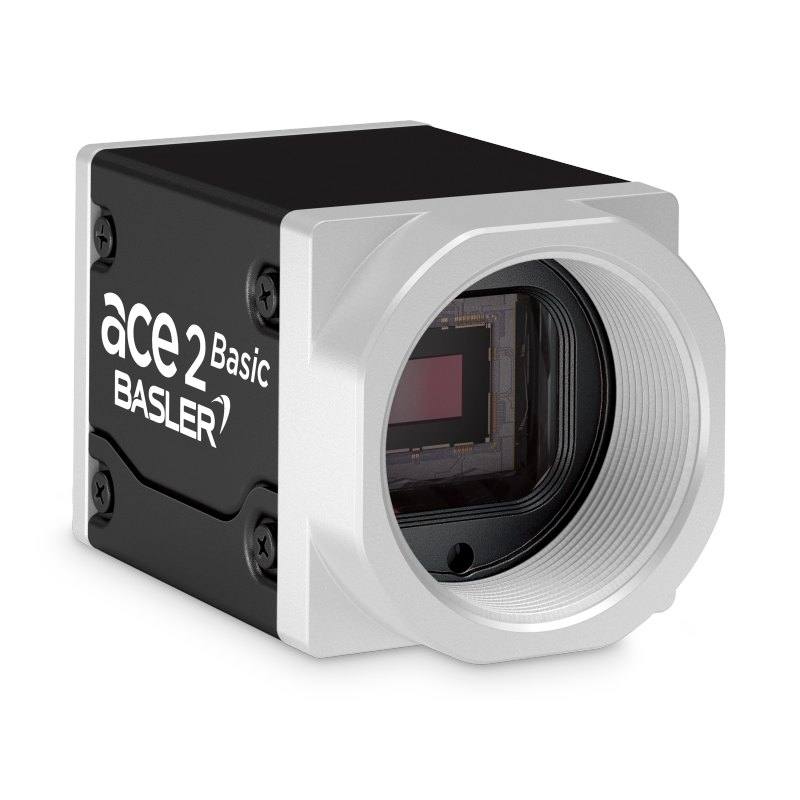
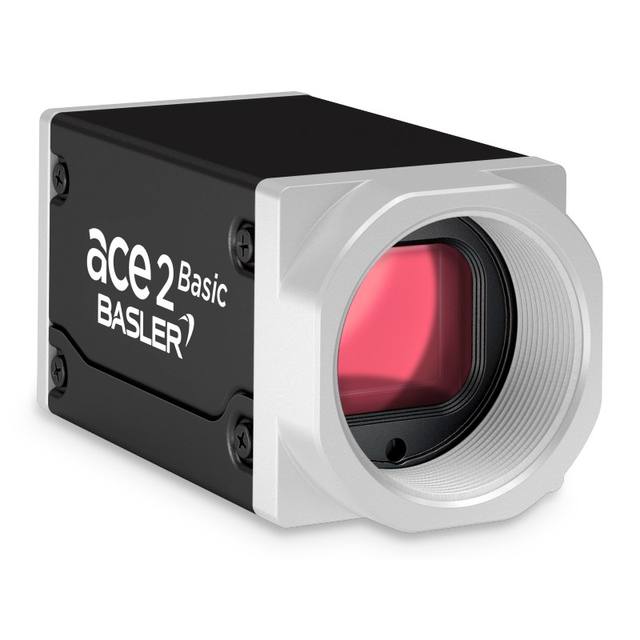
The Basler ace 2 a2A1920-160umBAS is a compact USB 3.0 area scan camera featuring the Sony IMX392LLR-C progressive scan CMOS sensor with global shutter, providing 2.3 MP (1920×1200) at up to 164 fps. Its 3.45 µm pixel pitch on a 1/2.3" sensor format offers a dynamic range of 71.7 dB and typical quantum efficiency of 62.2%. The camera conforms to USB3 Vision v1.0 and GenICam standards with a C-mount lens interface, and includes GPIO lines for hardware triggering. It carries IP30 protection and an operating temperature range of −10 to 60 °C.
The Basler ace 2 a2A1920-160umBAS is built around the Sony IMX392LLR-C, a Sony Pregius global-shutter CMOS sensor delivering 1920 x 1200 pixels (2.3 MP) at up to 164 fps over a 6.6 x 4.1 mm (1/2.3") imaging area. The global shutter is the defining characteristic for industrial use: every pixel integrates light simultaneously, so fast-moving parts — conveyor lines running at high speed, robot end-effectors, blister packs being ejected — are frozen without the spatial distortion that rolling shutters introduce. At 164 fps full-frame, the camera can inspect well over 9,800 discrete parts per minute on a 1-trigger-per-frame basis, or it can trade frame rate for a narrowed region of interest when even higher cadence is needed. The 3.45 µm pixel pitch is a proven sweet spot for C-mount lenses: it is fine enough to resolve small features without demanding exotic optics, yet large enough to collect light efficiently (71.7 dB dynamic range, 62.2% typical quantum efficiency), keeping exposure times short and strobe energy low.
The interface is USB 3.0 SuperSpeed (5 Gbit/s), conforming to the USB3 Vision v1.0 and GenICam standards. A single USB 3.0 cable carries both data and power: the camera draws approximately 2.8 W from the bus, eliminating a separate power supply and simplifying cabinet wiring. GPIO lines support hardware triggering and strobe control, which is essential when synchronising the camera to a PLC encoder pulse or a part-present sensor; the camera exposes those lines on a standard connector so integrators can wire directly into existing machine I/O without an intermediate break-out board. IP30 protection means the housing is sealed against solid particles larger than 2.5 mm and suits cleanroom or enclosed enclosure mounting, though it is not rated for washdown or open-air dusty environments without an additional housing.
The C-mount lens interface opens the full catalogue of standard industrial C-mount glass. For the 1/2.3" format (6.6 x 4.1 mm, diagonal approximately 7.8 mm) a lens with an image circle of at least 8 mm is needed; most quality C-mount machine-vision lenses rated for 1/2" or 1/1.8" formats cover this sensor without vignetting. The 3.45 µm pixel pitch sets a diffraction-limited resolution requirement: a lens resolving approximately 145 lp/mm at the sensor plane is needed to fill every pixel, so lenses carrying an MTF specification at or above that spatial frequency at the chosen aperture should be selected. Monochrome-only output means the camera is well suited to applications that use a single-wavelength illumination strategy — red, blue, or near-infrared LEDs — and that benefit from the roughly 40–50% sensitivity advantage that removing a Bayer colour filter array provides. The operating temperature range of -10 to 60 °C covers most factory floor and outdoor enclosure installations without additional thermal management.
Best for
High-speed surface and defect inspection on continuous production lines where part motion would blur a rolling-shutter image — printed circuit boards, pharmaceutical blisters, or food packaging moving at belt speeds above 0.5 m/s.
2D code reading and traceability (DataMatrix, QR, 1D barcodes) on small labels or directly marked parts, where the 2.3 MP resolution provides sufficient pixel density to decode codes as small as a few millimetres at typical working distances without resorting to macro optics.
Robot guidance and pick-and-place applications requiring precise, distortion-free position and angle data, where the global shutter eliminates motion artefacts when the camera or the part is moving at the moment of acquisition.
OCR and OCV verification on product labels, date codes, and lot numbers in pharma, medical-device, and packaging lines — applications that demand both the spatial resolution to resolve individual characters and the frame rate to keep up with labelling machine throughput.
Dimensional gauging and inline measurement tasks on electronic components or machined parts, where the 71.7 dB dynamic range accommodates parts with mixed-reflectivity surfaces (bare metal, black polymer, printed text) in a single exposure without HDR merging.
Selection notes
Verify lens image-circle coverage for the 1/2.3" sensor (diagonal approximately 7.8 mm): lenses marketed for 1/2" sensors are borderline — confirm the manufacturer's coverage specification at full aperture before committing to a lens-camera combination, as corner shading can degrade gauging accuracy.
USB 3.0 cable length is limited to 3 m by the USB specification without active extension; for installations where the camera is more than 3 m from the host PC, plan for an active USB 3.0 repeater rated for industrial environments, and validate latency impact on trigger timing.
The IP30 rating provides no ingress protection against liquids or fine dust; if the installation environment has cutting fluid mist, wash-down cycles, or significant airborne particulate, specify a sealed camera housing or choose a camera with a higher IP rating for that location.
GPIO trigger lines are integral to synchronising exposure to part arrival; confirm that the host machine's PLC or encoder output signal voltage is compatible with the camera's GPIO input levels, and include a signal conditioning stage (level shifter or optocoupler) if the PLC output is 24 V and the camera GPIO is 3.3 V logic.
At approximately 2.8 W drawn from the USB port, the camera is within the standard USB 3.0 bus power budget, but multi-camera installations sharing a hub must budget the aggregate current; use a powered industrial USB hub with per-port current management to avoid intermittent disconnections under full frame-rate load.
Specifications: General
Brand
Basler
Camera type
Area Scan
Specifications: Sensor
Resolution
2.3 MP
Horizontal resolution
1920 × 1200 px
Mono / color
Monochrome
Sensor manufacturer
Sony Pregius (IMX392)
Sensor model
Sony IMX392LLR-C
Shutter
Global Shutter
Sensor size
1/2.3" (6.6 × 4.1 mm)
Pixel size
3.45 µm × 3.45 µm
Specifications: Performance
FPS
160
Specifications: Interface
Interface
USB 3.0 (SuperSpeed, 5 Gbit/s)
Protocols
USB3 Vision v1.0, GenICam
Specifications: Optics
Mount
C-Mount
Specifications: Electrical
Power
Power over USB (~2.8 W typical)
Power consumption
2.8 W
Specifications: Environment
IP rating
IP30
Operating temperature
−10 to 60 °C
Specifications: Mechanical
Dimensions
6.6 × 4.1 mm
Weight
< 85 g (docs) / 85 g (shop) — no fabrication, minor source variance
Applications this camera is commonly selected for. Open one to see the full recommended hardware and approach.
Matched automatically by: lens mount fits the camera mount · lens image circle covers the camera sensor — this camera: C-Mount · 1/2.3" (6.6 × 4.1 mm) sensor.
By category
All 237C-mount lenses 172Telecentric lenses 62F-mount / large-format lenses 3
By brand
All 237Omron / Sentech 74iRAYPLE 66Basler 65Datalogic / Datasensing 32
Get a first image quickly with the pylon Viewer, then move into the pylon SDK for your application. These cameras are GenICam/GenTL-compliant, so any compliant vision software can drive them as well.
Download and install the pylon Camera Software Suite for your OS from Basler. This provides the pylon Viewer, the GenTL transport-layer producers and the pylon SDK (C/C++/.NET/Python). On Windows the installer adds the needed drivers; on Linux follow the included setup notes for USB and network permissions.
2. Connect the camera and check the link
Cable the camera to its matching interface: GigE Vision to a GigE port (use a quality cable and, ideally, a dedicated NIC with jumbo frames enabled), USB3 Vision to a USB 3.x port with the supplied cable, or CoaXPress to the frame grabber. Provide power where required (PoE, USB bus power, or PoCXP). Open the pylon Viewer and confirm the camera appears in the device list; for GigE, make sure the camera and NIC are on the same subnet.
3. Grab a first image and set exposure, gain and pixel format
Select the camera in the pylon Viewer and start a continuous grab. Adjust exposure time and gain until the image is well exposed (avoid clipped highlights), set the pixel format (e.g. Mono8 or a Bayer/RGB format), and focus the lens. Use a test pattern if the lens or scene is not ready yet.
4. Configure triggering and acquisition
Decide between free-run and triggered acquisition. For synchronized capture, set the trigger source (software or a hardware line on the I/O connector), trigger mode and any debounce or exposure mode, then verify timing. Note the parameter names you change in the Viewer feature tree, as you will reuse them in code.
5. Move to the SDK or a GenICam-compliant library
Recreate your settings in code with the pylon SDK (C, C++, .NET or Python) to open the device, apply the same features and pull frames into your pipeline; pylon vTools and pylon AI can add processing blocks. Because the cameras are GenICam/GenTL standard, third-party vision libraries work too. Once the image stream is stable, you can route frames to a deep-learning inspection such as Rosepetal for automated defect detection.
Frequently asked questions
The camera delivers up to 164 fps at its full 1920 x 1200 resolution. No resolution reduction is required to reach maximum frame rate — 164 fps is the full-frame specification. Narrowing the region of interest can push the rate higher still if the application requires it.
Yes, significantly for moving targets. A rolling shutter reads rows sequentially over a period of milliseconds; any lateral motion during that window skews the image geometry, causing straight edges to appear slanted. The IMX392's global shutter exposes all 1920 x 1200 pixels simultaneously, so a part moving at conveyor speed is captured with accurate geometry and no row-to-row positional offset — a prerequisite for reliable gauging and code reading on in-motion parts.
No separate power supply is required. The camera draws approximately 2.8 W from the USB 3.0 bus. A single USB 3.0 cable carries both data and power.
Any C-mount lens is mechanically compatible. For full image-circle coverage without vignetting, the lens must cover a sensor diagonal of approximately 7.8 mm; lenses specified for 1/2" or larger formats (1/1.8", 2/3", 1") meet this criterion. A lens MTF specification resolving at least 145 lp/mm at the sensor plane is recommended to match the 3.45 µm pixel pitch.
The camera is rated IP30, which protects against solid objects larger than 2.5 mm but offers no protection against dust or any liquid. For food-processing or pharmaceutical lines with washdown cycles or high humidity, the camera must be mounted inside a sealed IP65 or IP69K enclosure, or a camera model with a higher native IP rating should be selected instead.